
How to Launch Local Dog Training Ads That Bring in Clients

To launch local dog training ads, start with a Google Search campaign for one service you offer, such as puppy classes or private lessons. Target only the areas you serve. Send each ad to a page about that service, block irrelevant searches with negative keywords, and track calls and bookings before you spend more.
The goal isn't more clicks. It's more qualified local inquiries that turn into paying clients. This guide will show you how to build, budget, and improve your campaigns without guessing.
I'm Karin Wright. I've trained dogs professionally since 2008, and today I help trainers plan local dog training ads through SEO and paid search at So Fetch Consulting.
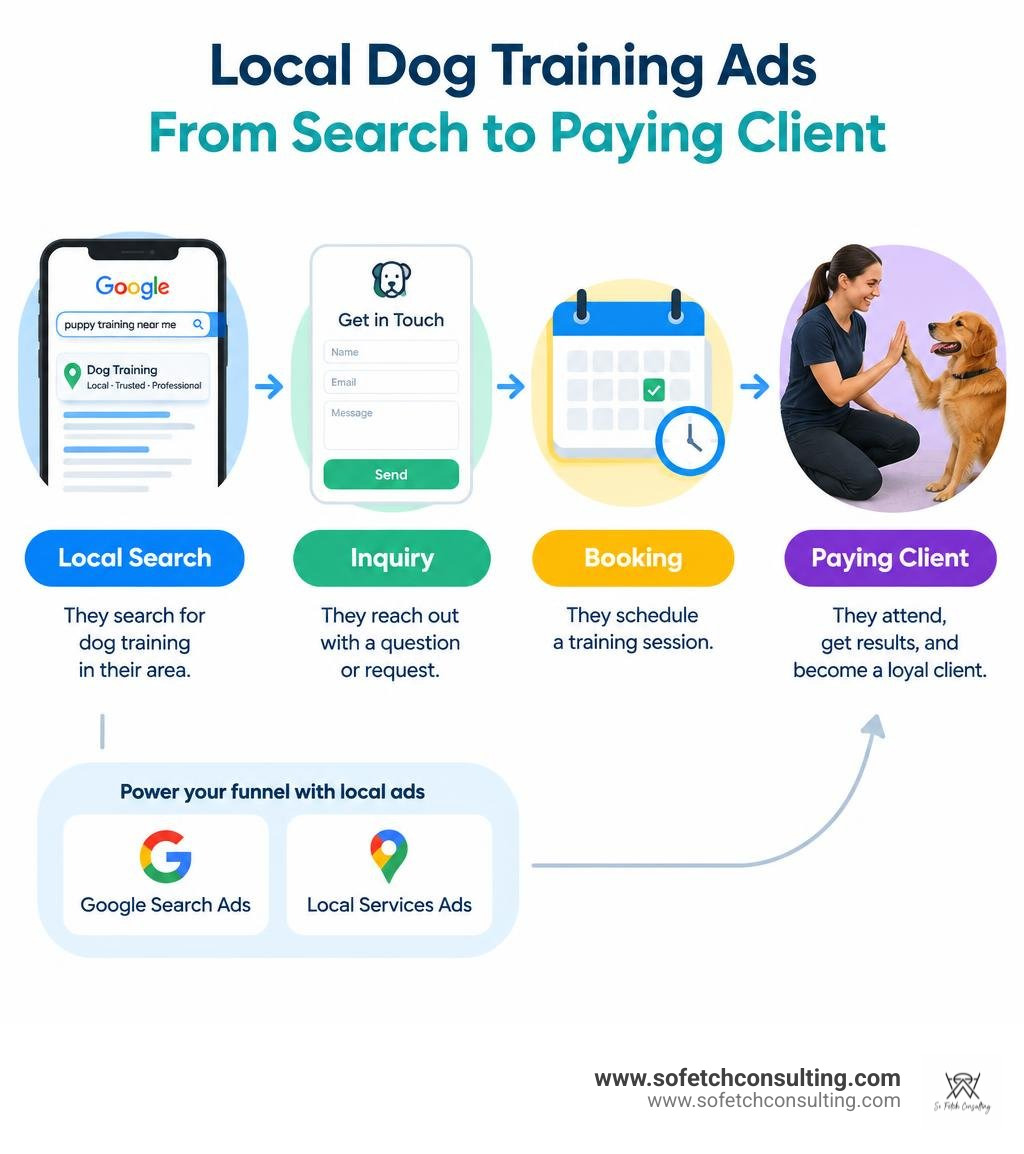
The Multi-Channel Local Search Strategy: Google Ads and Local Services Ads
Let us be real for a minute. The pet care space is wild right now. Americans spent over $150 billion on their pets in 2024, and in 2026, owners are treating their dogs better than most humans treat themselves. When a desperate dog parent has their French bulldog barking at the mail carrier or lunging on walks, they do not casually scroll social media hoping an answer pops up. They run straight to search engines.
Capturing people at that exact moment of crisis requires a smart search plan. If you want high-intent inquiries hitting your inbox daily, you can contact us for paid ads management to build this out, or you can piece it together yourself using two heavy hitters: traditional Google Search Ads and Google Local Services Ads (LSAs).
| Feature | Google Search Ads (PPC) | Google Local Services Ads (LSA) |
|---|---|---|
| Payment Model | Pay Per Click (CPC) | Pay Per Lead (Phone call or message) |
| Placement | Top of search results under LSAs | Absolute top of page with badges |
| Trust Badges | Business assets, site extensions | Google Guaranteed / Screened badge |
| Targeting Control | Exact keywords, match types, zip codes | Broad category selections and service areas |
| Landing Page | Dedicated, conversion-focused page | Direct call or Google-hosted profile |
| Average Cost | $3.00 to $10.00 per click | $15.00 to $45.00 per qualified lead |
Both tools have their place. Search ads give you surgical control over what search phrases trigger your budget. LSAs give you instant trust with that shiny Google badge. Combining them means you dominate the top of the search engine results page before anyone even sees your organic competitors.
Capturing Immediate High-Intent Searches with Google Ads
When setting up standard pay-per-click search ads, your secret weapon is intent matching. Someone typing "why does my dog bark at shadows" wants a free blog post. Someone typing "private aggressive dog trainer near me" has their credit card in hand.
To stop burning cash on useless clicks, structure your campaigns tightly around specific services. Keep private lessons, puppy kindergarten, and board-and-train in separate ad groups. Layer on every relevant ad asset available, including call buttons, location pins, and sitelinks highlighting your customer reviews.
A key part of modern inbound lead generation strategies is ruthless negative keyword filtering. You need to block search terms like:
- "Free dog training tips"
- "How to become a dog trainer"
- "Police K9 training videos"
- "Cheap dog training collars"
If you do not exclude those terms immediately, Google will gladly spend your daily budget showing your ads to broke college students writing research papers.
Leveraging Google Local Services Ads and Google Business Profile
If standard search ads are your precision rifle, Google Local Services Ads and your Google Business Profile are your local neighborhood presence. LSAs sit right at the very top of mobile searches. Pet owners see your business name, star rating, and that sweet green checkmark.
Because 88% of consumers read online reviews for local businesses and 76% pay attention only to reviews written in the last month, review velocity matters. You cannot rely on five reviews you got three years ago. Set up an automated post-lesson text asking happy clients for quick feedback.
Pair your ad efforts with consistent Google Business Profile updates. Posting weekly updates, before-and-after training wins, and seasonal behavioral tips signals to Google that your local business is active, which directly boosts your visibility in the local map pack.
How to Set Up and Launch Local Dog Training Ads That Convert

Throwing money at Google without a clear structure is just donating to a tech giant. You need a streamlined conversion funnel. When someone clicks your ad, they should not land on a generic homepage with sixteen navigation links and a picture of your cat. They need a dedicated landing page designed purely for service business lead generation.
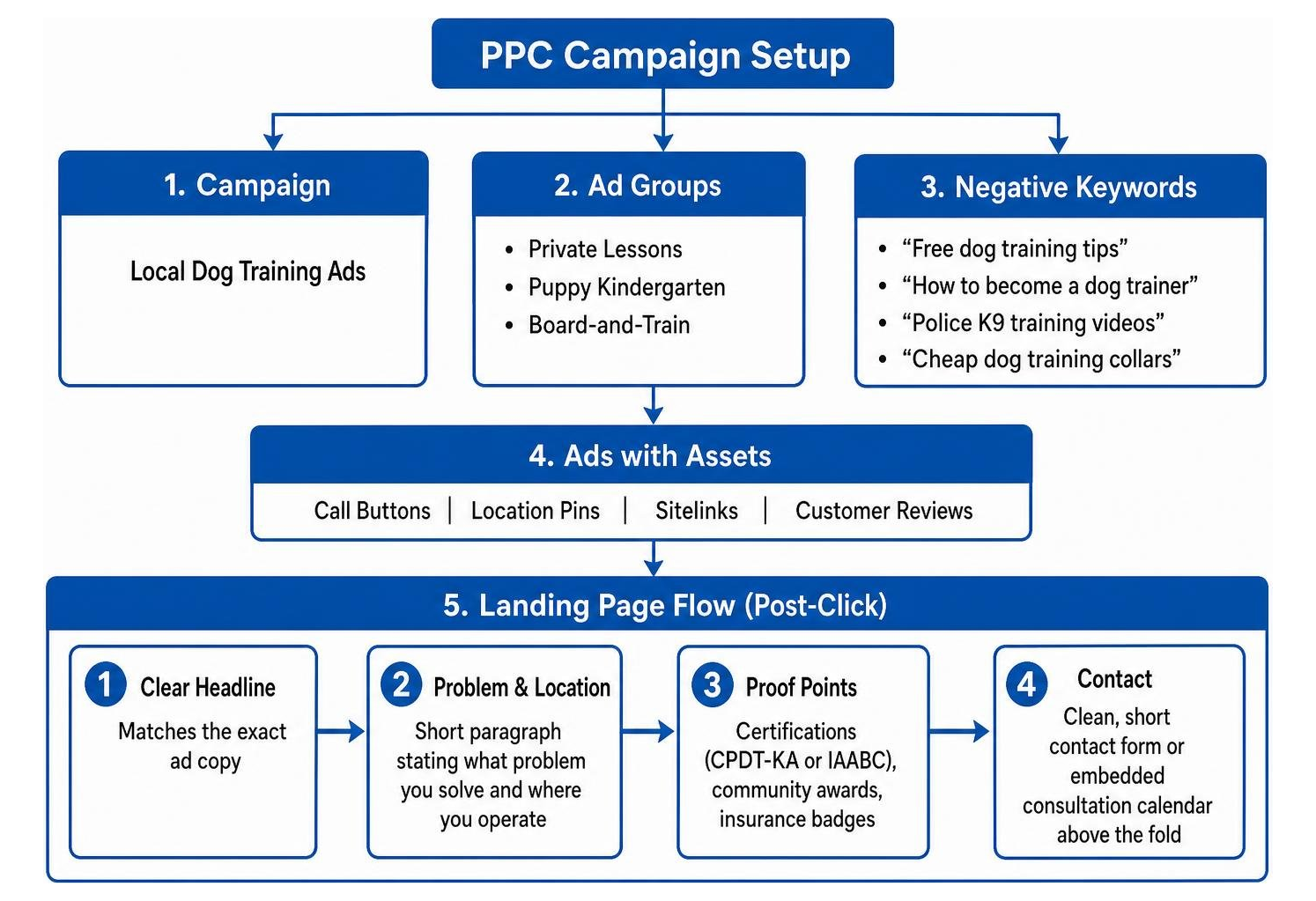
Keep the layout dead simple:
- A clear headline matching the exact ad copy they clicked.
- A short paragraph stating what problem you solve and where you operate.
- Proof points: certifications (such as CPDT-KA or IAABC), community awards, and insurance badges.
- A clean, short contact form or embedded consultation calendar above the fold.
Budgeting and Bidding Strategies for Local Dog Training Ads
How much cash should you actually put on the line? For dog trainers, industry standard benchmarks show search clicks running between $3.00 and $10.00 depending on your local market density. If you convert 10% of those clicks into inquiries, your cost per lead lands around $30.00 to $100.00.
If your private lesson package costs $1,200 and you close 1 out of every 3 consultation calls, your client acquisition cost is around $150.00 to $300.00. That is an outstanding return on investment.
As a general rule:
- Solo Trainers: Plan for $600 to $1,500 per month.
- Multi-Trainer Facilities: Allocate $1,500 to $3,500 per month.
Start with manual CPC or "Maximize Clicks" with a strict bid cap while Google gathers data. Once you log 20 to 30 conversions, switch to Target CPA (Cost Per Acquisition) bidding to let the algorithm find clients at your target price point.
Creative Formats and Copywriting for Local Dog Training Ads
Nobody buys dog training because they love commands. They buy dog training because they want peace in their living room, a dog that does not drag them down the sidewalk, and freedom from embarrassment.
Write your ad copy to address those real-world pains:
- Weak Headline: Certified Dog Trainer in Town
Strong Headline: Stop Leash Pulling Today | Expert In-Home Dog Training
Weak Description: We offer positive dog training for all breeds. Call us today to book an appointment.
- Strong Description: Frustrated by barking, reactivity, or jumping? Get custom, humane private lessons right in your living room. Fully insured. Schedule your free evaluation!
Do not hide your trust signals. About 80% of pet parents are significantly more likely to hire a pet professional who displays business insurance. Mentioning that you are insured, certified, and use humane, positive reinforcement methods eliminates hesitation before they even tap your link. Evaluating the performance of local social media marketing alongside your search ads will help you see where your messaging hits home best.
Demographic Targeting and Channel Mix for Local Campaigns

Not all pet owners behave the same way. Millennial (32%) and Gen X (27%) owners make up the bulk of US pet parents, but Gen Z is sprinting up behind them. A massive 41% of Gen Z dog parents report hiring a professional trainer, the highest percentage of any generation.
Understanding these groups helps you tailor your local ad campaigns to match their specific concerns:
- Gen Z and Young Professionals: Tech-forward, highly focused on pet emotional wellness, and quick to book online. They want separation anxiety solutions and modern puppy manners.
- Busy Families with Kids: Struggling with chaos, hyperactive jumping, resource guarding around toddlers, and door dashing. They need safety and reliable obedience.
- Empty Nesters: Focused on walking comfort, reliable recall, and gentle manners without intense physical wrestling.
Review Google's documentation on targeting geographic locations to make sure you are targeting users physically in your service area, rather than users merely expressing interest in the location from across the country.
Hyper-Local Demographics: Reaching Families, Professionals, and New Adopters
To win in local search, combine paid search ads with hyper-local visibility tactics. Build targeted campaigns around tight 5 to 10 mile radiuses surrounding affluent neighborhoods, master-planned family communities, and areas with high concentrations of dog parks.
Complement your digital ads by claiming spots on verified local directories. You can also partner with local rescue shelters, dog-friendly coffee shops, and boutique groomers for offline referral networks.
Integrating direct mail can also deliver surprisingly strong results. Direct mail campaigns routinely pull a 4.4% response rate compared to 0.12% for cold email. Mailing physical postcards with QR codes to new homeowners in pet-heavy zip codes creates top-of-mind awareness that pays off when they see your Google search ad later that week.
Video Ads and Retargeting Across Meta Platforms
Search ads catch people with immediate needs, but what about the pet owners sitting on the fence? With roughly 66% of dogs showing some form of reactivity, millions of owners are quietly struggling without actively searching for a trainer yet.
This is where Meta (Facebook and Instagram) video retargeting shines. Pet-related video content sees 48% higher engagement rates than static photo ads. When you retarget users who visited your website search landing page with a 15-to-30-second clip of a reactive dog calmly walking past a trigger, the transformation speaks for itself.
Apply proven tactics from in-home service lead generation to your retargeting funnel. Always caption your videos, keep the hook within the first three seconds, and end with a clear local call to action.
Tracking Core Metrics and Maximizing Ad Return on Investment
You cannot manage what you do not measure. If you are running local ads without call tracking and form conversion tags installed, you are flying blind in a thunderstorm.
Every lead source should be trackable down to the exact keyword and ad group. When someone calls the phone number on your landing page, dynamic number insertion (DNI) should attribute that call directly back to your Google Ads campaign. Connecting this data back to your broader marketing lead generation tracking keeps your acquisition costs predictable and clean.
Essential KPIs for Dog Training Campaigns
Filter out the vanity metrics like impressions and clicks. Focus on the core numbers that actually put money into your business account:
- Cost Per Qualified Lead (CPL): Total ad spend divided by the number of legitimate phone calls and form submissions.
- Lead-to-Booking Rate: The percentage of inquiries that schedule a paid consultation or assessment.
- Customer Acquisition Cost (CAC): Total ad spend divided by the number of paying clients signed.
- Client Lifetime Value (LTV): The total revenue a client generates across group classes, private packages, day training, and refresher sessions.
If your average client spends $900 across their relationship with your business, spending $150 to acquire them through paid search delivers a healthy, profitable 6x return on ad spend.
Troubleshooting Low-Performing Local Ads
When a campaign fails to deliver results, diagnose the problem step by step:
- High Impressions, Low Clicks (CTR under 3%): Your headlines are boring, your location targeting is too broad, or your pricing/offers miss the market. Revamp your ad hooks and test location-specific headlines.
- High Clicks, Zero Inquiries (Conversion rate under 5%): Your landing page is the culprit. It is loading too slowly, lacks trust signals and certifications, or asks for too much information on the intake form.
- Lots of Junk Leads: Your negative keyword list is neglected. Check your search terms report immediately to see what weird phrases people typed before clicking your ad.
If you hit a wall, working with dedicated dog training business marketing help will pinpoint leaks in your sales funnel before you waste more ad spend.
Frequently Asked Questions About Dog Training Advertising
How much should a local dog trainer budget for monthly advertising?
Most thriving dog training businesses invest between 7% and 12% of their gross revenue into marketing. A solo trainer pulling in $80,000 to $100,000 annually should plan on an ad budget of roughly $600 to $1,200 per month. Larger facilities with multiple trainers or dedicated board-and-train kennels often invest $2,000 to $4,000 per month to keep their staff booked solid.
What ad format delivers the highest conversion rate for dog trainers?
For immediate, ready-to-buy leads, hyper-targeted Google Search Ads and Google Local Services Ads deliver the highest conversion rates because they reach pet parents at the exact second they search for help. For social platforms like Instagram and Facebook, short 15-to-30-second before-and-after video demonstrations showing behavioral breakthroughs consistently outperform static images.
Can a dog training business advertise effectively on a small budget?
Yes. If your budget is capped at $300 to $500 per month, avoid broad keywords like "dog obedience." Instead, focus every dollar on high-intent, hyper-local phrases like "puppy crate training lessons near me" within a tight 5-mile radius. Combine that with a fully optimized Google Business Profile to capture organic map traffic alongside your paid ads. Discover more actionable low-cost steps in our guide on how to grow your dog training business.
Scale Your Client Roster with High-Performance Search Ads
You got into dog training to build better relationships between dogs and their humans, not to spend forty hours a week deciphering keyword bids and analytics reports. But having a steady, predictable flow of high-paying clients is what keeps your business healthy and stress-free.
Whether you are figuring out how to start a dog training business from scratch or looking to expand your current facility, local search ads give you direct control over your client roster. Start small, track every phone call and form fill, build out your negative keyword safeguards, and refine your landing pages. Once the system works, scaling your local business is simply a matter of turning up the dial.
