
Marketing Lead Generation: How to Stop Begging for Clients (Even for Dog Trainers)
Lead Qualification: Separating Tire-Kickers from High-Intent Clients

Let's be completely honest: chasing every random person who stumbles into your inbox is the fastest route to burnout. An effective marketing lead generation strategy attracts high-fit prospects through targeted channels, captures their info with actual value, and systematically weeds out the time-wasters before you ever get on the phone.
As laid out in this guide on what is lead generation, its definition and process, the real goal is not collecting contact details like Pokemon cards. It is about building a dependable filter that separates casual window shoppers from serious buyers who actually value your expertise.
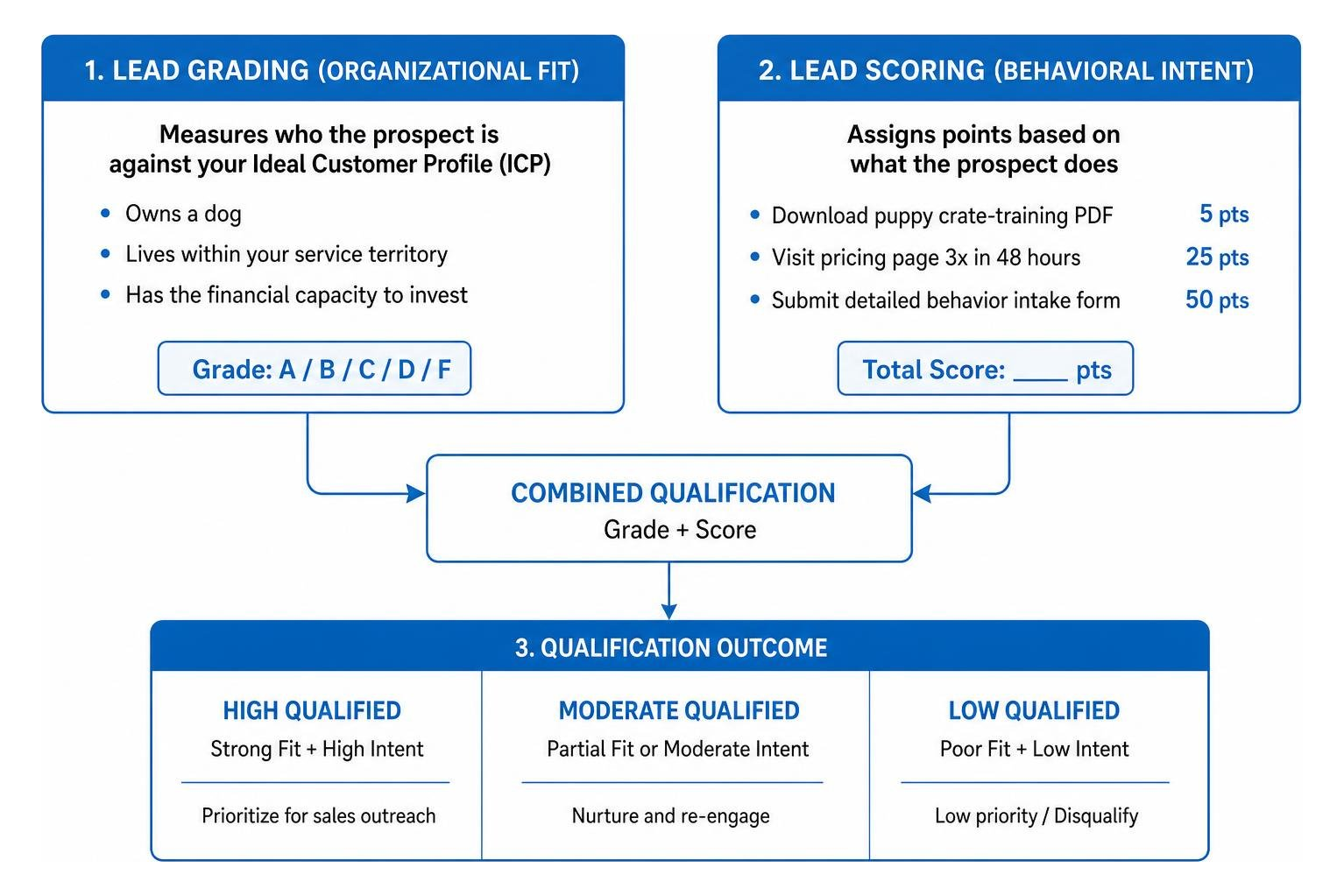
To keep your sanity intact, you need two distinct mechanisms working together: lead grading and lead scoring.
- Lead Grading (Organizational Fit): This checks who the prospect is against your Ideal Customer Profile. If you run a high-ticket dog board-and-train business, a qualified lead needs to own a dog, live in your service area, and have the budget to pay you. If someone reaches out from three states away for in-person training, give them an immediate F and move on.
- Lead Scoring (Behavioral Intent): This dishes out points based on what the prospect actually does. Downloading a free puppy crate-training PDF might get them 5 points. Checking your pricing page three times in two days earns 25 points. Filling out a detailed behavioral intake form scores 50 points.
Set a clear score threshold (say, 80 points) before you spend your precious time on direct sales outreach. You can also lean on classic frameworks like BANT (Budget, Authority, Need, Timing). Can they afford you? Are they the actual decision-maker? Is their problem urgent? If a client's dog is actively chewing a hole through their drywall, trust me, their timing is right now.
Defining Intent Signals and Pipeline Handoffs
If you want your pipeline to run like a well-oiled machine, everyone on your team needs to speak the same language. Pipeline leaks happen when marketing dumps unqualified tire-kickers onto sales, or when you let a hot lead sit around for three days before saying hello.
Here is how to slice your leads into four practical buckets:
- Marketing Qualified Lead (MQL): Someone who checked out your educational stuff (like attending a dog reactivity workshop or grabbing a PDF guide) but hasn't explicitly asked to buy anything yet.
- Sales Qualified Lead (SQL): A serious buyer who crossed the line by asking for an evaluation, booking a discovery call, or submitting an inquiry form.
- Product Qualified Lead (PQL): Common in software or self-paced courses, these folks have already experienced value through a free trial or mini-course.
- Service Qualified Lead: Current happy clients who are ready for package renewals, advanced group classes, or upsells.
Once an MQL turns into an SQL, speed is your best friend. Reach out fast to lock in that momentum before their attention wanders off to something shiny.
Mastering Modern Marketing Lead Generation: Inbound vs. Outbound Channels
Putting all your marketing eggs into one basket is a great way to wake up sweating when a platform algorithm changes overnight. A sustainable pipeline needs a smart blend of inbound attraction and targeted outbound outreach.
| Channel Type | Primary Acquisition Mechanism | Average Cost Structure | Conversion Speed | Long-Term Compounding Asset |
|---|---|---|---|---|
| Inbound Search & SEO | High-intent problem queries (e.g., local dog training) | Upfront investment, low ongoing unit cost | Medium (Self-directed buyer research) | High (Compounding organic traffic) |
| Content & Gated Assets | Educational value exchange (ebooks, calculators) | Moderate production cost | Medium to Long (Requires automated nurturing) | High (Evergreen authority library) |
| Targeted Paid Ads | Precision demographic, search, and social ads | Pay-per-click / Pay-per-lead (variable) | Fast (Immediate traffic generation) | Low (Stops when spend pauses) |
| Outbound Prospecting | Direct outreach, cold email, relationship building | Technology software stack + labor | Fast to Medium (Direct conversation start) | Low to Moderate (Relationship-dependent) |
Content Pillars for Organic Marketing Lead Generation
Your owned channels (website, blog, email list) are your real digital real estate. Unlike rented social media land where the rules change every Tuesday, high-value search content keeps paying dividends for years.
Modern buyers do their homework long before talking to a human. When an exhausted pet parent is frantically searching how to fix leash reactivity at midnight, your content should give them real, straightforward answers without the fluff.
Here are the core organic content pillars you should actually care about:
- Actionable Problem-Solving Guides: Detailed breakdowns that explain the root cause of a headache, offer quick practical wins, and clearly show why hiring a pro is the smarter move.
- High-Value Lead Magnets: Gated assets like puppy socialization checklists, transparent pricing sheets, or exclusive webinars that make trading an email address a no-brainer.
- Local SEO and Google Business Profile: Optimizing your local presence with localized service pages, accurate categories, and a steady stream of glowing client reviews.
- No-Fluff Case Studies: Real transformation stories with before-and-after proof that crush buyer skepticism.
High-Converting Paid Ads and Account-Based Strategies
When you need pipeline velocity yesterday, paid ads are there to bridge the gap. The trick is matching the ad platform to where your buyers' heads are at.
In B2B, LinkedIn delivers solid returns (averaging 113% on ad spend), and over 53% of marketers using native lead gen forms plug them directly into their CRM for instant follow-up. If you sell big-ticket contracts, Account-Based Marketing (ABM) flips the funnel: instead of yelling into a megaphone, you create personalized campaigns for a handpicked list of dream clients. About 87% of marketers find ABM yields a much higher ROI than generic blast campaigns.
For local pros, Google Paid Search ads grab people who have a burning problem right this second. Pair search ads with clean native forms and gentle retargeting, and you will stay top of mind without annoying your future clients.
Landing Pages and Conversion Optimization That Actually Work
You can drive tons of traffic to your site, but if your landing page looks like a cluttered relic from 2008, people will bounce faster than an untrained puppy on espresso.

Conversion rate optimization is simply about removing friction while keeping lead quality high. Here are the ground rules:
- Keep Forms Short and Sweet: Three to five fields is the sweet spot (Name, Email, Phone, Primary Challenge). If you start demanding their mother's maiden name or their dog's astrological sign upfront, form completions will crater.
- Make Your Value Crystal Clear: Your headline needs to explain what the visitor gets within three seconds. No clever riddles, just clarity.
- Show You Respect Their Privacy: Nobody wants spam. Drop a clean link to your privacy policy right near the submit button so people feel safe.
- Design for Thumbs First: Almost everyone clicks ads and local search results on a phone. If your buttons are tiny or your forms make users pinch-zoom, you are throwing money away.
AI-Driven Tactics for Smarter Marketing Lead Generation
Nearly 70% of B2B marketers are boosting their lead generation budgets, mostly around tech and automation. Modern AI tools can take a mountain of repetitive busywork off your plate.
Using smart platforms like B2B Lead Generation Software from Salesforce, teams can automate behavioral scoring, profile enrichment, and audience segmentation on the fly. Tools like IntelLeads.ai and AI Lead Genr demonstrate how AI can interpret intent signals and help you draft relevant, personalized outreach at scale.
Instead of wasting half your workday hunting down contact details by hand, use automation to:
- Pull verified contact info and company signals across target audiences.
- Score prospect fit dynamically based on web behavior.
- Trigger timely, personalized email sequences based on actions people take on your site.
- Embed calendar booking links in your follow-ups so hot leads can grab a spot on your calendar without twenty back-and-forth emails.
Key Metrics and Attribution: Proving Revenue ROI
If you aren't tracking your numbers, you're basically tossing darts in the dark. Vanity metrics like impressions and raw page views might give you a warm fuzzy feeling, but they won't pay your rent or cover payroll.
Keep your eyes locked on the metrics that actually impact your bank account:
- Cost Per Lead (CPL): Total marketing spend divided by leads generated. Spend $1,000 on ads and pull in 50 leads? Your CPL is $20.
- Customer Acquisition Cost (CAC): Total sales and marketing spend divided by your new paying clients.
- Lead-to-Opportunity Rate: The percentage of raw inquiries that turn into legitimate, qualified sales conversations.
- Pipeline Velocity: How fast a prospect goes from first discovering you to paying an invoice.
- Channel ROI: The actual revenue produced compared directly against what you spent on that specific channel.
Cold calling conversion rates hover around a dismal 2%, while targeted email campaigns easily produce open rates near 30% alongside compounding returns. Connect your CRM data with multi-touch attribution so you can see which marketing efforts actually ring the cash register.
Frequently Asked Questions About Lead Generation
What is the most cost-effective channel for generating B2B and local service leads?
Organic search engine optimization paired with a dialed-in Google Business Profile easily wins the long game. Paid ads are great for immediate traffic, but organic assets keep working without charging you every time someone clicks. Once your core authority pages rank, you get inbound inquiries around the clock without extra ad spend.
How many fields should a lead capture form have?
For top-of-funnel freebies and lead magnets, stick to three to five fields. Asking for just the essentials (first name, email address, main challenge) keeps drop-offs low. When selling high-ticket services, you can intentionally use a multi-step form with extra questions to filter out casual inquiries before they book a call.
Why do most outbound lead generation campaigns fail?
Most outbound campaigns flop because of bad data and painfully generic messaging. Blasting thousands of robotic pitches to an unverified email list just ruins your domain reputation and annoys people. Outbound works wonders when you use clean contact lists, tight targeting, and personalized messages that speak directly to a prospect's real problems.
Build a Predictable Client Acquisition System
Growing a solid business is not an accident, and it definitely won't happen by chasing every shiny marketing hack you see on your social feed. Real growth comes from setting up a clean, dependable system that pulls in the right crowd, filters out the tire-kickers, and makes saying yes a total no-brainer.
Whether you manage a busy dog training facility or run a boutique consulting firm, your pipeline deserves clarity, precision, and reliable execution.
If you are ready to stop playing guessing games with your pipeline and build a real client acquisition engine, take a look at our specialized digital marketing services and content strategy programs. We help service-based businesses swap marketing chaos for a predictable, revenue-generating strategy that actually delivers.
