
Evaluating the Best Social Media for Politics Across Major Networks
Choosing the best social media for politics requires evaluating each platform's distinct strengths, technical architecture, and community expectations. Running a successful campaign means matching your specific campaign goals to the right digital environment.
| Platform | Primary Voter Audience | Best Campaign Use Case | Key Strength |
|---|---|---|---|
| Older adults, broad community demographics | Grassroots organizing, local event mobilization | Massive reach, localized Facebook Groups | |
| X (Twitter) | Journalists, political junkies, policy advocates | Rapid response, shaping news cycles | Immediate real-time public reach |
| TikTok | Gen Z and younger Millennials | Name recognition, authentic viral storytelling | Dynamic algorithm rewards unpolished video |
| Gen Z and Millennials | Visual storytelling, behind-the-scenes content | High aesthetic appeal, interactive Reels | |
| Nextdoor | Local homeowners, active neighborhood voters | Hyperlocal issues, municipal campaign announcements | Verified resident address requirement |
| Close-knit social groups, immigrant communities | Direct voter mobilization, peer-to-peer discussions | High-privacy, encrypted direct messaging | |
| Deep policy enthusiasts, tech-savvy voters | In-depth policy Q&As, community feedback | High political posting frequency (46% user rate) | |
| Working professionals, local business leaders | Endorsements, policy whitepapers, professional credibility | High trust, business-oriented networking |
Facebook for Broad Reach and Community Groups
Facebook remains an indispensable foundation for political strategy. With 71% of Americans using Facebook as of 2025, it provides unmatched access to active, older voting demographics who consistently show up at the ballot box.
The core power of Facebook lies in community groups and localized pages. Town halls, local issue discussions, and neighborhood groups operate extensively on Facebook. Candidates can build real relationships by engaging in established groups, sharing event details, and answering local questions directly. While aggregate party posting on Facebook saw a drop during recent global election cycles, it remains the dominant driver for broad constituent engagement, donor acquisition, and campaign event organization.
X (Twitter) as the Best Social Media for Politics and Breaking News
When events move fast, X (formerly Twitter) functions as the default public square for political discourse. A staggering 57% of X users report using the platform specifically to keep up with politics and political issues—the highest concentration of political intent among major social networks.
X punches far above its weight because of who uses it: journalists, editors, political strategists, and policy experts. Pew Research report on Congressional social media use shows that lawmakers rely heavily on X to broadcast real-time updates and test political messaging. For campaigns, X is a rapid-response network. Tagging local news reporters, making breaking announcements, and issuing official responses on X can directly influence mainstream media coverage without high ad spend.
TikTok and Instagram for Youth Engagement and Short-Form Video
By 2028, Millennial and Gen Z voters will form the majority of the electorate. Reaching these younger voters requires prioritizing TikTok and Instagram. TikTok (43%) has officially surpassed Instagram (40%) among young adults looking for news and politics.
Short-form video recommendation algorithms allow accounts with low follower counts to achieve massive reach. Unpolished, direct-to-camera videos routine outperform polished, high-budget commercials. A Harvard Political Review study on digital campaigning highlights how underfunded candidates use creative video formats, popular audio tracks, and user remixing to drive massive voter engagement. Combining raw storytelling on TikTok with visually rich Instagram Reels gives campaigns a powerful 1-2 punch for youth outreach.
Nextdoor and WhatsApp for Hyperlocal and Closed-Network Mobilization

Hyperlocal and closed networks offer direct access to voters without public broadcasting noise. Nextdoor operates under strict address verification, ensuring candidates engage directly with actual local residents. It is the premier space for municipal races, school board seats, and neighborhood ballot measures. Candidates should join Nextdoor as active, helpful neighbors rather than promotional advertisers.
WhatsApp serves a critical role in direct mobilization through private, encrypted networking. Research shows exposure to political content on WhatsApp increases the likelihood of a user posting political content by 35 times. This tight network structure builds extreme trust, making WhatsApp perfect for coordinating grassroots field teams, organizing precinct captains, and conducting peer-to-peer voter turnout drives within tight-knit communities.
Reddit and LinkedIn for Policy Credibility and Deep Discourse
Reddit features the highest rate of political posting among major social platforms, with 46% of its active users posting political content. Subreddits dedicated to state politics, city affairs, or specific policy topics allow candidates to host "AMA" (Ask Me Anything) sessions. These open forums demonstrate policy mastery and earn support from deeply engaged civic voters.
LinkedIn serves as a candidate's digital policy hub and professional résumé. It allows campaigns to release long-form whitepapers, showcase endorsements from local business leaders, and appeal to working professionals. Maintaining an active LinkedIn presence builds candidate credibility and attracts high-value campaign donors.
How Political Ideology and Platform Architecture Shape Online Campaigns
A platform's technical architecture—whether it relies on open feeds, closed networks, algorithmic curation, or user anonymity—directly dictates how political content spreads across ideological lines.
Research across multi-national samples shows that political ideology strongly drives platform adoption and posting behavior:
- Posting Disparities: Right-wing users are more than twice as likely to post political content on Facebook, Instagram, YouTube, X, Snapchat, and WhatsApp compared to political moderates.
- Anonymous & Closed Platforms: On Reddit, right-wing users are nearly three times as likely to post political content as moderates. High horizontal privacy (protection from peer observation) lowers the social risks of sharing controversial views.
- Engagement Drivers: Platforms with algorithmic discovery feeds often reward emotionally charged content, whereas private messaging apps reward trust-based relational organizing.
A comprehensive Pew Research study on digital news consumption demonstrates that user intentions differ sharply between platforms. Knowing these structural traits helps campaigns choose the best social media for politics tailored to their specific ideological base and voter targets.
Benefits and Risks: Misinformation, Echo Chambers, and Algorithmic Polarization
Using social media for political outreach brings tremendous benefits alongside serious systemic risks. Understanding these dynamics helps campaigns navigate digital platforms effectively.
Key Campaign Benefits
- Direct Communication: Bypasses traditional news media filters, giving candidates complete control over their narrative.
- Cost Efficiency: Organic short-form video and strategic micro-targeting allow budget-strapped campaigns to compete with well-funded incumbents.
- Real-Time Data: Instant feedback metrics allow campaigns to adjust messaging quickly based on voter reactions.
Systemic Campaign Risks
- Algorithmic Echo Chambers: Platforms deliver content tailored to past interactions, trapping voters in ideological feedback loops that heighten affective polarization.
- Rapid Misinformation: Unverified claims can spread instantly. Meta's 2025 transition away from centralized third-party fact-checking toward crowdsourced flagging puts more responsibility on individual campaigns to rapidly debunk false claims.
- Harassment and Fatigue: Over 80% of users report online political harassment as a major problem. Over-saturating feeds can irritate voters and cause audience burnout.
Strategic Playbook: Building an Effective Social Media Political Campaign

A winning digital strategy requires structure, consistency, and clear platform choices. Campaigns must avoid spreading themselves too thin. Instead, focus on two or three channels that directly align with your target voter demographics. A Semafor report on Senate digital strategy reveals that prioritizing authentic, smartphone-recorded video over formal, scripted press statements leads to massive increases in caucus-wide user engagement.
Choosing the Best Social Media for Politics Based on Voter Demographics
Building an effective channel strategy requires matching campaign goals to actual user demographics.
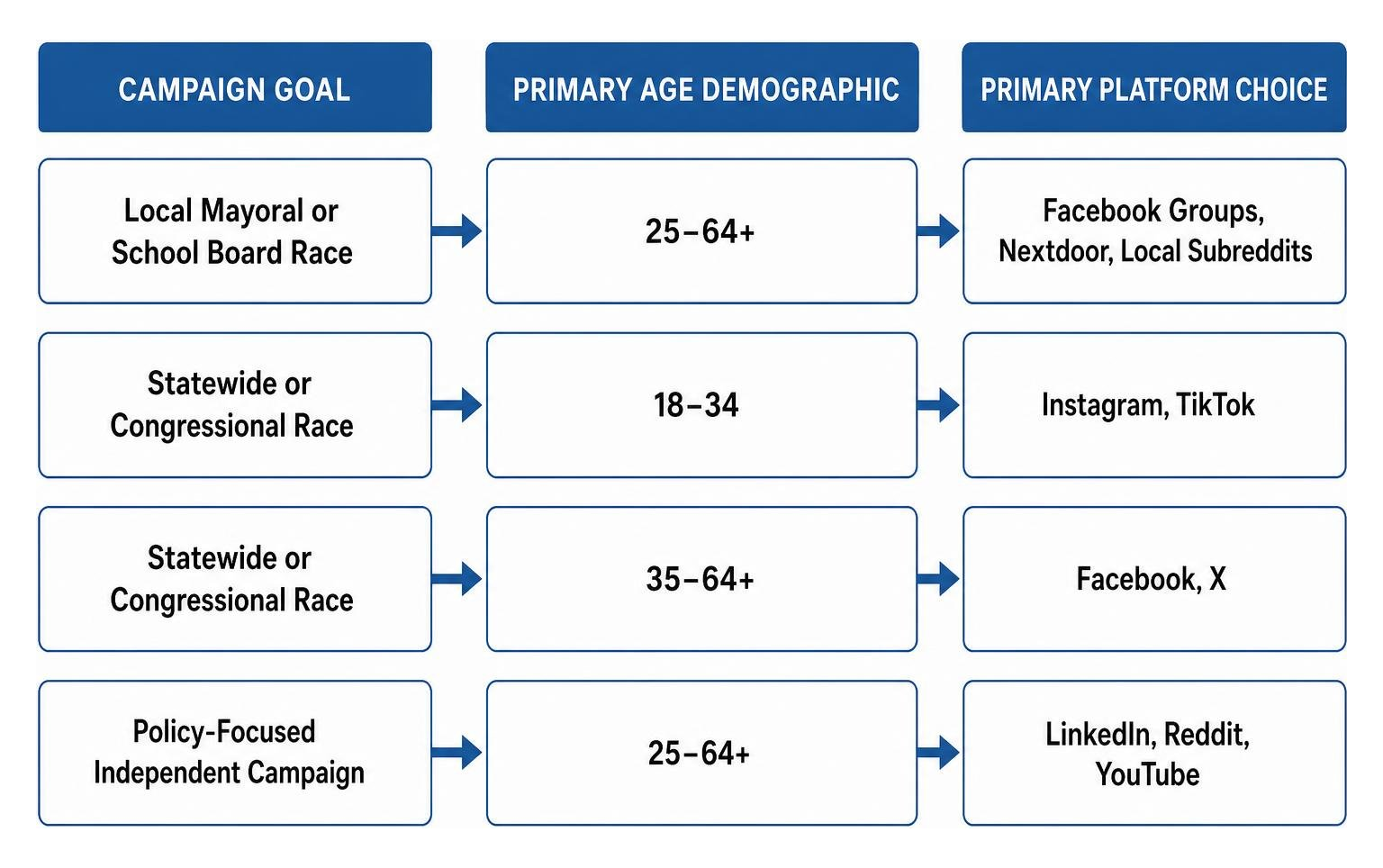
- Local Mayoral or School Board Race: Prioritize Facebook Groups, Nextdoor, and local community subreddits.
- Statewide or Congressional Race: Deploy X for breaking media response, Instagram/TikTok for youth outreach, and Facebook for general voter mobilization.
- Policy-Focused Independent Campaign: Utilize LinkedIn for whitepaper distribution, Reddit for deep-dive Q&As, and YouTube for long-form explanatory content.
Low-Budget Strategies for Independent and Local Candidates
Independent and local candidates with limited budgets can outperform well-funded opponents by leveraging smart organic strategies. Research on political campaigning effectiveness proves that raw virality paired with clear messaging levels the playing field.
- Embrace "Unpolished" Authenticity: Record quick 30-second videos answering everyday voter questions on your phone. Raw, unedited direct-to-camera videos build more trust than expensive studio commercials.
- Leverage Reusable Audio: Create clear audio soundbites when giving speeches. Let voters and volunteers remix your audio on TikTok and Instagram Reels to organically multiply your message.
- Participate in Local Groups: Join municipal Facebook Groups and Nextdoor conversations as an active resident. Answering local questions directly builds powerful grassroots trust at zero cost.
Content Best Practices and Campaign Analytics
Maintaining strong digital momentum requires discipline, rapid response, and constant adjustments based on data. UK Election analysis on party platform usage highlights that daily consistency matters far more than sporadic posting sprees.
- Maintain a Consistent Posting Cadence: Aim to post 1–2 times daily on primary channels rather than dumping content all at once.
- Always Include a Call to Action (CTA): Never leave an engaged voter hanging. Every viral video or post must clearly direct viewers to vote, volunteer, donate, or sign up for updates.
- Never Engage with Trolls: Responding to negative, toxic comments elevates those comments to the top of your post's feed. Ignore bad-faith actors and engage with supportive, constructive comments to boost organic post reach.
- Track Median Metrics: Evaluate campaign health using median engagement metrics (shares, comments, video watch time) rather than focusing solely on follower count spikes.
Frequently Asked Questions
Which social media platform is best for political campaigns?
There is no single "best" social media platform for all political campaigns. The ideal choice depends on your campaign goals and target voters. Facebook is best for broad reach and older, high-turnout voters. X leads for rapid response and political news coverage. TikTok and Instagram are essential for Gen Z and Millennial engagement, while Nextdoor excels at hyperlocal neighborhood organizing. Most successful campaigns select a mix of two to three platforms.
How does political ideology affect platform adoption?
Political ideology heavily influences where voters spend time online and how often they post political content. Research shows right-wing voters are more likely to share political content across mainstream platforms and show strong activity on private or anonymous networks like WhatsApp, Snapchat, and Reddit. Left-leaning voters show high activity on open, text-and-video platforms like X, Instagram, and TikTok.
How can local candidates with small budgets compete on social media?
Underfunded candidates can compete effectively by creating authentic, unscripted short-form video content using smartphones. By focusing on hyperlocal platforms like Nextdoor and Facebook Groups, engaging directly in post comment sections, and encouraging supporters to share and remix content, independent candidates can achieve massive organic reach without paying for expensive TV ads.
Modernizing Your Digital Campaign Strategy
Navigating the landscape to select the best social media for politics requires clear goals, authentic storytelling, and smart digital execution. Whether you are running for local school board or managing a multi-district campaign, success depends on meeting voters where they already spend their time online.
At So Fetch Consulting, we help organizations, local entities, and campaigns cut through digital noise. Using our proven content framework, The S3 System™, we build tailored social media strategies, search engine optimization (SEO), and conversion-focused campaign blueprints that deliver real-world results. Ready to elevate your digital presence and connect with your audience? Explore our full suite of Strategic Marketing Services today.
