
How to Pick the Right SEO Services for Your Small Business

Navigating the landscape of digital marketing can feel overwhelming when every agency uses different buzzwords to describe their packages. When evaluating seo services for small business, it helps to understand the core pillars that actually drive organic traffic and convert casual searchers into paying customers.
Instead of buying a generic "SEO package" that promises magical rankings overnight, smart business owners focus on targeted deliverables that build real search authority. Whether you operate a local dog grooming salon, a non-profit organization, or a private education facility, high-performing organic campaigns rely on a combination of foundational services.
A comprehensive SEO solution generally breaks down into four essential areas:
- Local SEO: Capturing near-me searches and dominating Google Maps.
- On-Page SEO: Optimizing your web page elements and text for relevant search terms.
- Technical SEO: Ensuring search engines can crawl, index, and render your site quickly on mobile devices.
- Content Strategy: Creating helpful, trustworthy content that answers buyer queries and earns authority.
Let's dive deeper into how each of these service types works and why they matter for your bottom line.
Local SEO Services for Small Business Visibility
For brick-and-mortar stores, service-area businesses, and community organizations, local search is often the fastest path to generating new leads. When someone searches for a service nearby, like "dog trainer near me" or "private school in your city," Google displays the Local 3-Pack at the top of the search results. Appearing in this coveted spot requires a dedicated local SEO effort.
Local seo services for small business focus heavily on Google Business Profile (GBP) setup and ongoing management. Your provider should optimize your primary category, upload high-quality images, post regular updates, and ensure your business hours, phone number, and physical address are completely accurate across the web.
Key local SEO tactics include:
- Name, Address, Phone (NAP) Consistency: Building and auditing citations on local directories to ensure your business details match everywhere.
- Geographic Keyword Targeting: Optimizing web pages with city, neighborhood, and regional terms that mirror how locals search.
- Review Strategy & Reputation Management: Setting up automated systems to request reviews from happy clients and responding professionally to feedback.
- Geo-Targeted Service Pages: Creating individual pages for each city or suburb you service, complete with localized copy and embedded maps.
By strengthening your local signals, you ensure that nearby customers find your business first when they are ready to make a purchase or book an appointment.
Technical and On-Page SEO Services for Small Business Success
While local signals draw nearby searchers, your website itself must be properly tuned to turn visitors into inquiries. On-page and technical SEO ensure that both search engines and human users enjoy a seamless experience on your site.
On-page SEO deals with the visible elements on your website. Service providers audit your existing pages and refine title tags, meta descriptions, header structures (H1, H2, H3), internal link structures, and body copy. They align these elements with key target terms that your prospective customers actually type into Google, avoiding artificial keyword stuffing in favor of natural, persuasive writing.
Technical SEO, on the other hand, works behind the scenes. If your website takes five seconds to load on a mobile phone or contains broken links, potential clients will bounce back to the search results before even reading your offer.
Essential technical and on-page tasks include:
- Mobile Responsiveness: Verifying that your layout scales perfectly on mobile screens, especially for platforms like SquareSpace.
- Page Speed Optimization: Compress images, clean up script bloat, and improve server response times.
- Schema Markup: Implementing structured data so search engines understand your exact business hours, pricing, reviews, and service categories.
- Crawlability and Indexing: Submitting XML sitemaps, fixing 404 errors, and ensuring Google can easily digest all your high-value pages.
When technical performance and on-page optimization work in harmony, search engine bots can easily rank your pages, and site visitors enjoy a fast, professional user experience.
How to Evaluate SEO Providers and Service Costs
Selecting the right partner for seo services for small business requires asking tough questions and evaluating pricing structures carefully. Because SEO is an unregulated industry, pricing models and service quality vary dramatically across agencies, freelancers, and consultants.
Common pricing structures in the industry include:
- Monthly Retainers: The most standard model where you pay a fixed fee every month for ongoing optimization, strategy, and content generation.
- Project-Based Pricing: A fixed fee for a specific scope of work, such as a comprehensive technical audit, a website redesign optimization, or setting up a local listing foundation.
- Hourly Consulting: Paying an expert for strategic advice, training, or high-level problem-solving on an hourly basis.
To help you evaluate options, here is a comparison of monthly retainers versus project pricing:
| Feature | Monthly Retainer | Project-Based Pricing |
|---|---|---|
| Best For | Continuous growth, ongoing content, long-term competitive industries | One-time website launches, audits, or setting up initial local presence |
| Cost Predictability | Fixed monthly cost built into your ongoing marketing budget | Single up-front investment with defined deliverables |
| Flexibility | High adaptiveness to search algorithm changes and changing business goals | Scope is locked in advance; additional requests require extra fees |
| Time Horizon | Long-term (usually 6 to 12+ months) | Short-term (typically 4 to 8 weeks) |
| Primary Deliverables | Continuous optimization, monthly reporting, fresh content, authority building | Audits, single implementation, initial technical fixes, initial setup |
When vetting providers, beware of red flags such as "guaranteed #1 rankings," extremely cheap monthly packages (e.g., $99/month), or secretive proprietary techniques. High-quality SEO partners practice complete transparency, provide clear deliverables in plain language, and align their strategy with your actual revenue goals.
Effective SEO Strategies for Small Businesses on a Limited Budget
You do not need a multi-million dollar marketing budget to win at organic search. Small businesses can achieve substantial visibility by taking a focused, high-impact approach to their marketing strategy.

If your budget is modest, focus your resources where they deliver the highest return:
- Target Long-Tail Keywords: Instead of trying to rank for broad, highly competitive phrases like "dog trainer," optimize for specific, lower-competition intent phrases like "positive reinforcement puppy training in your area." These terms receive lower monthly volume but bring in highly qualified buyers ready to convert.
- Execute The S3 System™ Content Method: Build an integrated content plan where a single core content piece, like a detailed service guide or case study, gets adapted into localized blog posts, social media updates, and newsletter snippets.
- Combine Paid Ads and Organic SEO: Align your short-term search engine marketing (SEM) with your long-term SEO. Running targeted paid ads on Google lets you immediately test which keywords yield actual sales before investing heavily in organic content for those terms.
- Leverage Your Local Ecosystem: Connect with non-competing businesses in your area, local non-profits, or community organizations for cross-promotion and natural link building.
- Focus on Website Usability: Make sure your website platform, whether on SquareSpace or another builder, is easy to navigate, features prominent phone numbers, and includes clear call-to-action buttons.
By combining low-cost local tactics, smart content repurposing, and focused targeting, small businesses can easily outsmart larger competitors who rely solely on big spend.
Frequently Asked Questions About SEO Services
How long does it take to see results from SEO?
Unlike paid advertising, which can drive traffic the day your campaigns go live, organic search strategies require patience and steady execution.
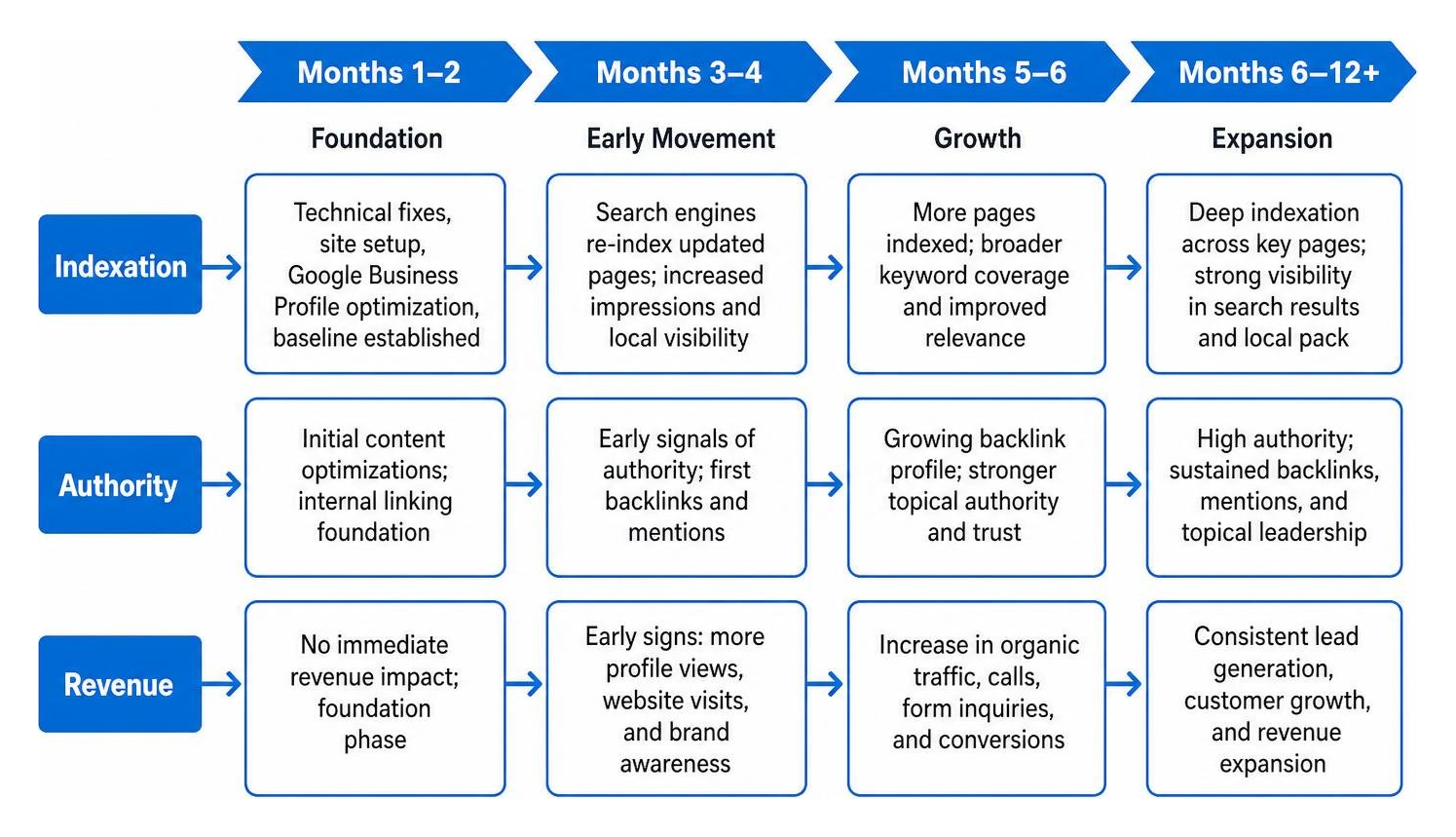
In most small business industries, you can expect the following realistic timeline:
- Months 1 to 2: Technical fixes, initial website auditing, keyword research, Google Business Profile cleanup, and baseline setting.
- Months 3 to 4: Search engines re-index your updated pages. You may start seeing early movements in local pack visibility and impression counts in Google Search Console.
- Months 5 to 6: Noticeable increases in organic traffic, long-tail keyword rankings, phone calls, and form inquiries.
- Months 6 to 12+: Sustained momentum, higher authority, top-three placements for valuable local terms, and consistent lead generation.
SEO operates like a compounding investment: the effort you put in today continues to generate organic traffic and business value long into the future.
What are the key SEO metrics small businesses should track?
It is easy to get lost in vanity metrics like overall traffic spikes or vanity keyword positions. Small businesses should focus on indicators that directly correlate with sales and brand growth.
Track these critical metrics:
- Organic Conversions: Phone calls, appointment bookings, contact form submissions, or direct sales coming from search engines.
- Local Pack Actions: Calls, website clicks, and direction requests generated directly through your Google Business Profile.
- Targeted Organic Traffic: Visitors coming to your core service and contact pages (not just overall visitors to irrelevant blog posts).
- Keyword Visibility for Intent Terms: Tracking where you rank for "buying-intent" keywords rather than generic broad terms.
- Click-Through Rate (CTR): The percentage of searchers who click on your listing when it appears in search results.
What common SEO mistakes should small businesses avoid?
Many small business owners fall into traps that waste budget or harm their website's standing with search engines. Knowing what not to do is just as important as implementing correct tactics.
Avoid these frequent pitfalls:
- Keyword Stuffing: Forcing location names and search phrases unnaturally into every sentence. Always write for humans first and search engines second.
- Ignoring Local Profiles: Leaving your Google Business Profile incomplete, unverified, or unmonitored.
- Buying Cheap Backlinks: Purchasing low-quality link packages off market forums. Google easily detects these unnatural links and can penalize your domain.
- Poor Mobile Experience: Having tiny text, slow-loading images, or unclickable buttons on smartphones.
- Neglecting Page Speed and Site Architecture: Organizing your website content in a confusing way or cluttering pages with oversized images that slow down loading times.
Build a Search Strategy That Keeps Working
Finding the right seo services for small business isn't about chasing secret tricks or spending beyond your means. It comes down to establishing a clear local footprint, maintaining a fast, accessible website, and creating helpful content that answers your ideal customer's real questions.
When you align your organic search goals with an overarching marketing strategy, including smart social media management, targeted paid ads, and clear messaging, your online presence becomes a reliable engine for sustainable business growth.
Ready to gain search visibility, attract high-quality leads, and work with a strategist who understands small business needs? Get Expert Small Business SEO Services and let's build an organic search system tailored specifically for your brand success.

