
Smart Ways to Jumpstart and Scale Your Dog Training Business
How to Grow Your Dog Training Business by Defining High-Value Niches and Offers
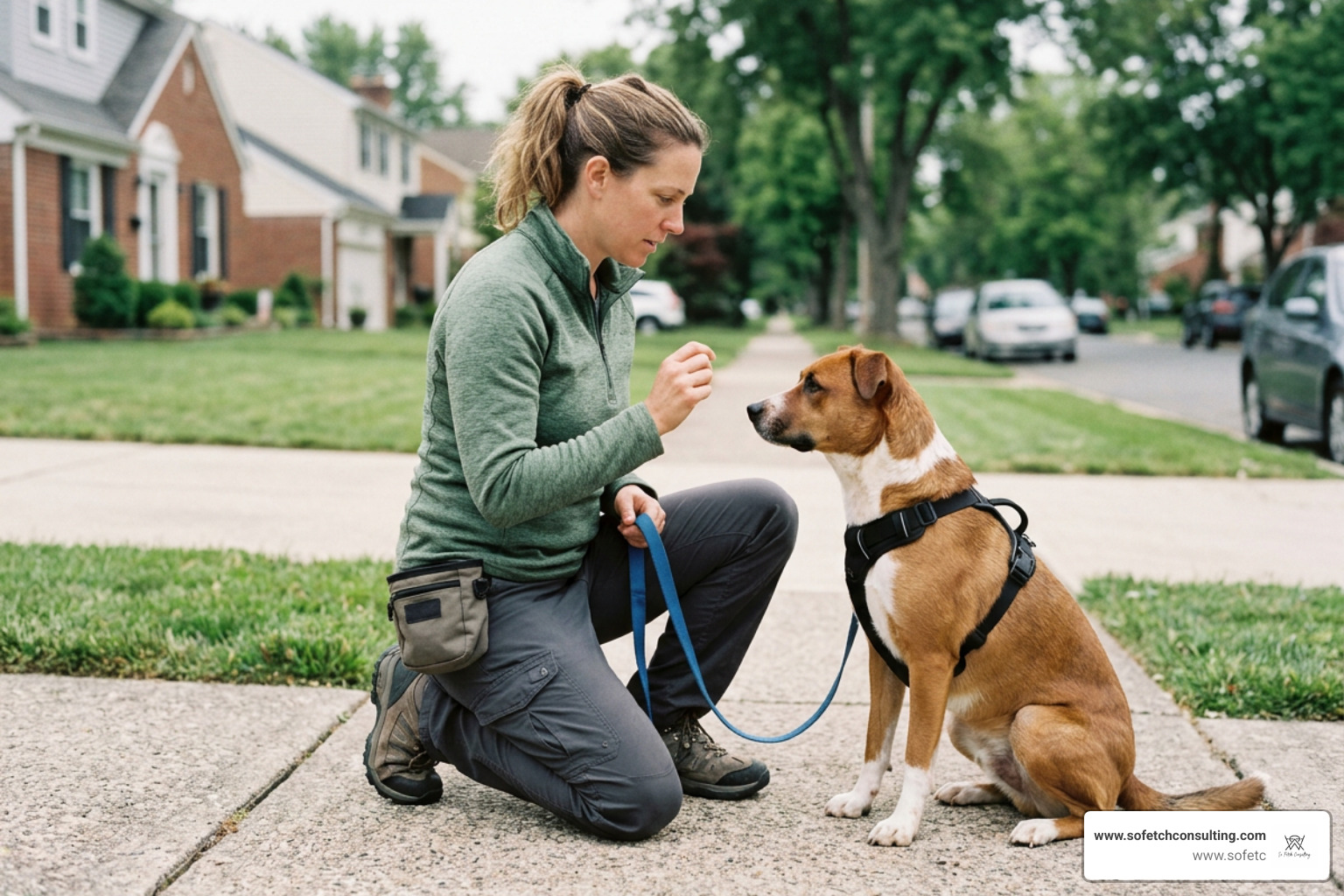
To grow your dog training business, focus on four core pillars: select a high-demand specialty niche, replace single hourly sessions with outcome-based multi-week packages, build local referral partnerships with veterinarians and pet businesses, and scale your delivery through group classes or associate trainers.
If you try to train every dog in your zip code, your marketing ends up speaking to nobody. Many trainers jump into the market believing that offering everything from basic puppy manners to extreme aggression rehabilitation is the fastest way to get booked. In reality, being a generalist makes you blend into the background. It also forces you to compete purely on price with every hobbyist down the street.
Targeted positioning acts like a specific lure rather than a giant net thrown into empty water. When you define an ideal client avatar, you design your messaging, your website copy, and your social content around their exact pain points. Think about the specific household you love working with. Is it the busy executive who just brought home an energetic adolescent working breed? Is it the suburban family overwhelmed by a rescue dog showing leash reactivity in the neighborhood?
Selecting a profitable specialty transforms your marketing from an uphill battle into an inbound pipeline. High-demand niches like reactive dog rehabilitation, early puppy development, and separation anxiety allow you to charge premium rates. When an owner is dealing with a dog that lunges at every passing stroller, they are not looking for a bargain obedience class. They are looking for a specialist who understands their specific struggle and can restore calm to their home.
Modern dog owners increasingly research training methodologies before booking. Positive reinforcement and humane, scientifically supported techniques have become standard expectations for discerning pet parents and veterinary networks alike. Focusing on clear, humane communication positions your brand as modern, trustworthy, and referral-worthy. For trainers exploring foundational business launch steps, reviewing proven approaches for launching dog training services can provide a solid baseline as you refine your specialized niche.
How to Grow Your Dog Training Business Through Package Structuring
One of the quickest ways to stall your business is selling individual sessions. When you sell single appointments, you shoulder massive hidden costs: drive time between houses, admin emails, scheduling friction, and sudden cancellations. Even worse, single sessions rarely produce lasting behavioral transformations because dogs and owners need sustained reinforcement over time.
When you transition to structured multi-week programs, you change the entire dynamic. Instead of selling an hour of your time, you sell a clear milestone. That could be a 6-week "Calm Canine Foundation" or an 8-week "Reactivity Reset." Programs require an upfront commitment, secure non-refundable deposits, and provide structured homework between visits.
| Training Format | Advertised Price | Actual Working Hours (Inc. Drive/Admin) | Real Revenue Per Worked Hour | Client Commitment Level |
|---|---|---|---|---|
| Single Private Session | $110 / session | 2.0 to 2.5 hours | $44 - $55 / hour | Low (High drop-off rate) |
| 6-Week Structured Program | $1,800 / package | 9.0 to 11.0 hours | $163 - $200 / hour | High (Full transformation) |
| 6-Week Group Class (8 Dogs) | $200 / dog ($1,600 total) | 10.0 hours total | $160 / hour | Medium-High (Structured schedule) |
| 14-Day Board-and-Train | $2,800 / dog | 10.0 to 14.0 active training hours | $200 - $280 / hour | Maximum (Intensive immersion) |
Structured programs protect your schedule and ensure that clients actually finish the curriculum. The result is better client compliance, happier households, and raving testimonials that fuel your organic pipeline.
Building the Yield Ladder: From Private Sessions to Group Classes
To build a business that does not burn you out, you need to climb the yield ladder. The yield ladder represents your progression from low-leverage services to high-yield formats that multiply your earning power for every worked hour.
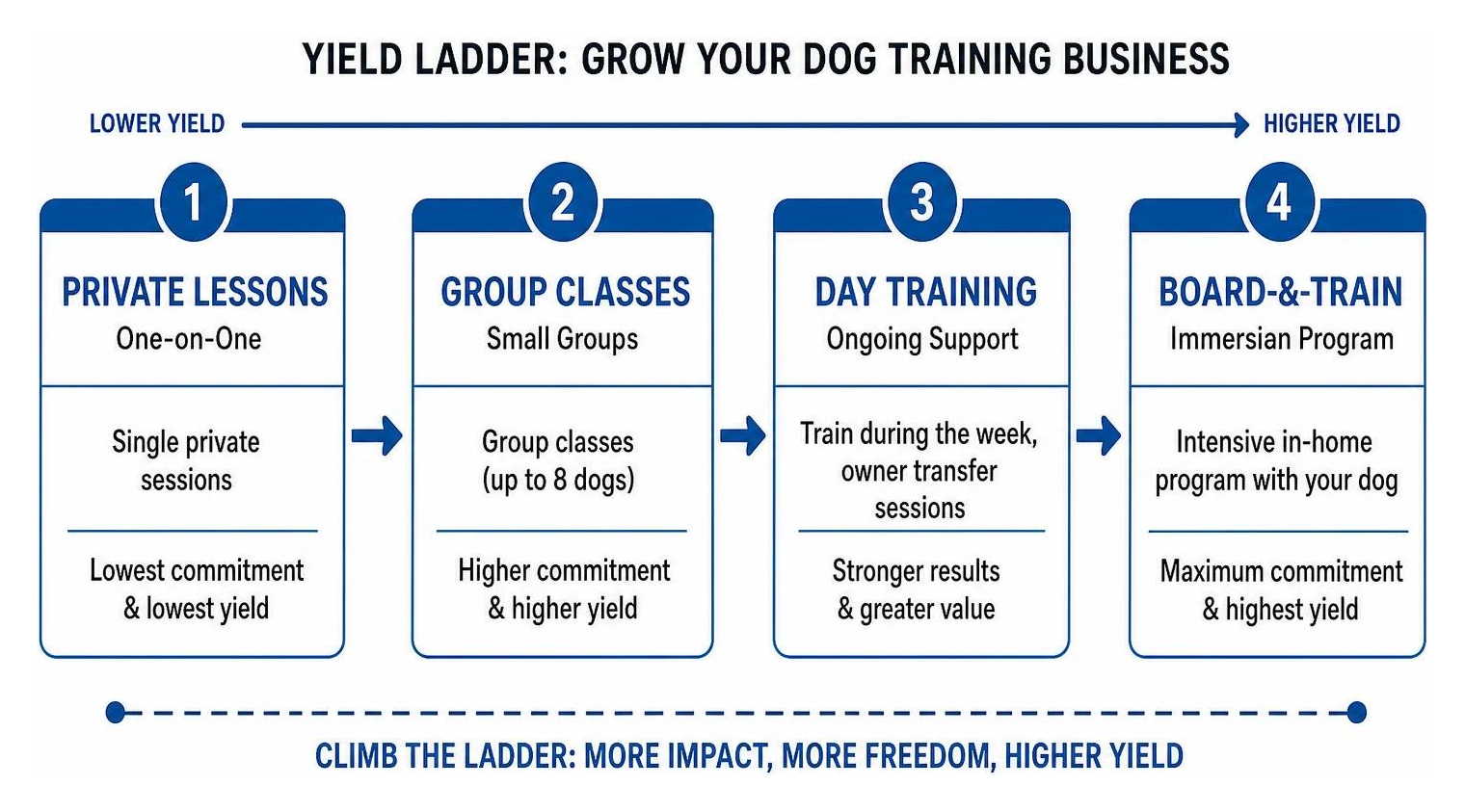
At the bottom of the ladder are one-off private house calls. As you move up, you introduce group classes, day training, and board-and-train immersion programs:
- Group Classes: An 8-dog group class charged at $200 per dog generates $1,600 for roughly 6 teaching hours and 4 admin hours, pushing your hourly yield past $150.
- Day Training: You train the dog at the client's home or local park multiple times a week, followed by a weekly owner transfer session.
- Board-and-Train Programs: High-ticket immersion programs priced at $2,500 to $4,000 provide intensive foundation training while capturing top-tier margins.
- Hybrid Coaching: Combining digital video modules with weekly live check-ins allows clients to master foundational theory at their own pace, freeing your in-person time for hands-on coaching.
Climbing this ladder lets you serve more dogs without spending your entire life behind a steering wheel.
Proven Marketing Channels and Referral Networks for Pet Professionals
Relying solely on sporadic social media posts is a stressful way to find clients. Sustainable businesses run on automated lead generation paired with strong local referral networks. The pet industry thrives on community trust, and pet owners routinely turn to local service providers for recommendations before searching online.
How to Grow Your Dog Training Business with Strategic Local Partnerships
Local pet professionals are your best allies. Veterinarians, boutique pet supply owners, dog walkers, and professional groomers frequently encounter pet parents who are struggling with behavior issues.
To build productive, lasting partnerships:
- Approach with value first: Introduce yourself to clinic staff and veterinarians with practical materials. Drop off clean, helpful client handouts on puppy socialization or crate training rather than just a stack of business cards.
- Offer lunch-and-learn workshops: Host a short session for veterinary technicians on low-stress handling or safe muzzle training.
- Set up mutual referral agreements: Partner with local boutique groomers and force-free walkers who share your training philosophy. When a groomer encounters a dog that cannot handle nail trims, they can refer that client directly to your cooperative care program.
- Partner with rescue shelters: Offer post-adoption transition guides to new adopters to help reduce return rates and establish relationships with new pet owners early on.
Digital Presence: Local SEO, Google Business Profiles, and Social Proof
Your digital footprint must confirm the professional reputation you build offline. Over 60 percent of dog owners look up a trainer online before reaching out. If your online presence looks outdated or lacks clear reviews, potential clients will move on to the next option.
To maximize your organic reach:
- Optimize your Google Business Profile: Fill out every section, specify your service areas, upload fresh training photos weekly, and select accurate categories.
- Master Local Search Intent: Structure your website pages around local search terms like dog training, puppy obedience classes, and reactive dog behavior specialist.
- Collect Transformation Reviews: After a client completes a program, send an automated review request. Ask them to mention the specific behavior issue you solved in their review, which boosts your local search visibility.
- Showcase Video Proof: Capture short clips of leash manners, loose-leash walking past distractions, and calm settle behaviors. Visual transformations posted to Instagram, TikTok, and YouTube Shorts provide undeniable social proof.
Pricing Strategy, Unit Economics, and Operational Efficiency
A solo dog training business can operate at attractive 70 to 85 percent profit margins because there are virtually no inventory costs. However, poor unit economics and unmanaged overhead can quickly erode those margins if you do not track your time and expenses carefully.
Typical annual overhead costs for a solo operation are modest:
- Professional and General Liability Insurance: $300 to $1,200 annually (essential protection against property damage, bites, or animal bailee claims).
- Client Management and Booking Software: $300 to $700 annually.
- Marketing, Website Hosting, and Local SEO: $600 to $2,400 annually.
- Training Gear, Treat Pouches, Long Lines, and Props: $300 to $600 annually.
A disciplined solo trainer can generate $45,000 to $110,000 in gross revenue during their first full year, translating to $30,000 to $80,000 in owner profit. Keeping fixed overhead low in the early stages gives you the stability needed to reinvest in growth.
Shifting from Hourly Rates to Outcome-Based Pricing
Hourly pricing creates a mismatch between your goals and your client's goals. When you charge by the hour, you make less money the faster you solve the problem. Outcome-based pricing anchors the fee to the value of a well-behaved dog and a stress-free household.
When presenting your programs:
- Present clear transformation tiers: Offer a comprehensive foundation package, an intensive behavior modification tier, and an ongoing maintenance option.
- Eliminate travel time losses: Set a firm travel radius. For clients outside that radius, charge a standard mileage fee or transition them to virtual coaching.
- Raise rates based on capacity: When your schedule is consistently booked two to three weeks in advance, raise your package rates by 15 to 25 percent for new inquiries.
Automating Client Records, Booking, and Retention Systems
Managing client communications via random text messages, paper notebooks, and disjointed emails wastes hours every week. Adopting dedicated practice management systems keeps your business running smoothly:
- Automated Onboarding: Send intake forms, liability waivers, and deposit invoices automatically when a client books a consultation.
- Owner Homework Portals: Give clients access to short video recaps, printable training steps, and clear homework tasks so they stay accountable between lessons.
- Automated Check-Ins: Schedule automated email check-ins at 30, 60, and 90 days post-graduation to see how the dog is progressing and invite them to advanced group workshops.
Expanding Beyond the Solo Ceiling: Team Building and Facilities
A solo trainer maxes out around 25 to 35 client contact hours per week before exhaustion sets in. Crossing the six-figure mark while maintaining a balanced lifestyle requires scaling your capacity beyond your individual labor.
Transitioning from Solo Trainer to Multi-Trainer Practice
When your waitlist grows beyond a month, bringing on associate trainers allows you to capture overflowing demand.
- Document Standard Operating Procedures (SOPs): Write out your exact training protocols, client communication guidelines, and safety standards before making your first hire.
- Use an Apprentice Model: Bring on newer trainers, have them shadow your private sessions and group classes, and train them in your specific methodology.
- Structure Fair Compensation: Offer attractive hourly pay or percentage splits (typically 45 to 60 percent of the session fee for contractors or a competitive base plus bonus for W-2 employees).
A multi-trainer practice can reach $150,000 to $450,000 in annual revenue by Year 2 to 3, operating at a sustainable 45 to 55 percent profit margin while giving you time to focus on marketing and business development.
Adding Facility-Based Services and Board-and-Train Programs
Opening a physical training center or dedicated boarding facility is a major milestone. Facility-based operations can scale revenue beyond $600,000 annually by combining group classes, agility training, day school, board-and-train, and curated retail products.
Before signing a commercial lease:
- Verify Local Zoning and Permitting: Ensure the property is zoned for commercial pet services, overnight boarding, and outdoor exercise yards.
- Plan for Facility Overhead: Account for commercial rent, buildout expenses, specialized non-slip flooring, sound dampening, commercial HVAC ventilation, and staffing payroll.
- Build Recurring Revenue Streams: Use physical space to host weekly community puppy socials, canine fitness workshops, and specialty sport leagues to maintain steady cash flow throughout the year.
Frequently Asked Questions About Scaling a Dog Training Business
What certifications provide the highest return on investment?
While dog training does not carry mandatory state licensing, earning credentials from reputable bodies builds client trust and opens doors to veterinary referrals. The most respected certifications include:
- CPDT-KA (Certified Professional Dog Trainer – Knowledge Assessed): Widely recognized across the pet industry, signaling a strong grasp of canine behavior science and learning theory.
- KPA CTP (Karen Pryor Academy Certified Training Partner): Highly regarded for exceptional clicker training mechanics and positive reinforcement protocols.
- IAABC (International Association of Animal Behavior Consultants): The gold standard for trainers specializing in complex behavioral issues like aggression, fear, and separation anxiety.
Certified trainers consistently command higher package rates and win the confidence of local medical professionals who want proof of humane, evidence-based practices.
How do I stop trading hours for dollars in dog training?
To break out of the time-for-money trap, shift your business away from 1-on-1 hourly lessons:
- Package private coaching with digital course materials so clients can master foundational theory on their own.
- Launch weekly group obedience and socialization classes where you teach multiple clients within a single hour.
- Introduce structured day training or board-and-train programs where you train the dog directly during focused sessions.
- Host paid monthly webinars or community workshops on specific topics like loose-leash walking, recall games, and puppy manners.
When is the right time to hire a second dog trainer?
You are ready to bring on your first assistant or associate trainer when:
- You are consistently booked out three to four weeks in advance and turning away qualified leads.
- Your operational systems, client contracts, and intake workflows run reliably.
- You have documented training protocols that another trainer can easily follow.
- Your business has built up a 3-month operating cash reserve to comfortably support onboarding and training costs.
Next Steps: Build a Scalable, High-Margin Dog Training Enterprise
Building a thriving dog training business is about turning your hands-on animal skills into a sustainable, well-run company. By choosing a clear niche, packaging your services for real behavioral outcomes, cultivating local referral networks, and setting up automated systems, you build an enterprise that serves your community while supporting your personal and financial goals.
Growing past the solo ceiling takes intentional planning, smart financial management, and consistent marketing. To refine your brand positioning and implement an organic acquisition engine that keeps your schedule full, explore our tailored marketing strategy resources and take the next confident step in your business journey.
