
How to Build a Winning Search Engine Strategy for Nonprofits
Nonprofit SEO Tips That Help Supporters Find Your Mission

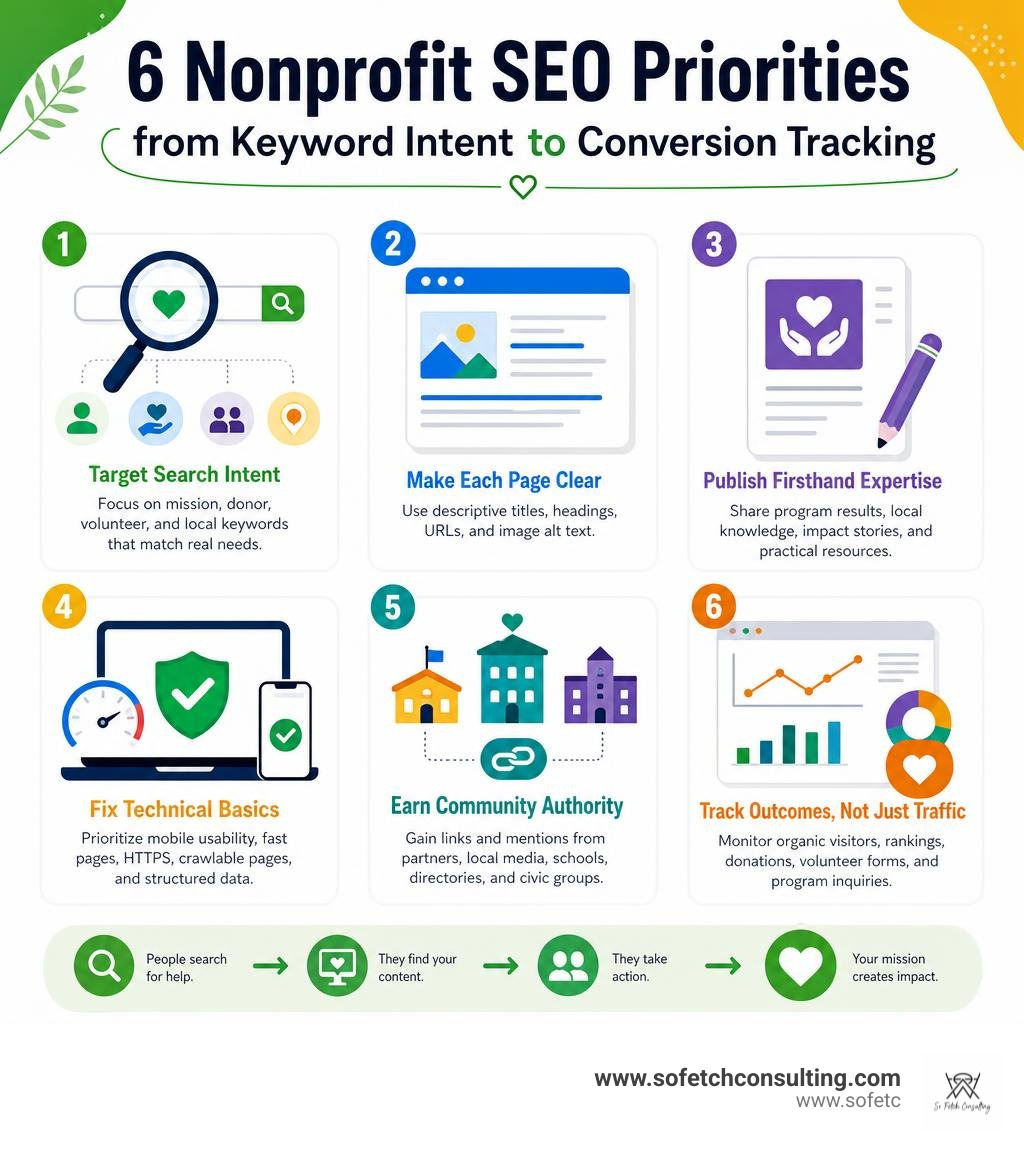
Nonprofit SEO tips help your organization appear when people search for services, volunteer opportunities, local programs, or causes they want to support. The quick version: create useful pages around real audience questions, make your website fast and easy to use, build trust through community mentions and links, and measure whether search visitors donate, apply, or get help.
- Target search intent: Use mission, donor, volunteer, and local keywords that match what people need.
- Make each page clear: Write descriptive titles, headings, URLs, and image alt text.
- Publish expertise: Share program results, local knowledge, impact stories, and practical resources.
- Fix technical basics: Prioritize mobile usability, page speed, HTTPS, crawlable pages, and structured data.
- Earn community authority: Seek links and mentions from partners, local media, schools, directories, and civic groups.
- Track outcomes, not just traffic: Monitor organic visitors, rankings, donations, volunteer forms, and program inquiries.
This matters because a nonprofit website can be a major source of awareness and action: nearly one-third of donors are inspired to give through nonprofit websites. Yet while most nonprofits have a website, far fewer use a deliberate SEO strategy. In 2026, strong search visibility also means creating reliable, clearly structured information that can appear in standard results and AI-powered search experiences.
I am Karin Wright, founder of So Fetch Consulting, a Google-certified digital marketer with 20-plus years of experience building businesses and creating practical search, ads, and content strategies. My approach to nonprofit SEO tips is simple: turn the real expertise and community impact your organization already has into pages the right people can find and trust.
What Is Nonprofit SEO and Why Does It Matter in 2026?
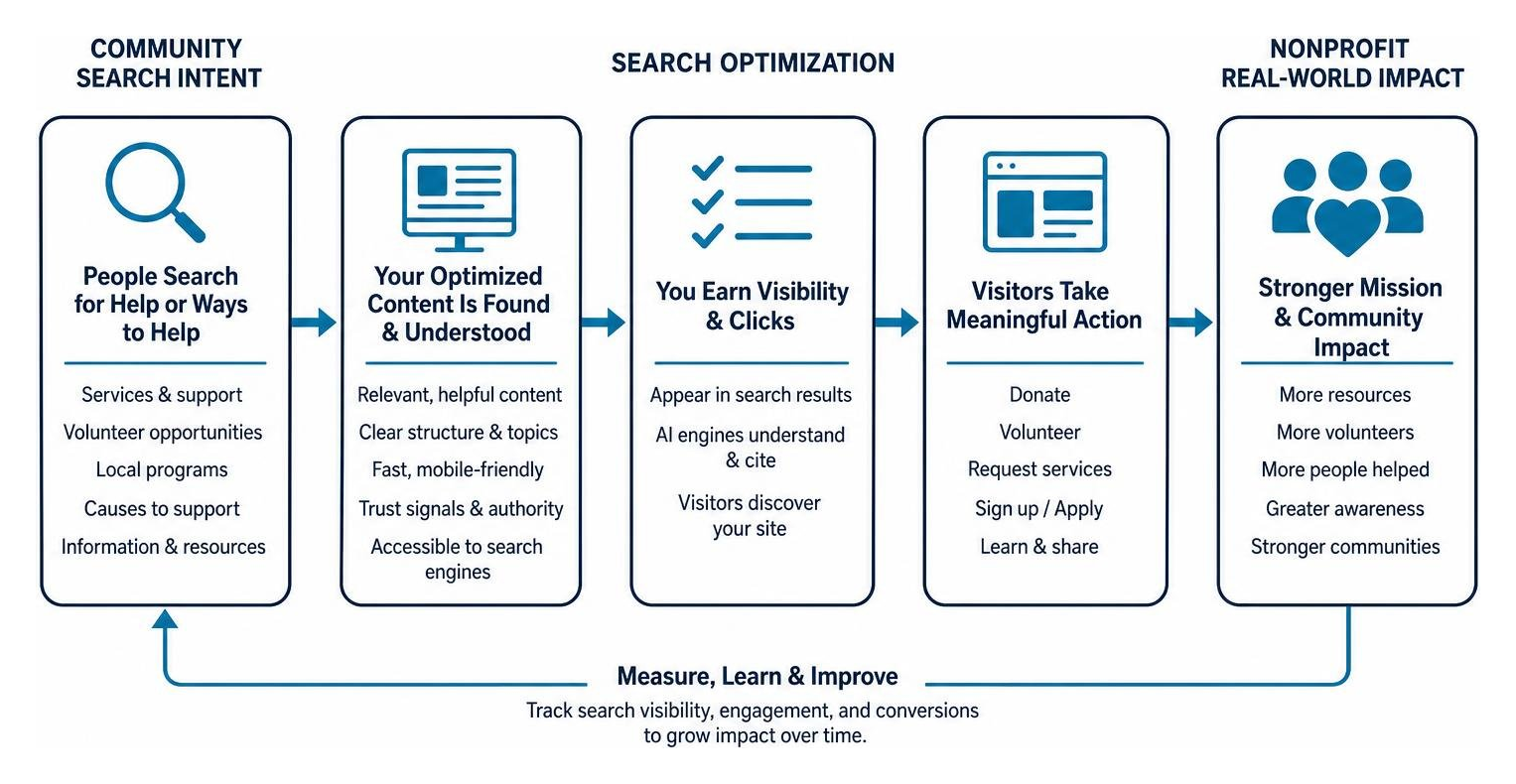
Nonprofit search engine optimization (SEO) is the practice of setting up your website so search engines like Google can find, understand, and rank your content higher when people search for topics related to your mission. While commercial businesses use SEO to drive sales and profit, non-profit organizations leverage SEO to drive social impact: recruiting volunteers, attracting individual donors, providing vital services to community members, and raising awareness for critical causes.
The urgency of implementing an effective strategy has never been clearer. Organic search accounts for 53% of all web traffic across the internet, and 44% of visitors to nonprofit websites arrive via organic search engines. Furthermore, 80% of nonprofit professionals agree that a strong digital presence is essential to their organization's overall success.
However, a major gap exists in the social sector. Industry research shows that while 91% of nonprofits maintain an active website, only 37% implement a deliberate SEO strategy. That means almost two-thirds of organizations are missing out on reliable organic discovery, leaving valuable funding and community support on the table.
In 2026, search engine optimization is also evolving rapidly. With Google’s AI Overviews appearing on over 13% of all search queries, and 58.5% of U.S. Google searches ending without a single click, getting listed at the top of organic results is no longer the only goal. Nonprofits must build high-trust content that AI engines understand, summarize, and cite directly.
Fortunately, mission-driven organizations possess a natural competitive edge here. AI search platforms heavily favor authentic E-E-A-T signals (Experience, Expertise, Authoritativeness, and Trustworthiness). Nonprofits doing hands-on work in local communities have genuine real-world stories and impact metrics that automated AI generators simply cannot replicate.
Core Search Engine Ranking Factors for Nonprofits
Google algorithms evaluate hundreds of subtle signals to decide which pages earn top placement on search engine results pages (SERPs). For mission-driven groups, these core ranking elements fall into three main buckets:
- Content Relevance and Search Intent: Does your webpage directly answer the user's specific query? Whether a visitor searches for emergency shelter information or looking for places to volunteer on weekends, your page must deliver precise, helpful information immediately.
- Trust Signals & E-E-A-T Framework: Because many nonprofit services involve community health, financial aid, legal guidance, or youth programs, search engines categorize them as YMYL ("Your Money or Your Life") topics. To rank well, we must showcase verified leadership bios, clear board details, transparent financial reporting (such as published Form 990s), and real impact updates.
- Domain Authority & Community Backlinks: Search engines judge authority based on who links to you. Earning references from local news outlets, university research projects (.edu), civic institutions (.gov), and peer organizations acts as digital votes of confidence for your domain.
Foundational Steps to Launch Your Search Strategy
Before jumping into content creation or page edits, every organization needs a baseline audit to establish technical health and clear benchmarks. Getting started does not require expensive tools or a massive marketing budget. We recommend taking these four foundational steps:
- Claim and Set Up Free Analytics Tools: Connect your website to Google Search Console to monitor search queries, indexing issues, and technical errors. Pair it with Google Analytics 4 (GA4) or a privacy-first analytics alternative like Matomo or Plausible to monitor traffic patterns.
- Conduct a Website Health Audit: Review your current website for basic usability issues. Ensure your site loads quickly, uses secure HTTPS encryption, operates seamlessly on mobile devices, and features clear navigational menus.
- Establish Baseline Metrics: Take a snapshot of your current performance. Record your average monthly organic traffic, top-ranking keywords, active donor conversion rates, and volunteer application submissions.
- Align Keywords with Organizational Goals: Map your SEO strategy directly to your non-profit’s operational goals. Identify whether your main priority for the upcoming quarter is securing monetary donations, recruiting local volunteers, or connecting community members with your programs.
For a broader look at modern search developments, you can check out The Ultimate Guide to SEO for Nonprofits: How to Get Found, Build Authority, and Drive More Donations in the Age of AI (2026) | Charitable .
Essential Nonprofit SEO Tips for Content and Keyword Research
Keyword research is the cornerstone of any successful search engine strategy. Keywords represent the exact phrases, questions, and terms people type into search engines when looking for help or ways to support a cause. Effective nonprofit seo tips revolve around identifying these search terms and organizing them thoughtfully across your website.
Practical Nonprofit SEO Tips for Finding Mission and Donor Keywords
Rather than targeting generic, highly competitive keywords like "charity" or "donation," nonprofits should categorize search terms into distinct intent buckets. We break nonprofit keywords down into four practical categories:
- Mission-Based Keywords (Direct Need): Queries entered by people seeking immediate support or resources from your programs (e.g., "free food assistance in Cleveland", "youth shelter services near me").
- Donor-Intent Keywords (Financial Support): Search terms used by prospective donors looking to contribute money or assets to a cause (e.g., "donate to animal rescue in Ohio", "tax deductible ocean cleanup charity").
- Volunteer-Intent Keywords (Active Participation): Terms searched by community members looking to give their time and skills (e.g., "youth mentoring volunteer opportunities", "how to volunteer at local food bank").
- Thought Leadership & Awareness Keywords: Broad educational topics that build organizational authority over time (e.g., "impact of urban community gardens on food security", "wetland restoration techniques").
Finding these search terms is simple using free tools. You can use free keyword research platforms like Google Keyword Planner, WordStream, Answer the Public, or Google's native auto-complete search suggestions.
Nonprofits running Google Ad Grants can also utilize their monthly Search Query Reports (SQRs) as a free sandbox to test high-performing keywords before optimizing their main website copy around them.
Once you gather your list, practice single-focus keyword mapping. Assign only one primary keyword to each webpage to prevent internal keyword cannibalization—a situation where multiple pages on your own website end up competing against each other in Google search rankings.
Actionable Nonprofit SEO Tips for On-Page Content Optimization
On-page SEO involves optimizing individual web pages so search engines and human readers can quickly digest your message. Here are our essential nonprofit seo tips for fine-tuning your page elements:
- Craft Compelling Title Tags: Your page title is one of the strongest ranking signals. Keep titles between 50 and 60 characters, put your focus keyword near the beginning, and include your brand or organization name (e.g., Volunteer Opportunities | Community Harvest Food Bank).
- Write Engaging Meta Descriptions: Meta descriptions do not directly impact rankings, but they act as your organic ad copy to boost click-through rates (CTR). Keep them between 150 and 160 characters, include a gentle call-to-action, and summarize what the visitor will gain.
- Maintain Clean URL Structures: Ensure page web addresses are short, human-readable, and include your focus keyword (e.g.,
/donate/or/volunteer/animal-shelter-roles). - Structure Header Tags Logically: Organize your main article text using a clear hierarchy: one H1 heading per page for the main topic, followed by H2 and H3 subheadings for subtopics.
- Optimize Image File Names and Alt Text: Web accessibility is critical. Add descriptive alternative text (alt text) between 100 and 150 characters to all website images. Alt text helps visually impaired visitors using screen readers while helping search engines index your imagery in Google Image Search.
- Keep Keyword Usage Natural: Aim for natural keyword placement across your titles, headers, meta descriptions, and body text. We recommend keeping total focus keyword occurrences to a modest 3 to 6 times per page. Overloading copy with artificial keywords hurts readability and risks search penalties.
For actionable implementation frameworks on keyword mapping, consult the Nonprofit SEO 2025: Playbook for Donors & Volunteers - Searcle AI .
Technical SEO and Local Optimization for Maximum Reach
High-quality content needs a strong technical foundation to succeed. If a website takes ten seconds to load on a smartphone or has broken links across its main navigation, prospective donors will leave before reading your message.
Technical Optimization: Speed, Mobile, and Structured Data

Technical SEO ensures that search engine crawlers can easily index your website while providing a fast, smooth user experience for human visitors.
- Mobile-First Indexing: Because the majority of web searches happen on mobile devices, Google evaluates the mobile version of your website first. Ensure your site uses responsive design, scalable fonts, and tap-friendly navigation buttons.
- Core Web Vitals and Page Speed: Fast pages keep visitors engaged. Test your performance using free tools like Google PageSpeed Insights. Focus on optimizing Core Web Vitals, including Interaction to Next Paint (INP)—which measures page responsiveness—and Largest Contentful Paint (LCP). You can dramatically improve page speed by running images through compression tools like Squoosh to reduce file sizes by 60% to 80% before uploading.
- HTTPS Security Encryption: HTTPS encryption has been non-negotiable for web security since 2018. If your site processes online financial contributions, an active SSL certificate is mandatory to keep donor payment details safe and maintain search engine trust.
- XML Sitemaps and Crawling: Create and submit an XML sitemap to Google Search Console and Bing Webmaster Tools. An XML sitemap acts as a clear roadmap that tells search bots exactly where your active content lives.
- Structured Schema Markup: Schema markup is specialized code added to your HTML that gives search engines precise context about your organization. Nonprofits should implement JSON-LD schema tags including
NGOorNonprofit,Event(for fundraising galas or volunteer drives), andFAQPageschema.
Local SEO: Claiming Community Visibility
With 46% of all Google searches carrying local intent, local optimization is essential for community-based NGOs, physical shelters, local food banks, and regional branch chapters.
The backbone of local search is claiming and verifying your Google Business Profile (GBP). Ensure your profile is fully filled out with your full organizational description, precise physical location, exact operating hours, and photos of your facilities and volunteers.
It is equally important to maintain consistent Name, Address, and Phone Number (NAP) details across all online business directories, including Yelp, Yellow Pages, Bing Places, and specialized non-profit directories like GuideStar.
| Local SEO Priority | Key Action Item | Impact on Nonprofit Visibility |
|---|---|---|
| Google Business Profile | Fully optimize listing, operating hours, photos, & primary category | Essential for appearing in local Google Map Packs |
| NAP Consistency | Standardize Name, Address, Phone format across all directories | Establishes local trust and prevents ranking confusion |
| Nonprofit Directory Profiles | Claim & update GuideStar, Charity Navigator, and local chambers | Builds industry credibility and high-trust backlinks |
| Online Reviews | Monitor & respond politely to public reviews on Google & Yelp | Direct ranking signal for local map search algorithms |
| Location Landing Pages | Create distinct website pages for each chapter or facility address | Captures location-specific queries (e.g., "food pantry near me") |
Furthermore, actively managing online customer and donor reviews improves local discovery. Encouraging supporters to leave feedback and taking the time to respond constructively to both positive and negative comments sends positive signals to Google's local ranking algorithms.
Building Authority, Backlinks, and Measuring Long-Term SEO Success
Off-page SEO focuses on building digital reputation and authority across the web. The most effective way to prove domain credibility is through backlinking—earning hyperlinks from respected third-party websites back to your own domain.
Authority Building on a Budget

Commercial corporations often spend thousands of dollars buying advertisement links. Nonprofits can build high-authority link profiles without a large marketing budget by leveraging their existing real-world relationships:
- Community Partnerships & Corporate Sponsors: Ask local business partners, corporate sponsors, and civic organizations who support your events to feature your logo and link back to your website on their sponsorship pages.
- Media Outreach and Digital PR: Local journalists frequently report on community initiatives, seasonal drives, and charitable events. Pitching real-world impact stories to local newspapers, TV stations, and podcasts can secure editorial mentions and valuable media backlinks.
- Educational (.edu) and Government (.gov) Extensions: Links from academic institutions and government websites carry tremendous weight in Google's algorithms. Partner with local universities for research initiatives, student internship listings, or community service projects to earn links from
.edudomains. - Reclaiming Unlinked Brand Mentions: Monitor web mentions of your non-profit name using free alerts. If a news outlet or blog mentions your charity's recent project without linking to your site, send a warm, polite email thanking them and requesting a direct hyperlink.
- Nonprofit Resource Pages: Request listings on curated community resource directories, local chamber of commerce sites, and civic volunteer databases.
To read more about aligning ethical digital practices with content authority, explore the SEO for Non-Profits & Mission-Driven Brands (2026 Guide) | AI & Intelligence | Vucense .
Measuring Performance and Tracking KPIs
SEO is an ongoing investment that compounds over time. To ensure your digital strategy delivers real value, look beyond simple pageview counts and measure meaningful key performance indicators (KPIs) in Google Analytics 4.
Set up custom event tracking to measure key conversion points, such as:
donation_complete(completed financial contributions)volunteer_application_submit(submitted volunteer forms)program_contact_submit(beneficiary service sign-ups)newsletter_signup(email subscriber additions)
Regularly evaluate these metrics against your organic acquisition channels to determine which blog articles, landing pages, and resource hubs generate genuine engagement.
Frequently Asked Questions About Nonprofit SEO
How long does it take to see results from nonprofit SEO?
SEO is a patient, long-term strategy rather than an overnight fix. While minor technical updates or fixing index errors can yield quick wins within 30 to 60 days, noticeable organic growth and higher keyword rankings generally take 3 to 6 months to take effect. Over 6 to 12 months, search engine authority compounds, delivering a lower overall acquisition cost for donors and volunteers compared to paid digital advertising.
How does Google Ad Grants interact with organic SEO?
Eligible 501(c)(3) organizations can receive up to $10,000 per month in in-kind Google Search advertising through the Google Ad Grants program. Google Ad Grants provide immediate paid search exposure for high-competition keywords, while organic SEO builds durable, long-term domain authority.
Rather than competing, the two channels complement each other: search query data from your Ad Grant campaigns can highlight high-converting keywords to target with permanent organic website content.
How can small nonprofits compete with larger organizations in search rankings?
Smaller organizations can outrank national charities by focusing hyper-locally and publishing deep niche expertise. While a small nonprofit may struggle to rank for broad keywords like "hunger relief," it can dominate local queries like "after-school meal programs in downtown Akron."
By sharing authentic E-E-A-T content, local program updates, real case studies, and securing local community backlinks, small groups can establish distinct search authority in their target region.
Final Thoughts for Getting Found and Growing Your Mission
Building a successful digital presence does not require complex technical jargon or huge corporate budgets. By implementing actionable nonprofit seo tips—focusing on user search intent, organizing on-page content, resolving technical site speed basics, and nurturing real community partnerships—your organization can reach the right people when they search for ways to help.
Search engine optimization is an ongoing journey of continuous refinement. Getting started today lays the groundwork for sustainable growth, predictable volunteer engagement, and expanded real-world impact for years to come.
If you are ready to refine your digital footprint and create a high-performing content roadmap, Get tailored digital strategy support from So Fetch Consulting. We are here to help your mission get found, build lasting authority, and inspire support.
