

Taking your passion for canines and turning it into a thriving practice requires stepping out of the dog park and into the owner's shoes. The very first steps you take will set the tone for your long-term success. Rather than diving headfirst into taking clients, you need a cohesive blueprint that covers business planning, market analysis, and your overarching brand vision statement.
A well-crafted vision statement defines what your company stands for, the methodology you use, and how you transform households. Are you focused on creating calm family pets, or are you specializing in rehabilitating severe behavioral cases? Knowing your target market allows you to tailor every piece of messaging, from your website copy to your intake questionnaires. Conduct a thorough local market analysis to identify gaps in your immediate area. Are local dog owners struggling to find qualified puppy trainers? Are existing trainers booked out for months with long waitlists? Identifying these gaps helps you position your services effectively.
Essential Qualifications and Dog Trainer Certifications
While there are no universal federal or state licensing mandates requiring a specific degree to work as a professional dog trainer, attempting to launch without formal education is a major strategic mistake. Acquiring recognized industry credentials serves as your license to command premium rates and immediately establishes credibility with clients and local veterinary health professionals.
To build a solid foundation, focus on these leading certifications and hands-on pathways:
- CPDT-KA (Certified Professional Dog Trainer - Knowledge Assessed): Issued by the Certification Council for Professional Dog Trainers, this designation requires at least 300 hours of documented practical dog training experience along with passing a rigorous standardized exam covering learning theory, instruction skills, and animal husbandry.
- KPA CTP (Karen Pryor Academy Certified Training Partner): A comprehensive program centered on positive reinforcement, mechanical skills, clicker training, and human coaching techniques.
- IAABC Credentials (International Association of Animal Behavior Consultants): Ideal for trainers transitioning into complex behavior modification, such as aggression, reactivity, and severe phobias.
- IACP Professional Membership: Joining the International Association of Canine Professionals gives trainers access to industry education, networking, professional resources, and a broader community of dog training and behavior professionals.
- Practical Experience & Shelter Volunteering: Education must be backed up by real-world handling. Volunteering at local animal shelters allows you to work with diverse breeds, temperaments, and behavioral issues while helping adoptable dogs become more suited for family homes.
Research shows that dog trainers with formal education can earn up to 60% more than their uncertified counterparts. Clients want peace of mind knowing that the person handling their family member is trained in modern, humane, and effective methodologies.
Business Plan and Legal Structures for Dog Trainers
Writing a formal business plan keeps your finances and operations grounded in reality. Approximately twenty percent of new businesses fail in their first year, and nearly half close their doors within five years. A clear roadmap helps you navigate early obstacles and track your performance against established benchmarks.
When setting up your business entity, you will generally choose between a sole proprietorship and a Limited Liability Company (LLC):
- Sole Proprietorship: The simplest and least expensive option to launch, but it offers zero personal asset protection. If a dog bites a client or another animal under your care, your personal savings, home, and assets can be targeted in a lawsuit.
- Limited Liability Company (LLC): Highly recommended for professional dog trainers. An LLC creates a clear legal barrier between your personal assets and your business obligations. Filing fees typically range from $50 to $500 depending on your state, providing crucial liability protection with minimal ongoing administrative paperwork.
Once your business entity is registered, secure an Employer Identification Number (EIN) directly from IRS.gov for free. You must also check with your municipal clerk's office regarding local business permits, occupational licenses, and zoning ordinances—especially if you plan to host clients or board animals on your private property.
For deeper insights into formal planning, check out the comprehensive guides at How to Start a Dog Training Business: 2026 Step-by-Step Guide — Dogster and review structured strategy outlines like the Dog Training Business Plan: Complete Guide with Financial Templates (2026) | Stratrix | Stratrix.
Financial Blueprint: Startup Costs, Equipment, and Location

One of the greatest advantages of how to start a dog training business is its low barrier to entry and exceptionally high profit margins. A lean solo practice can operate at a 70% to 85% profit margin because there are minimal physical goods to buy or inventory to hold.
Core Expenses for How to Start a Dog Training Business
Total startup costs for a new dog training venture generally range between $1,000 for a bare-bones mobile setup to $15,000 or more for a fully equipped operation. If you choose to launch a full-scale physical board-and-train commercial center right away, costs can top $20,000 to $50,000+.
To help visualize your initial capital requirements, here is a detailed breakdown comparing the three primary operational models:
| Expense Category | In-Home / Mobile Setup | Rented Class Space Model | Dedicated Commercial Facility |
|---|---|---|---|
| Business Formation & Legal Fees | $100 – $500 | $100 – $500 | $500 – $2,000 |
| Certification & Continuing Ed | $1,000 – $3,000 | $1,000 – $3,000 | $1,000 – $3,000 |
| Initial Insurance (Year 1) | $400 – $1,000 | $500 – $1,200 | $2,000 – $5,000+ |
| Training Gear & Supplies | $300 – $800 | $800 – $2,500 | $5,000 – $15,000+ |
| Website, Software & Tech Stack | $500 – $1,500 | $500 – $2,000 | $1,500 – $4,000 |
| Facility Lease & Buildout | $0 | $0 (Hourly rent: $30–$75/hr) | $15,000 – $50,000+ |
| Estimated Total Startup Budget | $2,300 – $6,800 | $2,900 – $9,200 | $25,000 – $79,000+ |
In a disciplined Year 1, a solo trainer serving 50 to 200 clients can generate $45,000 to $110,000 in gross revenue, resulting in $30,000 to $80,000 in owner profit. By Years 2 and 3, expanding into group sessions and adding contracted assistant trainers can boost revenue to $150,000–$450,000. For an in-depth analytical breakdown on unit economics and multi-year trajectory, see How do you start a dog training business in 2027?.
Choosing Your Location and Essential Equipment
Deciding where to conduct sessions impacts your fixed overhead:
- Mobile / In-Home Training: You travel directly to the client’s home or local neighborhood. This keeps overhead remarkably low and allows you to evaluate behavioral problems directly in the dog's daily environment.
- Rented Spaces: Renting community halls, local agility fields, or indoor dog daycares during off-peak hours gives you access to a safe, controlled environment for group obedience classes without committing to a multi-year commercial lease.
- Dedicated Facilities: A brick-and-mortar center allows for high-volume board-and-train programs, day training, and multiple concurrent group classes. However, taking on a facility lease in Year 1 before establishing proven client demand is a major financial risk that can easily drain your startup capital.
Regardless of your chosen operational model, your primary tool kit should include high-quality, professional gear:
- Leashes and Long Lines: Biothane or leather 6-foot leashes, along with 15-foot to 30-foot long lines for recall training.
- Harnesses and Collars: Ergonomic Y-harnesses and martingale collars for safe management.
- Reward Delivery Systems: Heavy-duty washable treat pouches, high-value rewards, and ergonomic clickers for precise timing.
- Agility & Management Gear: Pop-up place cots, exercise pens, visual barriers, and basic agility cones for spatial management during group sessions.
Defining Services, Niche Specializations, and Pricing Models
One of the biggest traps new business owners fall into is selling individual, pay-as-you-go hourly training sessions. Selling single private lessons creates an operational headache: you end up spending unpaid time driving across town, managing cancellations, and handling administrative follow-ups, which dilutes your true earnings to $40–$55 per worked hour.

Packaging and Pricing Your Dog Training Services
To build a sustainable income, package your services into structured, outcome-based programs that focus on complete household transformations:
- Structured Packages: Instead of charging $100 for an hour-long visit, sell a 4-to-6-week "Calm Household" or "Puppy Foundation" package for $3800 to $6000. Packages secure client commitment, lower cancellation rates, and give you the time needed to deliver actual behavior changes.
- Group Classes: Group classes offer an incredible hourly yield. Charging 8 dogs $200 each for a 6-week course generates $1,600 for just 6 instructional hours, yielding an effective rate of nearly $260 per teaching hour.
- Board-and-Train: Owners pay $1,500 to $6,500+ for 2 to 4 weeks of immersive, hands-on training where the dog stays with the trainer. While lucrative, this format requires clear legal contracts, dedicated space, and precise risk management protocols.
- Recurring Memberships: Offer ongoing maintenance sessions, alumni club walks, or monthly virtual check-ins for $50–$150/month to create predictable recurring revenue.
Selecting a Lucrative Training Specialty
Trying to be everything to everyone often leads to competing strictly on price. By specializing in a distinct niche, you stand out as an expert and can charge higher rates.
Lucrative specializations include:
- Puppy Socialization and Early Development: High volume, low risk, and highly receptive owners looking to establish good habits early.
- Leash Reactivity & Behavior Modification: According to industry surveys, over 60% of dog owners report that their pet displays some form of reactivity. Helping owners safely manage a leash-reactive dog commands premium rates ($125–$250/hr).
- Separation Anxiety Coaching: With many pet owners returning to in-office work, virtual separation anxiety coaching allows you to work with clients anywhere without travel time.
For an operational overview of service models and execution frameworks, consult How to Start a Dog Training Business in 2026 | Bizzby.
Risk Management, Legal Protections, and Business Insurance

Working with animals inherently carries physical and financial risks. A sudden dog fight, a broken leash leading to a runaway pet, or a client slipping during a group class can instantly jeopardize an unprotected practice.
Essential Insurance Policies and Client Contracts
Before taking on your very first client, secure comprehensive insurance coverage:
- General Liability Insurance: Protects your business against property damage and third-party bodily injury claims (e.g., a client tripping over a long line during a lesson). Typical coverage ranges from $30 to $100 per month.
- Professional Liability Insurance: Covers claims arising from professional negligence or errors in your training advice.
- Bailee Coverage (Animal Care & Custody): Standard insurance policies often treat animals as personal property. Bailee coverage pays for veterinary treatment or compensation if a client's dog is injured, sickened, or lost while in your care.
- Specialized Bite Liability / High-Risk Coverage: If you work with aggressive or reactive dogs with bite histories, ensure your policy explicitly includes bite coverage without breed-specific exclusions.
In addition to insurance, protect your business with ironclad legal contracts. Every client must sign a comprehensive service agreement prior to their first intake session. This document should explicitly outline:
- Liability Waivers: Acknowledging the inherent physical risks of animal handling.
- Veterinary Authorization Forms: Granting permission to seek immediate medical treatment for a dog in an emergency.
- Cancellation and Refund Policies: Establishing a strict 24-to-48-hour notice requirement for session rescheduling to protect your calendar.
- Realistic Behavioral Disclaimers: Clarifying that training outcomes depend on owner consistency and that no ethical trainer can offer a "100% money-back guarantee" on animal behavior.
To learn more about setting up your business safely and connecting with industry communities, review How to Start a Dog Business: Your 2026 Startup Guide - The Dog Gurus and How to Start a Dog Training Business .
Marketing Strategies and Finding Your First Clients
You can be the most skilled canine behavior consultant in your region, but without a steady stream of leads, your business won't survive. Successful dog training marketing relies on building strong local referral networks and maintaining an active digital presence.
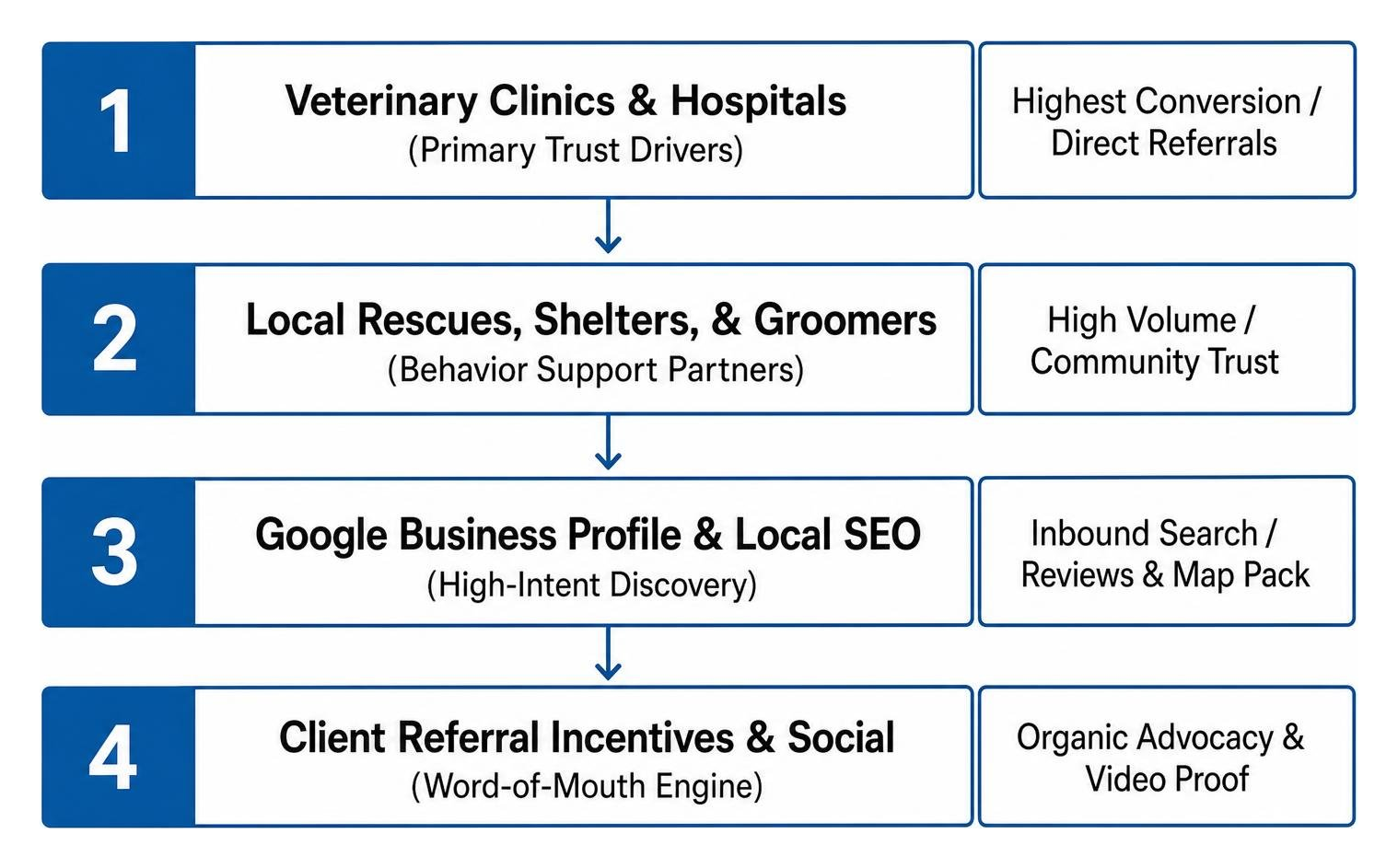
Marketing Strategies for How to Start a Dog Training Business
Paid advertising can be costly, but establishing high-trust local partnerships provides a reliable engine for new client inquiries:
- Veterinary Referral Pipelines: Vets see almost every new pet owner in your town. Visit local clinics, drop off informative rack cards, offer free behavioral handouts for their lobby, and introduce yourself to the staff. Vets are eager to refer clients to reliable, certified, force-free trainers.
- Shelter and Rescue Partnerships: Partner with local rescue groups to provide basic training materials or discounted transitional packages for newly adopted dogs. Rescues will routinely direct new adopters straight to your site.
- Groomer & Daycare Cross-Promotions: Groomers often encounter dogs with spatial sensitivity or handling fears. Partnering with a groomer allows you to help train cooperative care behaviors while exchanging client referrals.
- Google Business Profile & Local SEO: Set up a free Google Business Profile immediately. Complete every detail, upload pictures of active training sessions, specify your service area, and consistently ask happy clients to leave detailed 5-star reviews. Appearing in the local "3-Pack" map results is one of the single most powerful drivers of inbound client calls.
- Client Referral Incentives: Offer existing clients a $25 credit toward future training sessions or free entry into an advanced group class for every friend or neighbor they refer.
Common Year-One Mistakes New Dog Trainers Must Avoid
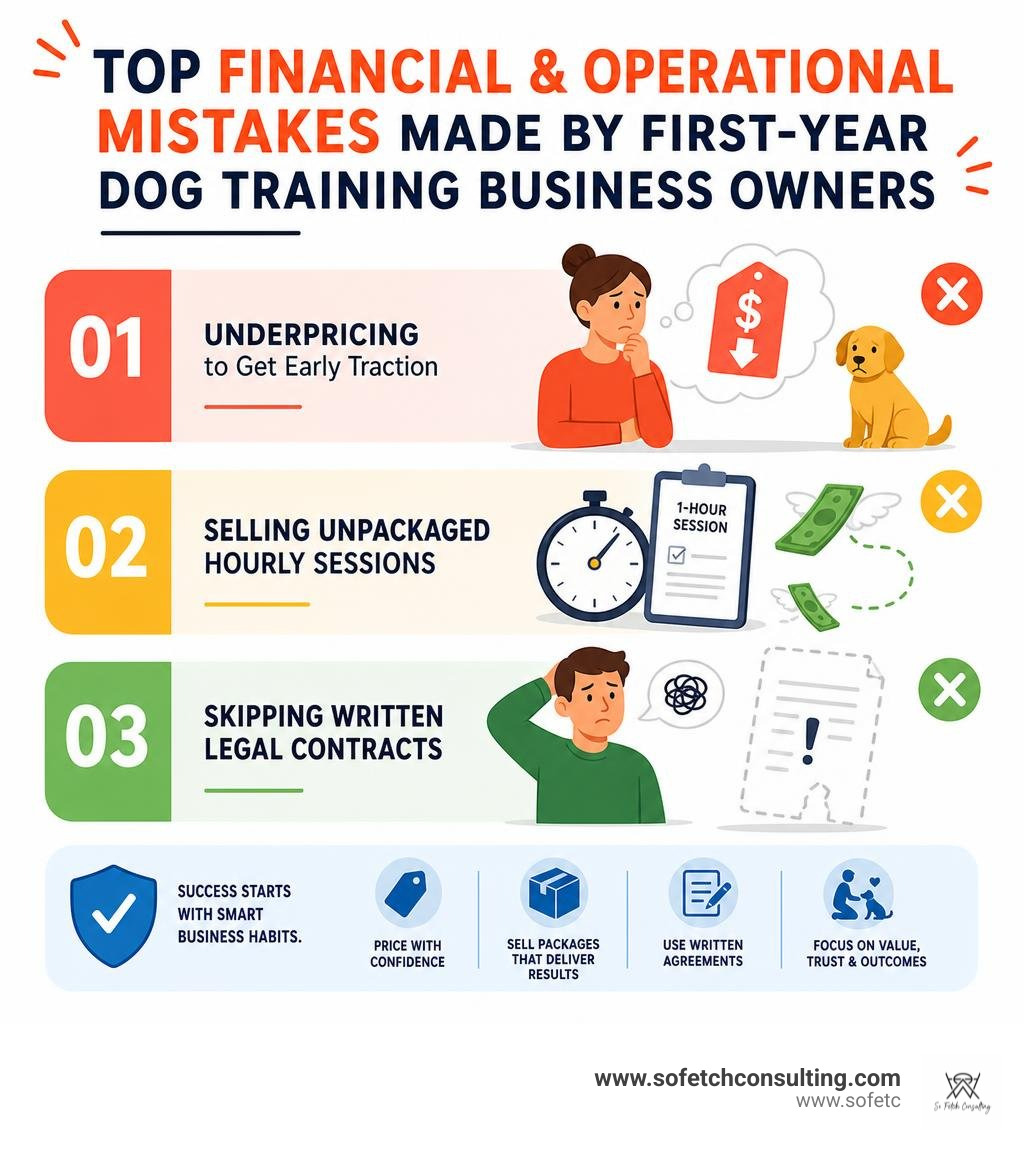
Many passionate dog lovers struggle in their first year of business due to predictable operational errors. Stay clear of these common pitfalls:
- Underpricing to Get Early Traction: Setting your prices too low signals poor service quality and attracts price-sensitive clients who are often the hardest to manage and retain. Price at market rates or higher from day one, competing on value and expertise rather than being the cheapest option.
- Selling Unpackaged Hourly Sessions: Selling individual sessions leads to unpredictable cash flow, high cancellation rates, and incomplete training outcomes. Always sell structured, outcome-focused packages.
- Skipping Written Legal Contracts: Relying on verbal agreements or informal handshakes leaves you completely vulnerable to unpaid invoices, legal liability, and dispute claims.
- Handling Admin Tasks Manually: Trying to handle scheduling, client intake, invoicing, and reminders manually via text and email quickly consumes your day. Implement simple software solutions like QuickBooks, PocketSuite, or specialized pet software from the start.
Frequently Asked Questions About Starting a Dog Training Business
Do I need a formal license or certification to train dogs professionally?
In most jurisdictions across the United States, professional dog training is an unregulated industry, meaning there is no state or federal government license legally required to open a practice. However, local municipalities do require standard general business licenses and zoning approval. Obtaining credentials from recognized certification bodies like the CCPDT or KPA is crucial for gaining market credibility and securing veterinary referrals.
How much does it cost to start a dog training business?
A lean mobile or in-home business can be launched for $1,000 to $3,000, covering basic certification fees, initial business registration, legal incorporation, essential training gear, and general liability insurance. Renting class spaces or launching dedicated facilities increases startup capital needs to between $6,000 and $25,000+.
How long does it take for a new dog training business to turn a profit?
Because a solo practice carries low overhead and virtually no cost of goods sold, many trainers achieve profitability within their first 3 to 6 months. Reaching a stable, full-time revenue level ($50,000 to $100,000+ per year) typically takes 12 to 18 months of consistent networking, Local SEO optimization, and word-of-mouth client acquisition.
Build a Profitable Dog Training Business With a Clear Plan
Stepping into the professional pet industry gives you the freedom of self-employment along with the satisfaction of improving the lives of dogs and their owners. By grounding your new business in science-based training methodologies, pursuing recognized certifications, establishing ironclad legal protections, and packaging high-value service programs, you can build a stable practice that yields great returns year after year.
Building a business requires a clear roadmap, predictable lead generation systems, and a strong digital brand that converts casual visitors into committed clients. At So Fetch Consulting, we specialize in helping pet service professionals, including dog trainers, groomers, daycares, and boarding facilities, turn their passion into profitable enterprises. Through tailored digital strategies, search engine optimization (SEO), and localized marketing programs built on our proven The S3 System™ content strategy, we give you the tools and visibility needed to attract consistent, high-paying clients. Ready to scale your brand and take control of your local market? Grow your dog training business with expert content strategy and start fetching the profits your hard work deserves.
