
Why Small Businesses Need Social Media: ROI, Reach, and Growth
Why Social Media Marketing Delivers Real Value for Small Businesses

The effectiveness of social media marketing for small business comes down to its ability to create low-cost visibility, build trust through direct conversation, and turn attention into trackable leads and sales. Start by choosing one or two platforms your customers already use, publish helpful and real content consistently, respond quickly, and track clicks, inquiries, bookings, and revenue, not just likes.
This matters because customers are already looking. More than 5.4 billion people used social media worldwide in 2025, nearly two-thirds of U.S. consumers use social search, and 29.7% discover brands through social ads. For a local dog trainer, groomer, nonprofit, or service business, a useful video, customer story, or timely reply can reach people in ways print ads and broad local promotions rarely can.
Social media is not free in the sense that it takes no work. But it gives small businesses something traditional advertising often cannot: direct feedback, precise local targeting, electronic word-of-mouth, and clear data about what helps customers take action.
I’m Karin Wright, founder of So Fetch Consulting, a business owner and digital marketer with more than 20 years of hands-on experience, including building and marketing businesses in the pet industry. I help founders understand the effectiveness of social media marketing for small business through honest strategy, practical content, SEO, paid ads, and measurement that connects marketing work to business results.
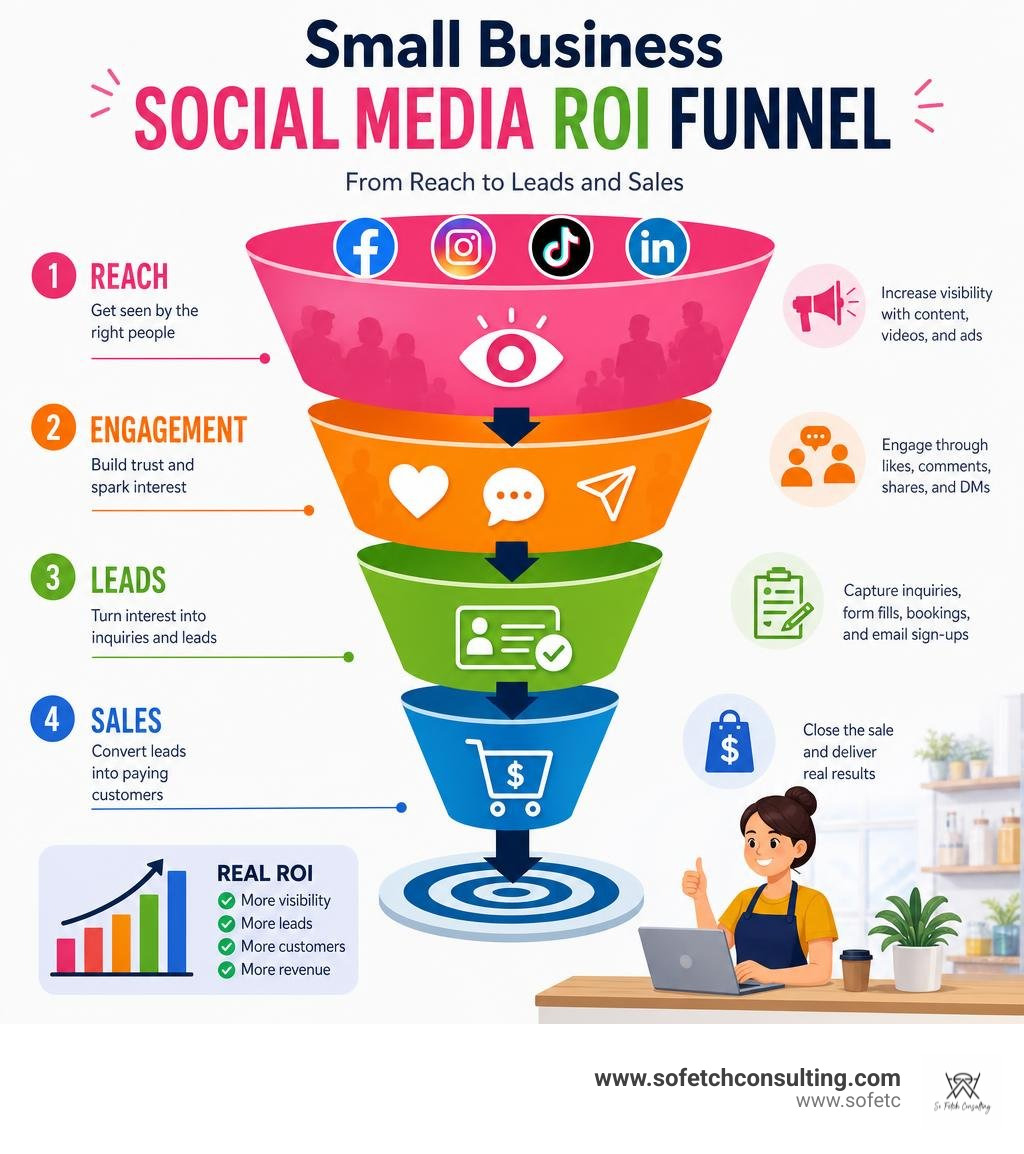
Evaluating the Effectiveness of Social Media Marketing for Small Business Performance
When we evaluate how social platforms move the needle for independent enterprises, the data reveals a clear transformation in operational reach and commercial stability. Small businesses that establish a structured digital presence experience significant gains in brand visibility and revenue generation within relatively short timeframes.
Empirical studies confirm this measurable impact. Research published in The Impact of Social Media Marketing on Small Businesses demonstrates that small companies implementing structured social strategies achieved an average revenue increase of 50%, alongside a 70% improvement in brand visibility and a 45% increase in qualified inbound leads within six months.

Furthermore, quantitative econometric modeling from the IMPACT OF SOCIAL MEDIA ON THE PERFORMANCE OF SMALL AND MEDIUM ENTERPRISES (SME) IN BAUCHI METROPOLIS shows that digital marketing competence, content engagement, and targeted advertising account for nearly 73% of the variance in small enterprise performance ($R^2 = 0.729$). Every intentional improvement in content and distribution translates into direct operational efficiency and customer acquisition gains.
Traditional Advertising vs. Modern Social Platforms
For decades, small business owners had to rely on print directories, local newspapers, radio spots, or direct mail flyers. These traditional channels carry high upfront costs, offer virtually zero audience segmentation, and lack actionable conversion tracking. You pay upfront and hope the right person drives past your billboard or opens their mailbox.
Modern social platforms flip this dynamic entirely:
- Granular Audience Targeting: Instead of blanket advertising across an entire postal code, platforms allow us to reach specific demographics based on interests, geographic proximity, and purchasing behaviors.
- Two-Way Communication: Traditional marketing is a one-way megaphone. Social media establishes a live dialogue where prospective clients ask questions, read real-time reviews, and receive instant support.
- Lower Customer Acquisition Costs (CAC): Organic social content costs nothing to publish, while paid social ad campaigns can be tested with budgets as low as a few dollars per day.
- Electronic Word-of-Mouth (eWOM): When a happy pet parent tags their dog trainer in an Instagram Reel, that single interaction provides social proof to hundreds of local friends simultaneously.
Key Metrics Proving the Effectiveness of Social Media Marketing for Small Business
To measure whether your campaigns are working, you must look beyond vanity metrics like raw follower counts. We focus on metrics that tie directly to customer intent and financial returns.
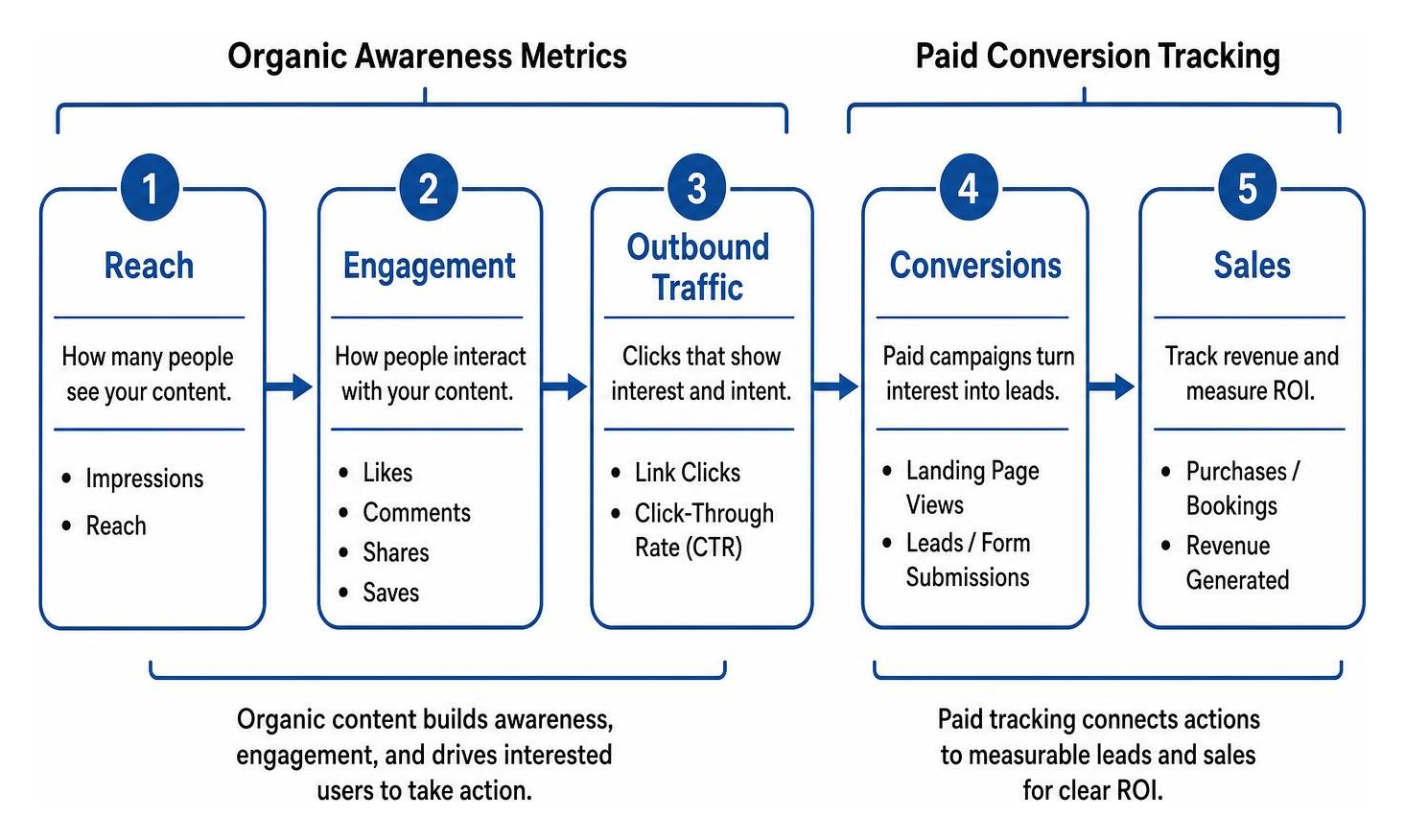
One essential calculation every business owner should understand is Click-Through Rate (CTR). This measures the percentage of people who viewed your post or ad and decided to take action:
- CTR Formula: $(\text{Total Clicks} \div \text{Total Impressions}) \times 100 = \text{CTR percentage}$
For instance, if a local promotion reaches 1,000 neighborhood pet owners and generates 40 clicks to your booking page, your CTR is 4.0%.
| Marketing Metric | Organic Social Focus | Paid Social Advertising Focus | Business Impact |
|---|---|---|---|
| Reach & Visibility | Unpaid post impressions, hashtag discovery | Targeted geo-fenced impressions | Introduces your brand to potential local clients |
| Engagement | Comments, saves, direct messages, shares | Post interactions, ad clicks | Builds authentic trust and consumer intimacy |
| Conversion Rate | Bio link clicks, inquiry form completions | Pixel-tracked purchases, lead form fills | Directly fuels business revenue and booking pipelines |
| Return on Investment | Client retention, organic referral revenue | Return on Ad Spend (ROAS), CAC reduction | Confirms financial profitability of marketing time and spend |
Choosing the Right Channels for Your Audience and Business Model
A common trap for busy founders is trying to maintain an active presence across every single social media channel. Spreading your energy thin leads to inconsistent posting, creative burnout, and watered-down messaging.

Instead, we recommend choosing one or two primary networks where your ideal buyers already spend their time, supplemented by essential local discovery tools like Google Business Profile.
Visual Storytelling and E-Commerce: Instagram and TikTok
Visual-heavy businesses such as dog grooming salons, boarders, boutique retailers, and creative studios flourish on short-form video platforms.
With over 2 billion active users on Instagram and roughly 1.8 billion on TikTok, these channels excel at top-of-funnel discovery. According to The Utilization of Social Media as a Digital Marketing Tool to Improve the Performance of MSMEs: A Literature Study, Instagram offers unmatched strength for building long-term community relationships and aesthetic storytelling, while TikTok delivers unmatched algorithmic reach for reaching fresh local audiences through engaging, short-form clips.
Unpolished, authentic videos such as a 15-second clip showing how you calm an anxious puppy on the grooming table regularly outperform expensive, studio-produced commercials. Modern consumers value transparency over corporate perfection.
Community and Local Engagement: Facebook and Messaging Channels
Facebook remains an absolute cornerstone for local enterprise discovery. With more than 200 million businesses on the platform and 78% of consumers discovering products through its feeds, Facebook serves as an interactive community bulletin board.
- Neighborhood Groups: Participating constructively in local neighborhood and community groups positions you as a helpful local resource.
- Facebook Ads Manager: The Meta Ads dashboard gives small owners deep control over geographic radius targeting, local event promotion, and lead generation campaigns.
- Direct Messaging Integration: Connecting Facebook Messenger and WhatsApp allows prospective clients to ask pricing questions and book appointments instantly, capturing high-intent leads before they look elsewhere.
B2B and Professional Services: LinkedIn and Thought Leadership
For private educators, commercial service providers, nonprofits, and B2B consultants, LinkedIn offers direct access to decision-makers. Over 50% of college-educated adults use LinkedIn, making it the premier platform for sharing case studies, discussing industry standards, recruiting top talent, and securing corporate partnerships.
Balancing Organic Content and Paid Advertising on Limited Budgets
A healthy small business marketing strategy does not rely exclusively on organic posts or paid campaigns. It balances both. Organic content builds community, demonstrates authenticity, and nurtures existing followers. Paid advertising breaks through algorithm limits to place your best offers in front of highly specific, localized prospects.
Maximizing the Effectiveness of Social Media Marketing for Small Business on a Budget
When budgets are lean, consistency and value trump raw volume. Academic research in The Impact of Social Media Marketing On SMES: A Case Study of Nigeria demonstrates a direct statistical link between active, conversational social media engagement and increased customer purchase intention.
To maximize your organic reach without spending thousands on production, focus on these high-performing content types:
- Educational How-To Guides: Share quick training tips, pet safety advice, or seasonal guidance that solves an immediate headache for your customer.
- Behind-the-Scenes Storytelling: Show the day-to-day work behind your business. Introduce your team, highlight facility cleanings, or explain why you use certain positive reinforcement methods.
- Customer Transformations & Testimonials: Share before-and-after stories, client reviews, and user-generated photos that provide undeniable proof of your service quality.
- Interactive Polls & Q&As: Use platform question stickers and polls to invite feedback. This sparks authentic dialogue and signals algorithms to boost your post visibility.
- Local Cross-Promotions: Partner with neighboring non-competing businesses, such as a dog trainer hosting a joint event with a local pet supply store, to share audiences organically.
Findings highlighted in The Role of Social Media Marketing in enhancing the Performance and Growth of Small Businesses show that two-way media engagement generates significant improvements in sales growth and customer retention, even when small businesses operate with limited initial operating capital.
Overcoming Common Adoption Challenges and Digital Literacy Gaps
Many small business owners struggle with social media adoption due to three common obstacles:
- Time Constraints: Running daily operations leaves little time for creative brainstorming. Solve this by batching your content creation into a single two-hour window each week and using scheduling tools.
- Content Quality Worries: You do not need professional camera gear. Natural lighting, clear audio, and a helpful message delivered from your smartphone are more than enough to engage modern buyers.
- Algorithm Frustration: Algorithms update continuously, but platforms consistently reward content that keeps users engaged. Focus on providing genuine value to your target audience rather than trying to game short-term algorithm quirks.
Under the Technology Acceptance Model (TAM), digital marketing adoption becomes sustainable once owners experience how simple tools save operational time and increase customer responsiveness.
Frequently Asked Questions About Small Business Social Media Marketing
How quickly can a small business expect to see ROI from social media?
Most small businesses begin seeing initial engagement, profile visits, and website traffic within the first 30 to 60 days of consistent posting. Meaningful financial returns and steady lead flow typically compound across a 3 to 6-month window as brand recognition and search discovery grow across your local market.
How much should a small business spend on social media advertising?
You do not need a massive budget to see results. Many successful local service businesses start with $5 to $10 per day on Meta Ads to boost high-performing posts or run targeted local lead generation ads. This controlled spend allows you to test messaging, measure click-through rates, and confirm positive Return on Ad Spend before scaling your budget.
Which single platform is best for local service businesses?
For localized service providers like dog trainers, groomers, and daycares, a combination of an optimized Google Business Profile and an active Facebook page provides the strongest baseline. Google captures high-intent local search queries, while Facebook facilitates community recommendations, direct messaging, and hyper-local targeted promotions.
Turn Social Media Strategy into Sustainable Business Growth
Social media marketing works best when it is integrated into a unified digital ecosystem. Social platforms build initial awareness and trust, your website converts visitors into paying clients, and strategic email marketing retains them for years to come.
At So Fetch Consulting, we help dog trainers, pet service providers, and purpose-driven small businesses build sustainable marketing engines. As a licensed content strategist utilizing our proven The S3 System™ framework alongside custom Squarespace web design, search engine optimization (SEO), and geo-targeted search marketing, we build strategies that turn casual social scrolling into measurable business revenue.
If you are ready to stop guessing and start growing with a clear, data-backed plan, explore our tailored digital marketing and content strategy to elevate your small business today.