
How to Master Digital Marketing for Private Schools to Boost Enrollment
Why Digital Marketing for Private Schools Drives Enrollment Growth

Digital marketing for private schools helps schools reach the right families, earn trust before a tour, and turn interest into qualified enrollment inquiries. The strongest approach combines local search visibility, a fast mobile-friendly website, authentic social content, helpful email follow-up, and a clear admissions process.
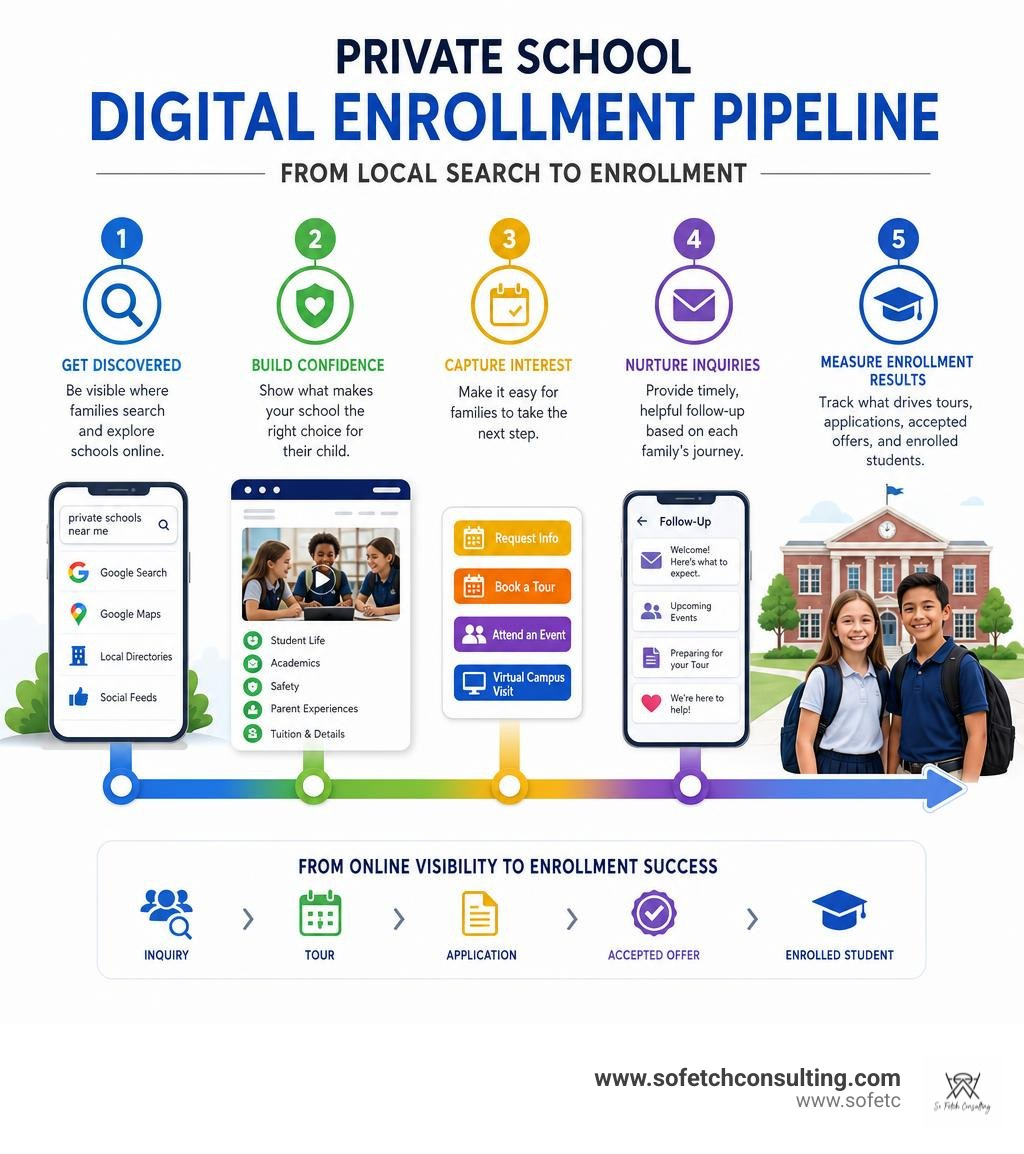
A quick view of the modern enrollment pipeline:
- Get discovered: Appear in Google search, Google Maps, local directories, and social feeds when families research schools.
- Build confidence: Show real student life, academic strengths, safety practices, parent experiences, and clear tuition information.
- Capture interest: Give families easy ways to request information, book a tour, attend an event, or explore a virtual campus visit.
- Nurture inquiries: Use timely, useful email and text follow-up based on where each family is in the decision process.
- Measure enrollment results: Track which channels create tours, applications, accepted offers, and enrolled students - not just clicks or likes.
Private-school participation has grown over the past decade. In 2022, 11.8% of U.S. children ages five through 17 attended private school, up from 10.4% in 2015. Families are looking for personalized learning, direct communication, flexibility, and confidence in their child's school environment. But growth is not automatic. Schools need a clear message and an easy online experience for busy parents and other tuition decision-makers.
I am Karin Wright, founder of So Fetch Consulting, with more than 20 years of experience building businesses and creating practical SEO, Google Ads, analytics, and social strategies. My work in digital marketing for private schools applies the same no-guesswork approach: connect marketing activity to real inquiries, stronger relationships, and measurable growth.
Why Private Schools Are Experiencing an Enrollment Surge

Private education is seeing a significant shift in family interest. Recent national data shows that 11.8 percent of U.S. children between five and 17 were enrolled in private schools in 2022, a notable rise from 10.4 percent in 2015. This momentum reflects a broader evolution in what parents prioritize for their children's education.
Shifted demographics, changing work patterns, and family relocations have reshaped community educational expectations. Parents are no longer defaulting to their nearest neighborhood option. Instead, they actively evaluate learning environments based on academic focus, campus culture, values, and individualized care.
Understanding the Factors Driving Post-Pandemic Enrollment Growth
Several core drivers fuel this enrollment expansion:
- Personalized Attention and Learning Support: Parents seek smaller class sizes where educators can adapt lessons to individual student needs and learning styles.
- Direct and Transparent Communication: Families want clear, proactive updates regarding school policies, academic progress, and daily activities.
- Enhanced Safety and Digital Security: Families prioritize both physical campus safety protocols and transparent digital privacy standards (such as data security and mental health resources).
- Flexibility and Academic Rigor: Evolving family lifestyles require programs that balance strong core academics with extracurricular enrichment and schedule predictability.
When schools communicate these pillars clearly through their online presence, prospective parents feel confident taking the next step toward booking a tour or filing an application.
Engaging Extended Family Decision-Makers Through Web Accessibility
Education investment decisions are rarely made in isolation. Grandparents and extended family members frequently contribute to tuition payments or participate in evaluating school options. If your website is difficult to navigate for older adults or mobile users, you risk alienating key decision-makers.
Prioritizing web accessibility makes clear business sense:
- ADA and WCAG Standards: Implementing Web Content Accessibility Guidelines (WCAG) ensures screen readers, high-contrast displays, and keyboard navigation work smoothly.
- Multilingual Translation Tools: Integrated translation widgets welcome multilingual families and non-native English speakers evaluating your programs.
- Intuitive Mobile Navigation: Incorporating translucent mega-menus and simplified top-level navigation allows family members of all ages to locate admissions details, tuition rates, and campus calendars quickly.
Focusing on accessibility delivers a frictionless digital experience for every family member involved in the choice.
Core Pillars of Digital Marketing for Private Schools

To build a steady stream of prospective families, private schools must move beyond basic print brochures and sporadic social posts. Sustainable growth requires an interconnected digital engine that catches intent, nurtures curiosity, and drives conversion.
Search Engine Optimization and High-Intent Local Search
Most family journeys begin with a search query on a phone or laptop. Effective digital marketing for private schools relies heavily on capturing local, high-intent search traffic.
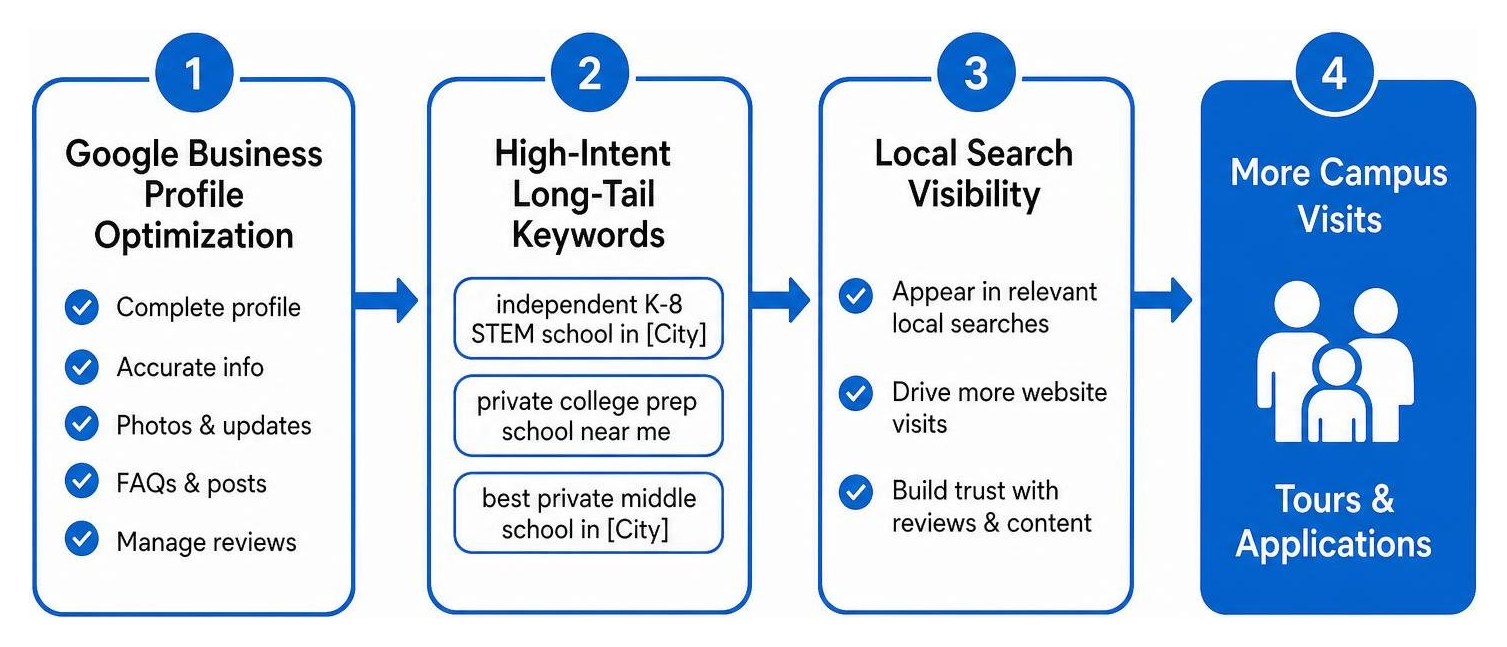
- Optimize Your Google Business Profile: Claim, verify, and complete every detail of your profile. Upload high-resolution campus photos, keep operating hours current, update upcoming open house dates, and answer FAQs.
- Target High-Intent Long-Tail Keywords: Broad phrases like "private school" are overcrowded and competitive. Instead, optimize web content around hyper-local, descriptive terms such as "independent K-8 STEM school in [City Name]" or "private college prep school near me."
- Manage Online Reviews Proactively: Encourage satisfied current parents and alumni to share honest, positive reviews on Google Business Profile and local directories. Promptly and professionally respond to feedback to show community engagement.
Social Media and Nontraditional Channels for Digital Marketing for Private Schools
Social media platforms serve as virtual open houses where prospective parents observe daily campus life and culture.
- LinkedIn for Targeted Parent Reach: Approximately 53 percent of LinkedIn users come from high-income households. Publishing school leadership insights, academic milestones, and alumni achievements on LinkedIn builds institutional prestige among working professionals.
- Nextdoor and Hyper-Local Outreach: Neighborhood networks like Nextdoor allow schools to engage local residents, announce community service initiatives, and invite nearby families to seasonal events without competing in crowded ad spaces.
- Authentic Short-Form Video: Families connect with genuine experiences over staged advertising. Share unpolished short-form videos (Reels, Shorts) showing active classroom projects, athletic events, artistic performances, and teacher highlights.
Interactive Content Experiences and Automated Nurture Sequences
Capturing a parent's email address is only the beginning. Modern digital strategies use interactive lead magnets and automated communication workflows to keep prospective families engaged.
- Interactive Campus Tools: Offer 360-degree virtual campus tours, video walk-throughs, interactive curriculum guides, or downloadable self-assessment checklists (e.g., "5 Questions to Ask When Selecting a Private Middle School").
- Automated Email Drip Sequences: When a parent requests information, trigger an automated sequence tailored to their prospective grade level. Follow up initial brochures with invitations to campus tours, student spotlight stories, and financial aid guides.
- Lead Scoring and CRM Integration: Use customer relationship management (CRM) systems to track parent engagement—such as email opens, tour bookings, and link clicks—allowing admissions teams to prioritize high-intent leads.
Balancing Traditional Tactics with Modern Digital Channels
Traditional outreach—such as open houses, printed viewbooks, and word-of-mouth recommendations—remains important in private education. However, pairing classic approaches with modern digital channels yields higher ROI and conversion rates.
| Marketing Strategy | Focus & Strengths | Primary Digital Integration | Expected Admissions Outcome |
|---|---|---|---|
| Word-of-Mouth Advocacy | High trust, authentic parent reviews | Digital ambassador programs, organic social shares | Increased referral inquiry volume |
| Campus Open Houses | Direct connection, physical experience | Online booking, automated SMS reminders, virtual tours | Higher attendance and tour conversions |
| Local Community Ads | Brand awareness, local community reach | Hyper-local PPC search ads, Nextdoor posts | Targeted local website traffic |
| Print Prospectus & Mailers | Tangible take-home material | QR codes linking to digital application portals | Seamless offline-to-online conversion |
Evolving Traditional Open Days into Flexible Open Door Access
Single, rigid open house events can pose scheduling challenges for busy working parents. Forward-thinking independent schools complement seasonal open houses with flexible, ongoing access:
- Personalized Campus Tours: Offer easy online self-scheduling tools that let parents select individual tour slots during regular school hours.
- "Open Week" Access: Host open weeks featuring drop-in classroom observations so parents can see typical daily instruction in action.
- Streamlined Digital Follow-Up: Send automated thank-you messages immediately following a tour, featuring a direct digital link to start an enrollment application.
Digitizing Word-of-Mouth with Parent and Alumni Ambassadors
Word of mouth remains a dominant driver of private school leads, accounting for approximately 80 percent of prospective family inquiries across independent education markets. Modern schools systematically scale organic word of mouth using digital platforms.
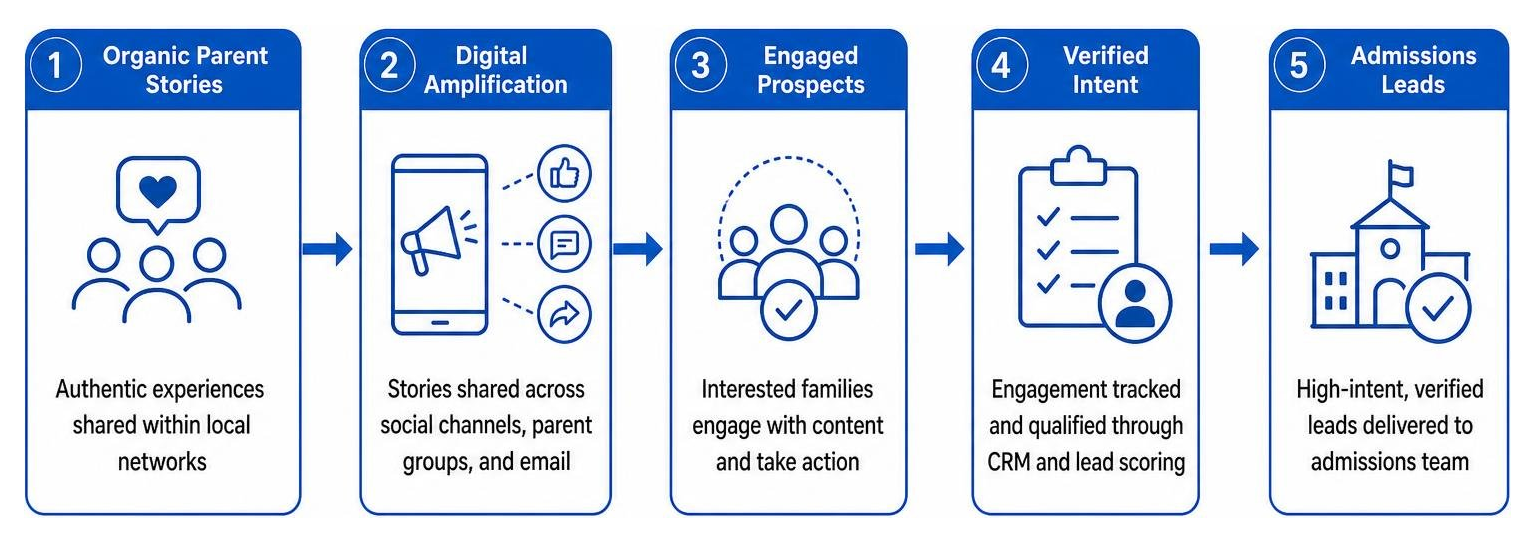
Create formal digital ambassador networks featuring current parents, active alumni, and faculty members. Provide ambassadors with digital toolkits—such as social media graphics, referral links, and direct messaging templates—so they can easily share their experiences across local social groups and parent forums. Additionally, interactive alumni subscription calendars keep past graduates connected to campus news and fundraising initiatives, reinforcing long-term community support.
Overcoming Budget Challenges and Maximizing Marketing ROI
Private school marketing budgets vary, but allocating funds wisely matters far more than total spend. According to national independent school data, 54 percent of independent schools operate with annual marketing budgets exceeding $70,000, while 28 percent have budgets over $120,000.
Despite these investments, many schools struggle to tie marketing spend directly to enrolled students.
Avoiding Common Budget Allocation Mistakes in Independent Schools
A frequent mistake in independent school marketing is spending heavily on low-impact broad awareness campaigns while neglecting conversion infrastructure.
- Ditch Vanity Metrics for Conversion Tracking: High web traffic numbers and social impressions mean little if they do not convert into tours and enrolled students. Focus budget reporting on cost-per-inquiry, tour completion rates, and completed applications.
- Reallocate Glossy Print Spend: Redirect excess spend from mass mailings and magazine advertisements into optimized search campaigns, mobile-first website speed enhancements, and targeted local ad channels.
- Invest in Internal Quality Control: First impressions happen everywhere. Upgrading waiting area amenities, enhancing visitor reception procedures, and providing friendly admissions touchpoints often deliver a higher return on investment than static billboard advertising.
Solving Key Strategy Hurdles in Digital Marketing for Private Schools
Most independent schools operate with compact teams. Research indicates that the typical independent school employs three or fewer full-time staff members handling marketing and communications.
To maximize output with limited staffing:
- Clarify Distinct Competitive Advantages: Identify three core institutional strengths that competing local schools cannot replicate (e.g., specific STEM certifications, specialized student support models, unique outdoor education facilities). Focus messaging on these differentiators.
- Align Admissions and Marketing Functions: Integrate admissions personnel with marketing planning. Provide admissions teams with sales-conversion training, prompt follow-up workflows, and unified CRM management.
- Adopt Purpose-Built Marketing Software: Use intuitive digital marketing and CRM tools designed for educational workflows so staff spend less time managing complex technical platforms and more time connecting with families.
Frequently Asked Questions
Why are private schools seeing a surge in enrollment?
Families are seeking environments offering smaller class sizes, personalized academic attention, transparent communication, strong physical and digital safety protocols, and direct involvement in their children's education.
What are the most effective strategies in digital marketing for private schools?
The most effective approaches combine high-intent local SEO, Google Business Profile management, mobile-first accessible web design, targeted social media presence (including LinkedIn and short-form video), and automated email nurture workflows.
How big should a private school's marketing budget be?
More than half of independent schools manage annual marketing budgets exceeding $70,000, with over a quarter exceeding $120,000. However, strategic budget allocation—focusing on SEO, search ads, CRM tools, and admissions training—is far more critical than total spend.
Conclusion: Sustaining Long-Term Enrollment Growth
Sustaining private school enrollment growth requires more than traditional word-of-mouth outreach. By building an accessible, mobile-first web presence, capturing local search demand, utilizing authentic social content, and streamlining admissions nurture workflows, your school can build a strong pipeline of prospective families.
At So Fetch Consulting, we help small businesses and educational institutions build straightforward, data-driven marketing strategies that deliver clear, measurable outcomes. Ready to boost your school's online visibility and turn website visitors into enrolled families? Explore how to Modernize Your School Marketing Strategy and establish a clear plan for sustainable enrollment growth.