
Public Sector Digital Marketing Strategies That Build Trust

Building institutional trust is the single most critical goal of any public sector campaign. Unlike commercial brands seeking immediate transactions, government agencies and civic organizations must demonstrate reliability, transparency, and accountability. When residents engage with public communications, they expect clarity rather than jargon or policy-heavy memos.
To achieve this, public sector digital marketing relies on plain language and universal accessibility. Replacing bureaucratic phrasing like "we are pleased to announce the commencement of..." with direct instructions such as "here is what is changing and what you need to do" dramatically improves readability and user trust. Plain language reduces anxiety, saves citizens time, and lowers customer support loads on public offices.
Accessibility is equally paramount. In the United States, Section 508 compliance mandates that federal agencies make electronic and information technology accessible to individuals with disabilities. Extending these standards across local government and civic digital marketing ensures that every resident—regardless of physical, visual, auditory, or cognitive ability—can access public services.
Best practices for digital accessibility in campaign assets include:
- Ensuring high contrast ratios for digital typography and infographics.
- Providing closed captions and full text transcripts for all video and audio content.
- Auditing forms and web portals for screen reader compatibility and keyboard-only navigation.
- Using clear visual hierarchies and action-oriented formatting on mobile screens.

Driving Behavioral Change and Service Adoption
In the public sector, generating awareness is only the first step. The ultimate objective is driving real-world behavior change—such as shifting citizens from traditional phone calls or walk-ins to digital self-service portals.
To motivate behavioral shifts, digital messaging must speak directly to user intent and offer tangible personal benefits, such as saving time or streamlining administrative tasks. When public agencies present digital tools as convenient solutions rather than mandatory hurdles, user adoption accelerates.
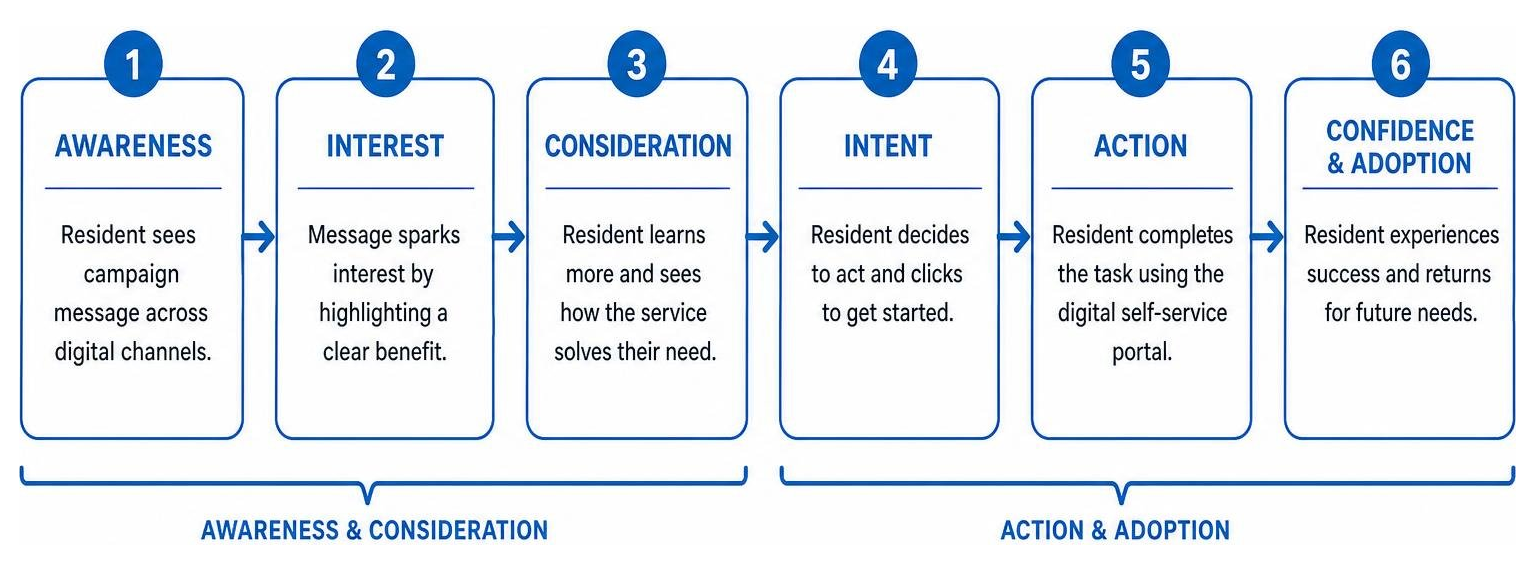
When designing campaigns for service adoption, consider these core principles:
- Highlight Immediate Benefits: Emphasize speed, ease of use, and convenience (e.g., "Manage your account in minutes from your phone").
- Remove Friction: Ensure campaign links lead directly to dedicated, mobile-friendly landing pages rather than generic agency homepages.
- Use Prompt Messaging: Deploy behavioral cues during peak operational windows or seasonal deadlines (such as annual permit renewals or tax filing periods) to prompt timely action.
Balancing Audience Personalization with Strict Privacy Laws
Modern citizens expect relevant messaging tailored to their specific circumstances, yet government bodies must adhere to strict privacy standards and regulatory frameworks. Public agencies cannot rely on invasive tracking mechanisms or unvetted third-party data networks.
The solution lies in leveraging consented first-party data and contextual targeting. Rather than tracking users across the web, marketers can segment audiences by life milestones—such as new residents, small business owners, or parents enrolling children in local programs—through voluntary opt-in channels like email newsletters, SMS updates, and self-selected landing page paths.
To balance privacy compliance with effective campaign delivery, agencies should:
- Prioritize First-Party Data Capture: Encourage residents to subscribe to official channels for emergency alerts or community updates.
- Adopt Contextual Targeting: Place ad creatives on local news outlets, neighborhood blogs, or regional community sites where target demographics actively seek information.
- Implement Persona Pathways: Use "Choose Your Path" options (e.g., Resident, Local Business, Visitor) on campaign hubs so visitors easily navigate to tailored information without requiring persistent tracking cookies.
Engaging Demographics and Managing Community Dialogue
Public sector marketing is fundamentally a two-way street. Modern civic engagement requires agencies to foster open community dialogue while maintaining firm moderation standards to keep public spaces respectful and constructive.
Establishing two-way communication builds trust by showing residents that their feedback is heard. However, unmanaged channels can quickly devolve into misinformation or public frustration. Public sector marketing teams must establish structured workflows, defined response windows, and clear public comment policies.
Essential components for managing public community channels include:
- Service Level Agreements (SLAs): State explicit response expectations on official social profiles (e.g., "We monitor this account Monday–Friday and reply within 24 to 48 hours").
- Public Comment Guidelines: Publish clear moderation rules detailing what constitutes inappropriate content, spam, or abusive language.
- Escalation Workflows: Maintain standard operating procedures for routing urgent resident inquiries or crisis situations to the appropriate department heads.
Reaching Gen Z and Millennials Through Modern Public Sector Digital Marketing
Reaching younger demographics (18–34 year olds) requires government agencies to meet audiences where they already consume media. Traditional press releases and television spots are far less effective for younger generations, who rely primarily on short-form video and social platforms.
During public health and civic awareness initiatives, pioneering public sector teams expanded beyond conventional channels onto platforms like TikTok, Snapchat, and Reddit. Creative formats such as interactive polls, AR face filters, and bite-sized video updates allow agencies to deliver vital information in an engaging format.
A landmark example of strategic channel adaptation occurred during the multi-year health communication effort evaluated in the Government COVID-19 Campaign Case Study. The campaign deployed daily digital pulse meetings, expanded onto seven diverse social platforms, used hyper-local geotargeting across community networks, and utilized Snapchat AR filters and chatbot conversation ads to achieve over 19 billion impressions and 95 million site clicks.
Similarly, strategic video outreach led by government communication leads, such as those highlighted in the profile of Nadia Tan , demonstrates how dedicated short-form video units on platforms like TikTok successfully bridge engagement gaps with younger civic audiences.
Responsible AI Integration in Government Workflows
Artificial intelligence offers major efficiency gains for public sector communicators, from drafting content variations to summarizing complex policy updates or translating announcements into multiple languages. However, AI cannot operate without human accountability.
Public sector entities must enforce an "AI-assisted, human-approved" workflow. While generative tools can speed up initial content drafting, human subject matter experts must verify every piece of information for factual accuracy, plain language compliance, and non-discrimination before publication.
Key guardrails for AI usage in public agency marketing include:
- Strict Fact Verification: Reviewing all AI-generated policy summaries against official legal documentation.
- Bias and Tone Audits: Ensuring automated language matches the agency's warm, neutral, and inclusive tone of voice.
- Data Privacy Protection: Prohibiting the input of non-public citizen data or confidential files into public AI models.
Proven Case Studies and ROI Measurement in Government Campaigns
Demonstrating return on investment in the public sector requires measuring outcomes beyond commercial profitability. Instead of tracking sales revenue, agencies measure success through channel shift, service adoption, cost reduction per transaction, and improvements in overall institutional trust.
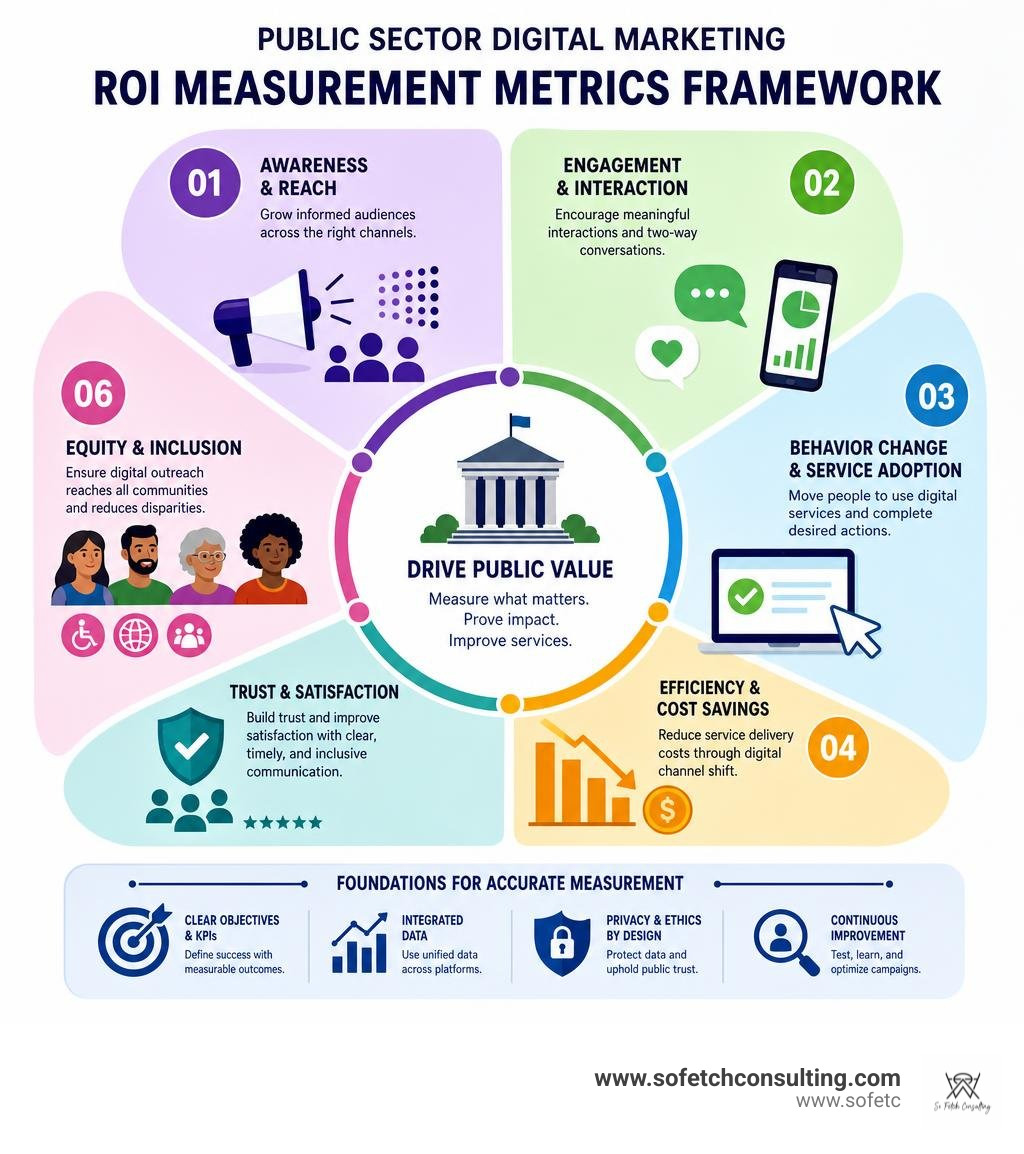
Measuring Impact and ROI in Public Sector Digital Marketing
A premier example of measuring digital campaign ROI in the public sector is detailed in the official GOV.UK Digital Shift Campaign Evaluation. HM Revenue and Customs (HMRC) executed a national digital channel shift campaign aimed at encouraging citizens to resolve routine inquiries using online portals and a mobile app rather than calling busy telephone centers.
The rigorous multi-phase evaluation revealed striking results regarding awareness, behavior change, and institutional trust:
- Campaign Reach & Demographics: 24% of UK adults recognized at least one campaign advertisement. Recognition reached 41% among 18–34 year olds compared to 18% for those aged 35 and over.
- Clear Messaging: 71% of respondents identified the core campaign takeaway as "HMRC has an app."
- Digital Awareness: Overall awareness of engaging with the department through digital channels increased from 69% baseline (Phase 1) to 75% post-campaign (Phase 3).
- Behavioral Intent & Adoption: 60% of Phase 3 respondents reported they would first use a digital channel to resolve a issue (up from 55%), 63% said they would consider using digital channels, and 13% had downloaded the mobile app by Phase 3.
- Institutional Trust: Campaign recognisers reported significantly higher trust in the organization (56%) compared to non-recognisers (39%). Furthermore, 56% of recognisers agreed the app helped them feel "on it" regarding their personal affairs.
These metrics confirm that well-executed public communications improve service efficiency while directly building public confidence.
Cross-Agency Collaboration for Local Government Success
Local government campaigns frequently operate on tight public budgets, requiring strategic collaboration across regional agencies, emergency services, and community partners to maximize campaign reach.
As demonstrated in the career achievements of senior campaign leaders like Genevieve Case Profile, effective local government marketing relies on cross-agency integration. Delivering multi-channel public safety and awareness initiatives—such as regional anti-social behavior awareness or foster care recruitment—demands unified messaging across county councils, district authorities, and local police forces.
By pooling resources, utilizing internal graphic creation tools, executing multi-platform paid search and social campaigns, and grounding creative briefs in community research, public sector teams deliver measurable, award-winning campaign results without overspending taxpayer funds. Furthermore, insights shared by e-governance leaders like Gurudeep H R highlight how institutional e-governance initiatives rely on cohesive digital communications to execute structural digital transformations smoothly.
Frequently Asked Questions About Public Sector Marketing
How does public sector digital marketing differ from private sector marketing?
Public sector digital marketing focuses on driving public awareness, institutional trust, community participation, and civic behavior change rather than driving immediate commercial transactions or product sales. Public agencies operate under strict regulatory constraints—including accessibility standards, public procurement guidelines, privacy rules, and intense public scrutiny—making institutional trust the primary Key Performance Indicator (KPI).
How can public sector agencies ensure Section 508 compliance across digital assets?
Agencies can ensure digital accessibility by conducting systematic technical audits of websites and landing pages, using screen reader tools, validating color contrast ratios, testing keyboard navigation, adding descriptive alternative text to image assets, and ensuring all published video materials include closed captions and full audio transcripts.
What is the most effective way for local government to handle two-way community feedback?
The most effective strategy is implementing a structured community response model. This includes setting clear public SLAs (e.g., stating response windows), establishing standardized comment moderation guidelines to filter abusive content, preparing approved response templates for common inquiries, and training communications staff to route specialized technical questions directly to subject matter experts.
Conclusion
Modern public sector digital marketing transforms how government institutions and civic organizations connect with the public. By prioritizing institutional trust, plain language, digital accessibility, and privacy-first targeting, public sector organizations can effectively reach diverse demographics and drive meaningful service adoption.
Executing multi-channel government campaigns requires specialized strategy, compliant creative execution, and accurate data evaluation. Whether you are leading a local municipal initiative, managing public education outreach, or optimizing civic web services, adopting modern digital marketing standards ensures taxpayer resources deliver maximum community impact.
Ready to elevate your civic messaging and build lasting public trust? Explore how our specialized content frameworks and digital strategies can transform your public sector campaigns with Elevate Your Marketing Strategy with SoFetch Consulting.