
Nonprofit SEO Services That Turn Search Visibility Into Real Impact
Turn Search Visibility Into Real Mission Impact

Professional nonprofit SEO services help the right people find the right next step: donate, apply to volunteer, access a program, or verify your organization's impact. The best approach is not chasing random traffic. It is building fast, accessible pages around real search questions, creating separate paths for each audience, and tracking completed actions instead of celebrating clicks like they pay the bills.
A solid nonprofit SEO plan should:
- Make program and eligibility information easy for beneficiaries to find.
- Create clear donation, volunteer, and partnership pages for supporters.
- Strengthen local visibility through Google Business Profile, location pages, and accurate listings.
- Build trust with team credentials, transparent impact reporting, and well-sourced claims.
- Measure completed gifts, qualified volunteer applications, and program inquiries, not just rankings.
Nonprofits have a tougher job than most businesses because one website often serves donors, volunteers, beneficiaries, funders, and local partners. Those groups do not search the same way, and stuffing every message onto one generic page is a pretty reliable way to confuse everyone.
I'm Karin Wright, founder of So Fetch Consulting, a Google-certified marketer and business operator with 20-plus years of hands-on experience building and marketing real businesses. I bring a practical, data-first approach to nonprofit SEO services, focused on sustainable visibility and measurable action rather than hopes, vibes, or mystery reports.
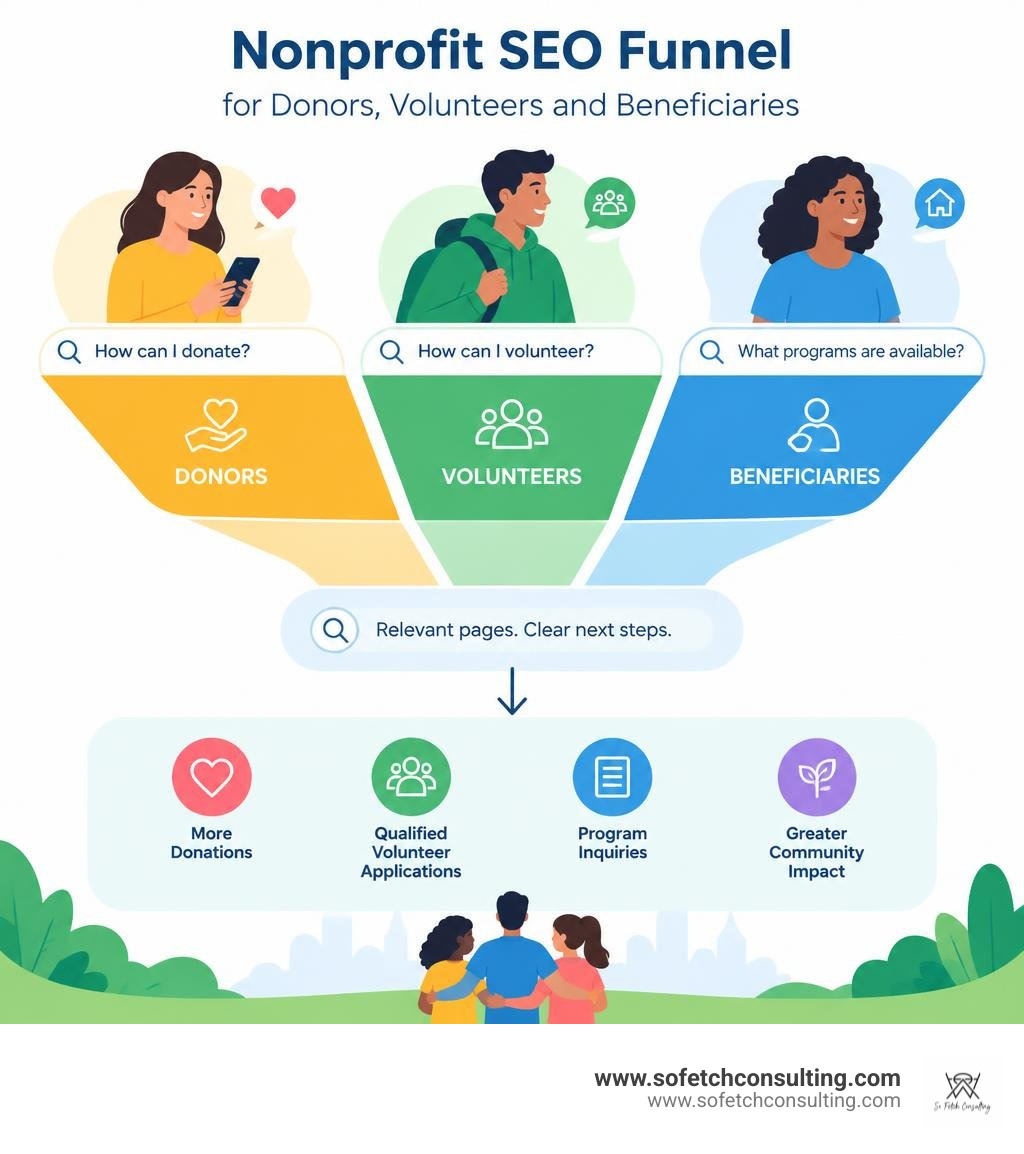
Understanding the Distinct Search Funnels in Nonprofit Marketing
Let us be completely honest with each other for a second. Most commercial businesses only have to worry about one primary customer journey: "Here is my widget, give me your credit card, thank you very much." Nonprofits do not have that luxury. Your digital storefront has to juggle at least three wildly different crowds simultaneously without tripping over its own shoelaces.
When you treat your organic strategy like a generic corporate sales pitch, you end up with messy messaging, confused visitors, and a bounce rate that gives your marketing director hives. Successfully managing organic search for a cause requires separating user intent into neat, intentional buckets. That means designing a web architecture where a desperate family looking for community pantry hours never lands on a sterile endowment fund pitch, and a corporate foundation officer does not have to dig through volunteer onboarding forms to find your 990 tax documents.
Why Mission-Driven Teams Need Specialized Nonprofit SEO Services
Traditional commercial SEO targets high-converting commercial keywords like "buy organic dog food" or "best CRM software." But mission-driven search revolves around empathy, community urgency, trust verification, and distinct supporter journeys.
If your digital presence is built around vague taglines, search engines will have no idea who to send your way. Specialized optimization focuses on the actual language humans type into search engines when they need immediate assistance, when they want to roll up their sleeves on a Saturday morning, or when they want to make a tax-deductible gift before December 31. By establishing clean navigation pathways, you turn everyday search queries into real community outcomes. For teams wanting to master these foundational mechanics, our practical nonprofit SEO tips can help you quickly identify the baseline fixes your site needs right now.
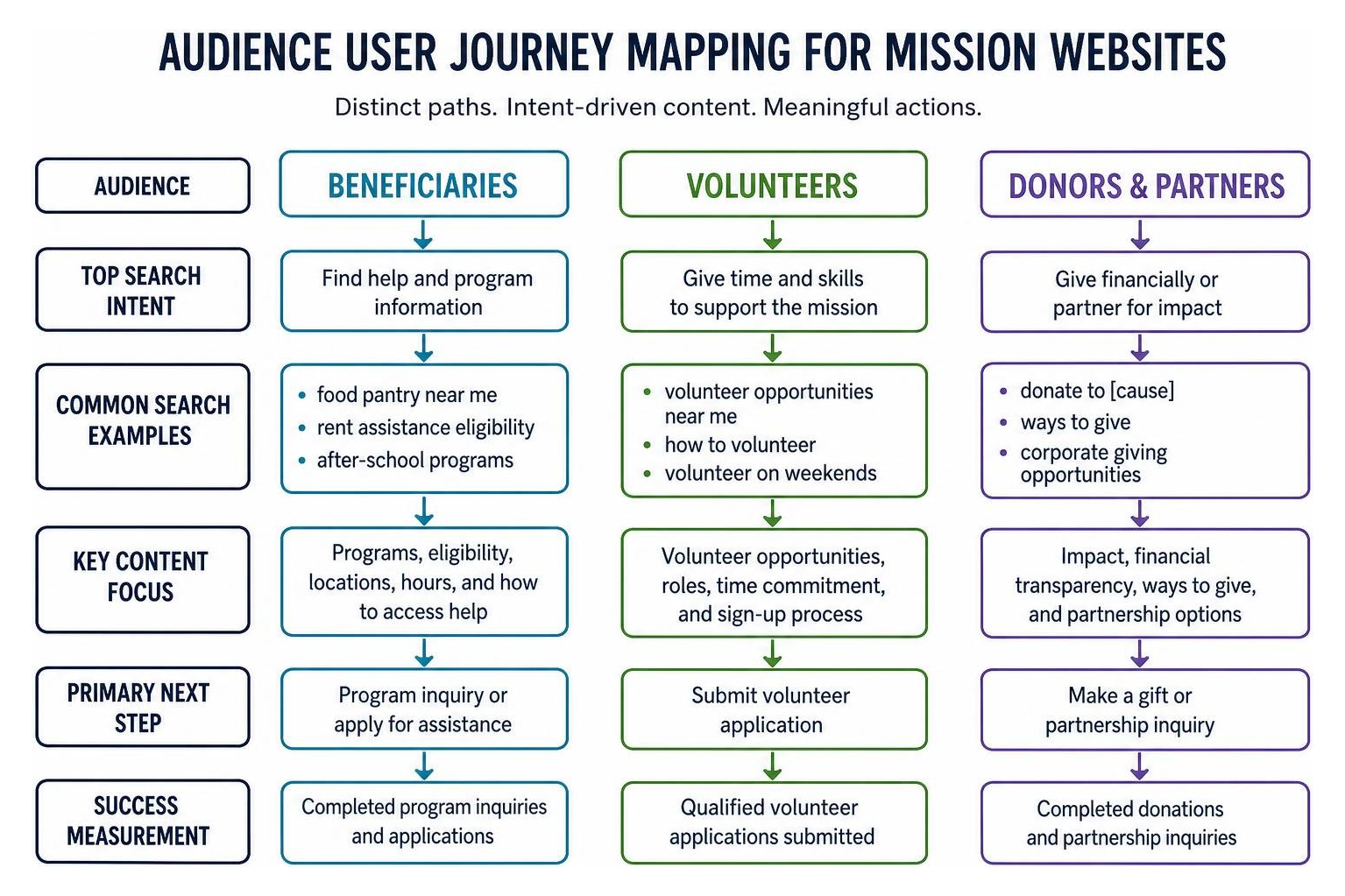
Mapping Distinct Audiences: Donors, Volunteers, and Beneficiaries
To dominate organic search, your website needs dedicated real estate for each audience segment. A single homepage cannot pull all that weight. You need dedicated landing pages designed around the exact phrase choices and psychological mindsets of donors, volunteers, and beneficiaries.
| Audience Persona | Primary Search Intent | Real-World Search Query Examples | Critical Landing Page Requirements |
|---|---|---|---|
| Individual & Major Donors | Transactional & Informational: Evaluating trust, program effectiveness, and tax deductibility. | donate to animal rescue near me, tax deductible food charity, best mental health nonprofits 2026 | Frictionless donation forms, 501(c)(3) verification, impact statistics, clear annual reports. |
| Community Volunteers | Experiential & Local: Looking for weekend opportunities, court-ordered hours, or team activities. | weekend youth volunteer opportunities, animal shelter volunteer requirements, volunteer with seniors | Clear role descriptions, time commitments, screening details, online application forms. |
| Program Beneficiaries | Urgent & Solution-Focused: Seeking immediate resources, assistance, or specialized care. | free emergency grocery assistance, temporary pet fostering support, youth counseling services intake | Plain-language eligibility rules, hours of operation, intake forms, strict privacy assurances. |
| Institutional Funders | Navigational & Research: Checking governance, board leadership, and methodology. | organization name impact metrics, annual 990 filings, community partnership grant reports | Executive bios, transparent financial registers, peer-reviewed methodology, program audits. |
Core Offerings in Professional Nonprofit SEO Services
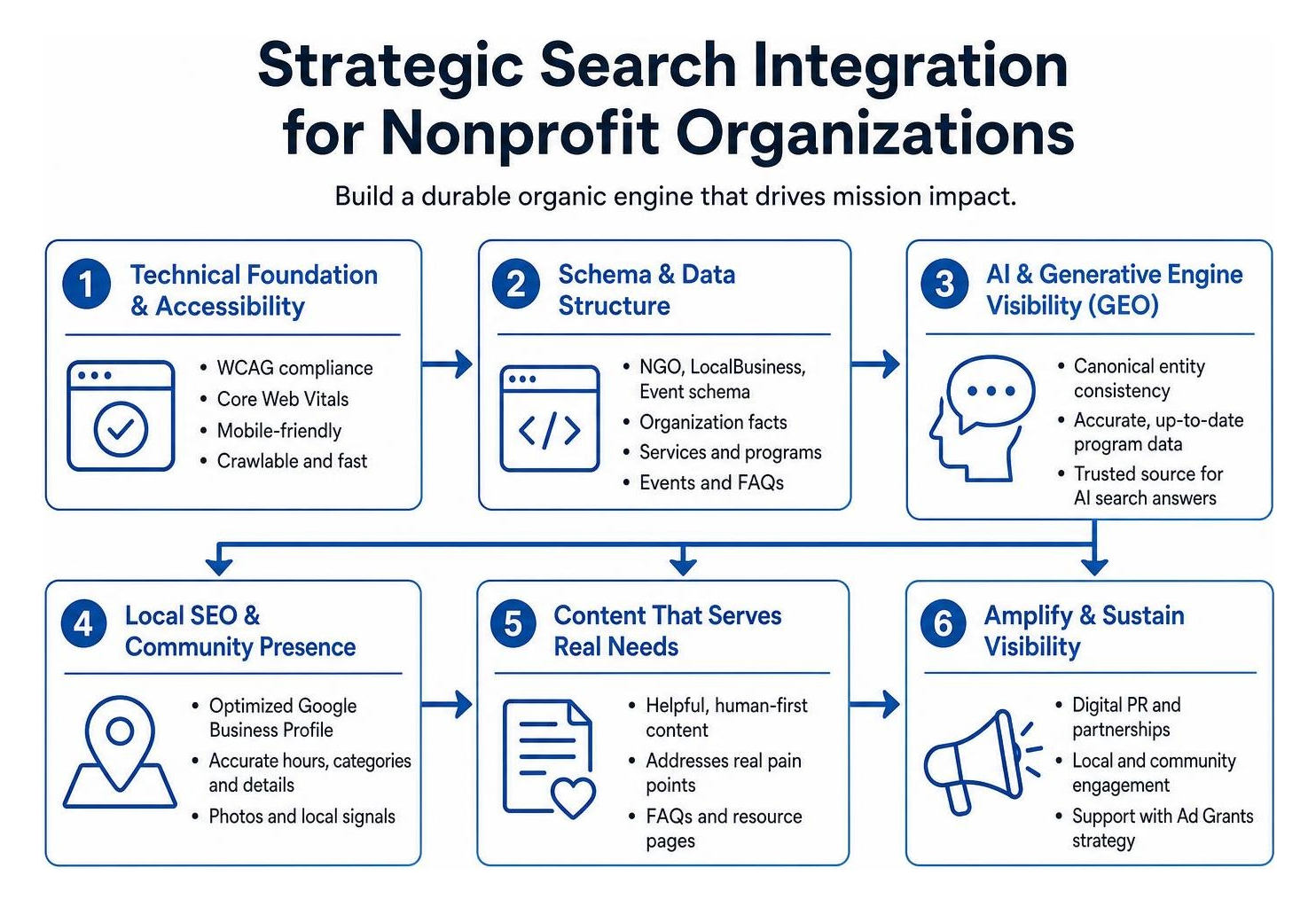
Running a nonprofit means you are likely wearing fourteen hats before lunch. You do not have thirty hours a week to untangle broken canonical tags, monitor generative AI search engines, and rebuild XML sitemaps. That is why professional optimization is designed to build a durable organic engine for your cause. According to the Nonprofit organization resource, mission-driven entities face unique governance and operational constraints that commercial businesses simply do not have, making specialized digital strategy non-negotiable.

Sustainable organic growth comes from fixing your technical foundation, structuring your mission data so machines can understand it, and writing helpful content that speaks to real human pain points. If you run an organization with limited hands on deck, exploring flexible SEO services for small business gives you the specialized framework you need without hiring a massive, expensive internal team.
Technical SEO, Accessibility, and Schema Architecture
If Google's web crawlers cannot crawl your pages, or if someone using a screen reader cannot navigate your volunteer form, your mission stalls before it even gets out of the driveway. Technical optimization starts with Web Content Accessibility Guidelines (WCAG) compliance, rock-solid Core Web Vitals, and lightning-fast mobile responsiveness.
On top of technical hygiene, we implement structured data using Schema.org vocabulary. By wrapping your content in structured NGO, LocalBusiness, and Event schema markup, you hand search engines a neat cheat sheet:
- Organization Facts: Your official non-profit status, legal name, EIN, and mission focus.
- Service Offerings: Clear definitions of specific community programs and service areas.
- Event Data: Exact dates, times, and RSVP links for fundraising galas or adoption events.
- FAQ Schema: Direct answers to common questions about donation security or intake rules.
If your site runs on popular platforms, like Squarespace, simple configuration errors can quietly tank your visibility. Checking out resources on Squarespace improve SEO can keep your clean templates completely visible to search crawlers.
Generative Engine Optimization and AI Search Visibility
Search is evolving beyond simple blue links on a screen. Today, platforms like ChatGPT, Perplexity, and Google AI Overviews act as digital concierges, answering questions like: "Where can I donate gently used blankets to an animal rescue in my area?"
This is where Generative Engine Optimization (GEO) comes into play. If your program data is messy or buried in scanned PDF newsletters, AI engines will hallucinate your hours, misquote your intake rules, or skip you entirely. We establish canonical entity consistency across the web. That means standardizing your program names, eligibility criteria, and leadership credentials so that large language models cite your organization accurately as the authoritative community source.
Strategic Execution: Local Reach, Digital PR, and Ad Grants
Having a high-minded mission is great, but visibility requires boots-on-the-ground execution. Organic search works best when paired with community-level local search signals and digital public relations that make your team unmissable in your primary service area.
Maximizing Local SEO for Regional Branches and Community Programs
When a neighbor types "food pantry open right now" or "volunteer at shelter near me", they are not looking for a national think tank in Washington, D.C. They want immediate help within a five-mile radius. Local SEO makes sure your physical locations show up in the top three spots on Google Maps:
- Google Business Profile Polish: Keep your hours, holiday schedules, phone numbers, and categories perfectly updated. Upload real photos of your facility, your therapy dogs, or your community garden.
- Dedicated Catchment Pages: If you operate across three different counties, build dedicated, indexable location pages for each branch with hyper-local details, driving directions, and local intake coordinators.
- Local Directory Alignment: Lock down your Name, Address, and Phone number (NAP) across regional directories, municipal resources, community foundation listings, and local chambers of commerce.
Aligning Organic Search with the Google Ad Grant
The Google Ad Grant gives qualifying 501(c)(3) organizations up to $10,000 per month in in-kind search advertising. That sounds amazing, but many organizations waste that free ad spend on low-intent keywords because their landing pages do not meet Google's strict quality thresholds.
The real magic happens when paid search and organic optimization work hand-in-hand:
- Overcoming Bid Limits: The Google Ad Grant comes with strict keyword bidding caps. While your grant might lose competitive commercial auctions for terms like "donate to animal shelters", a strong organic SEO strategy wins that top organic spot naturally without spending a dime.
- Landing Page Conversion: SEO polishes your landing pages to load in under two seconds, answer search intent immediately, and provide direct calls to action, keeping your Google Ad account compliant while driving up gift conversions.
- Keyword Expansion: We use search term data from your grant campaigns to spot high-converting queries, then turn around and build long-term organic content assets around those exact topics.
If you are ready to combine paid search grants with organic campaigns that actually move the needle, you can reach out via our contact for SEO paid ads portal to get your integrated search engine running at full speed.
Building Trust and E-E-A-T Through Impact Governance
Google holds non-profit websites to elevated quality standards because donations and community health fall under the "Your Money or Your Life" (YMYL) content classification. Search algorithms want to know that you are a legitimate, trustworthy entity before they recommend you to donors and beneficiaries.

Demonstrating Organizational Authority and Transparent Evidence
E-E-A-T stands for Experience, Expertise, Authoritativeness, and Trustworthiness. You do not build trust with flowery marketing fluff; you build it through clear evidence governance:
- Documented Evidence Registers: Avoid sweeping claims like "we eliminated local hunger." Instead, write: "In 2025, our mobile pantry provided 42,000 fresh meals across north county, as audited in our 2025 Community Impact Report." Link that claim directly to your published report.
- Clear Team and Board Bios: Search engines evaluate the people behind the organization. Include detailed author bios for program leaders, highlighting their degrees, licenses, board positions, and years of frontline community experience.
- Trauma-Informed Copywriting: Pages written for vulnerable populations should use simple, respectful language that prioritizes user safety, clearly explaining intake rules, data privacy, and emergency protocol without unnecessary hurdles.
Low-Cost Backlink Acquisition and Community PR
Backlinks are the currency of search engine trust. When other respected websites link to yours, search engines view it as a massive vote of confidence. Fortunately, mission-driven teams have an incredible advantage over commercial companies: people genuinely want to talk about the good work you do.
You can earn powerful, natural backlinks at virtually zero cost:
- Local News & Event Coverage: Send focused press releases when launching new initiatives, hitting major milestones, or organizing local fundraising drives.
- Partner & Sponsor Pages: Ask corporate sponsors, municipal partners, and community foundations to link to your dedicated program pages from their partner directories.
- Educational Assets & Infographics: Publish original research, community surveys, or informative infographics on pet care, youth mentorship, or food access that other local bloggers and journalists can embed and link back to.
To discover how these organic outreach strategies fit into a comprehensive digital marketing pipeline, take a deep dive into our inbound lead generation guide for 2026.
Evaluating Agencies and Measuring True Mission ROI
Not all marketing providers understand the subtle dynamics of the non-profit world. Plenty of cookie-cutter agencies will promise you the world, flood your site with useless spam traffic, and send you a confusing invoice at the end of the month without a single new recurring donor to show for it.
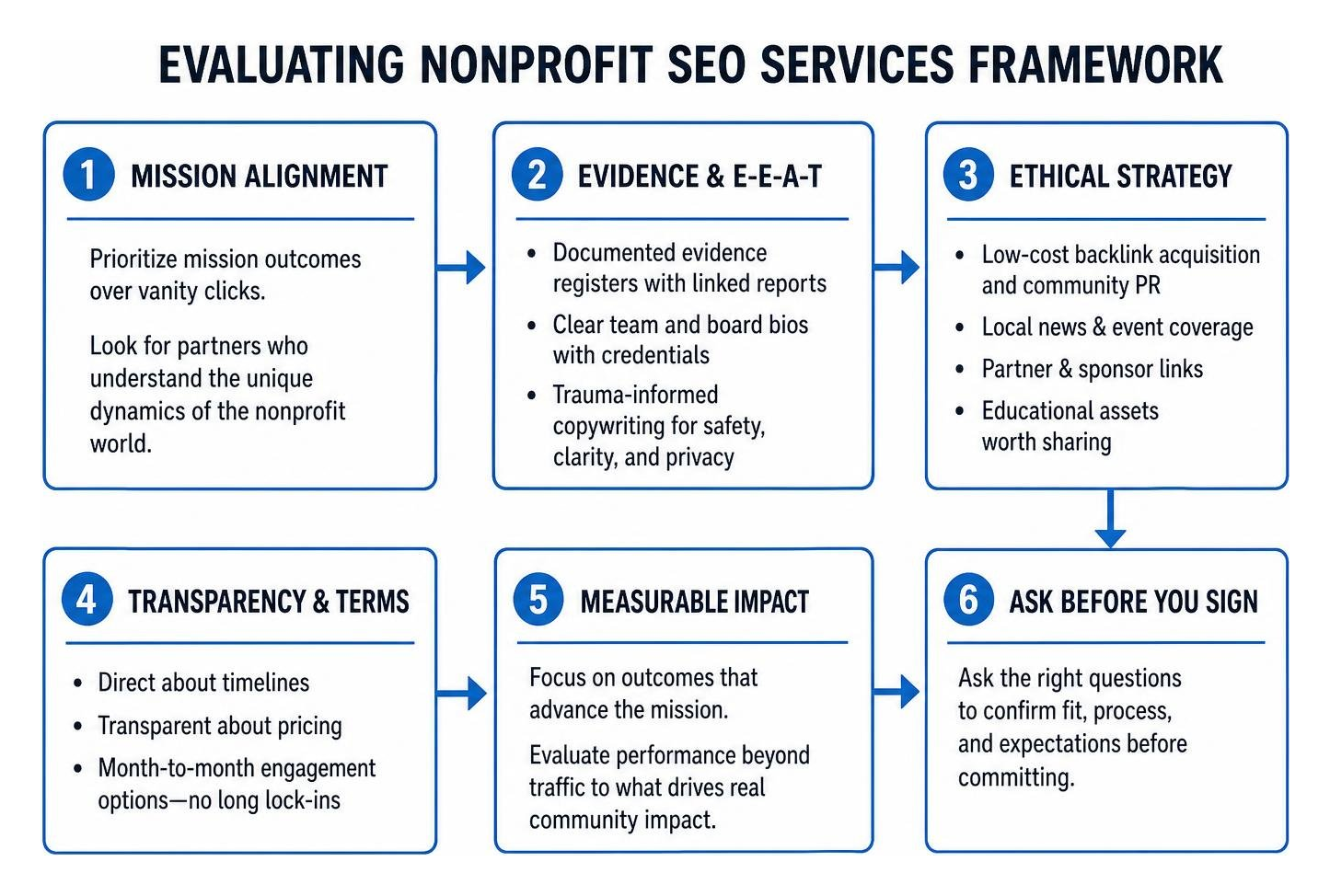
What to Expect When Hiring Nonprofit SEO Services
When evaluating potential partners, look for people who prioritize mission outcomes over vanity clicks. A great agency will be direct with you about timelines, transparent about pricing, and happy to work month-to-month rather than locking your board into an ironclad twelve-month agreement.
Ask any prospective consultant these questions before signing on the dotted line:
- How do you differentiate keyword strategy for donors, volunteers, and beneficiaries?
- Will you help us set up custom conversion tracking for completed gifts and intake forms in GA4, or do you only report on raw clicks?
- Do I work directly with an experienced strategist, or will my account be handed off to an entry-level intern?
- How do you optimize our content for AI answer engines like ChatGPT and Perplexity?
If you are currently evaluating your options, reviewing our checklist on how to pick an SEO agency for small business will help you spot red flags and protect your hard-earned funds.
Essential Mission-Driven KPIs Beyond Vanity Traffic
Raw page views do not keep your shelter lights on or stock your community pantry shelves. Your monthly search reporting needs to focus entirely on actionable, mission-driven Key Performance Indicators (KPIs):
- Completed Online Donations: Tracking total gifts, recurring donor sign-ups, and average donation size driven by organic search.
- Qualified Volunteer Applications: Measuring submitted forms from volunteers who meet your specific role requirements.
- Beneficiary Service Intake: Counting qualified program applications, phone clicks for intake coordinators, and appointment requests.
- Resource Downloads: Tracking how often community members download your eligibility guidelines, pet adoption applications, or educational guides.
To see how these action-oriented metrics connect to your broader fundraising and program expansion goals, explore our breakdown of marketing lead generation.
Frequently Asked Questions About SEO for Nonprofits
How long does it take for a nonprofit to see measurable results from SEO?
You will usually see early technical wins and movement on hyper-local keywords within 60 to 90 days. Broader cause-related authority and competitive donor queries compound steadily over 6 to 12 months. Because fundraising spikes around seasonal giving cycles in November and December, starting your optimization efforts in the spring or summer gives your site the authority it needs to capture high-intent holiday donations.
How can we balance donor appeals with sensitive beneficiary services on one website?
Keep their user journeys completely separated in your site structure. Build clean, dedicated landing pages for your programs with empathetic, plain-language intake instructions and clear privacy notices. Reserve your fundraising pitches, financial audits, and donation appeals for your supporter pages. Use your main navigation to let visitors easily self-select who they are the moment they arrive.
Can a nonprofit with a small budget compete against national organizations?
Yes, absolutely. Search engines prioritize local relevance and authentic community trust. A massive national organization cannot beat your hyper-local community knowledge, your genuine local press coverage, or your physical proximity to the people seeking help in your area. By targeting localized, long-tail search terms, a focused local organization can easily outrank multi-million-dollar national institutions on home turf.
Scaling Your Cause with Sustainable Search Growth
Paid social ads stop working the minute your budget runs out, and grant algorithms can shift overnight without warning. Investing in your website's organic visibility builds a permanent, compounding asset that continues to attract donors, recruit passionate volunteers, and serve your community 24/7.
At So Fetch Consulting, we do not believe in smoke and mirrors. We build straightforward, search-optimized websites and data-backed digital strategies that turn your digital footprint into measurable real-world outcomes. Whether you run a community outreach program, a humane society, or a private education initiative, we give you the tools and visibility you need to leave a lasting mark. Ready to make your digital presence work as hard as you do? Explore our complete collection of specialized nonprofit SEO tips and strategies to kickstart your mission's growth today.
