
What Are the Advantages of Social Media for Politics in Modern Campaigns
The Digital Transformation of Political Campaigns

So, what are the advantages of social media for politics? In short: campaigns can reach voters directly, raise money from everyday supporters, bypass traditional media gatekeepers, and level the playing field against well-funded incumbents. Social platforms turn one-way political speeches into two-way conversations, letting candidates listen, respond, and mobilize in real time without needing a massive war chest.
Political campaigning used to be an expensive, top-down affair. You bought 30-second TV slots, printed yard signs by the truckload, kissed babies at the county fair, and hoped the local evening news anchor pronounced your name right. If you lacked a massive war chest or party insider connections, your campaign was basically dead on arrival.
Today, digital channels have flipped that dynamic on its head. Globally, 64 percent of the total population (around 5.24 billion people) and 94 percent of all internet users are active on social platforms. In the United States, 73 percent of adults log into social feeds daily. Political discourse no longer waits for Sunday morning talk shows. It unfolds continuously across feeds, timelines, and community groups.
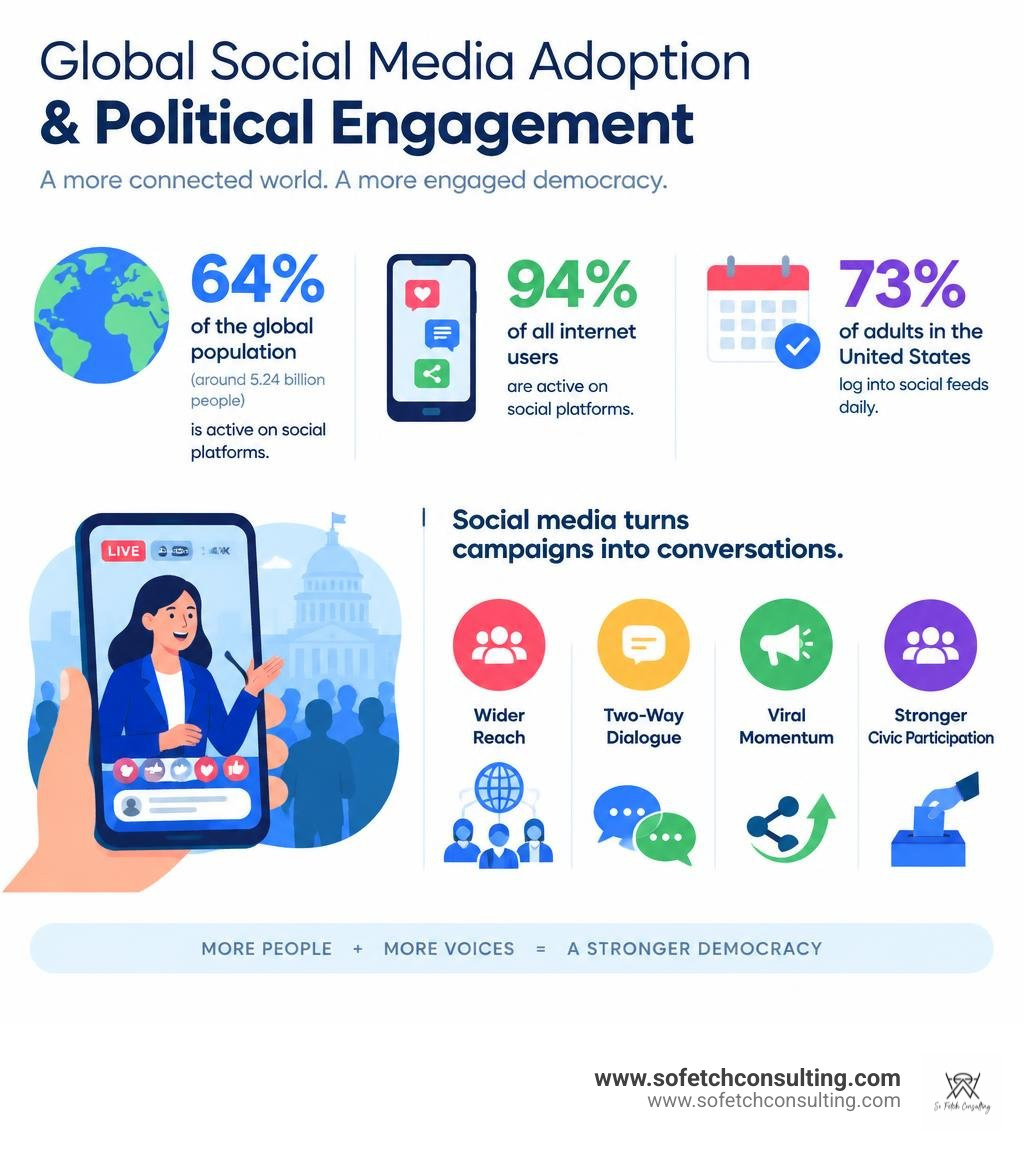
This massive connectivity turns campaigns into living, breathing public networks. Instead of one-way broadcast speeches, candidates participate in dynamic, multi-directional conversations. Voters do not simply consume campaign literature; they dissect it, share it with neighbors, make memes out of it, and challenge candidates directly in comment sections.
Key Breakdown: What Are the Advantages of Social Media for Politics?
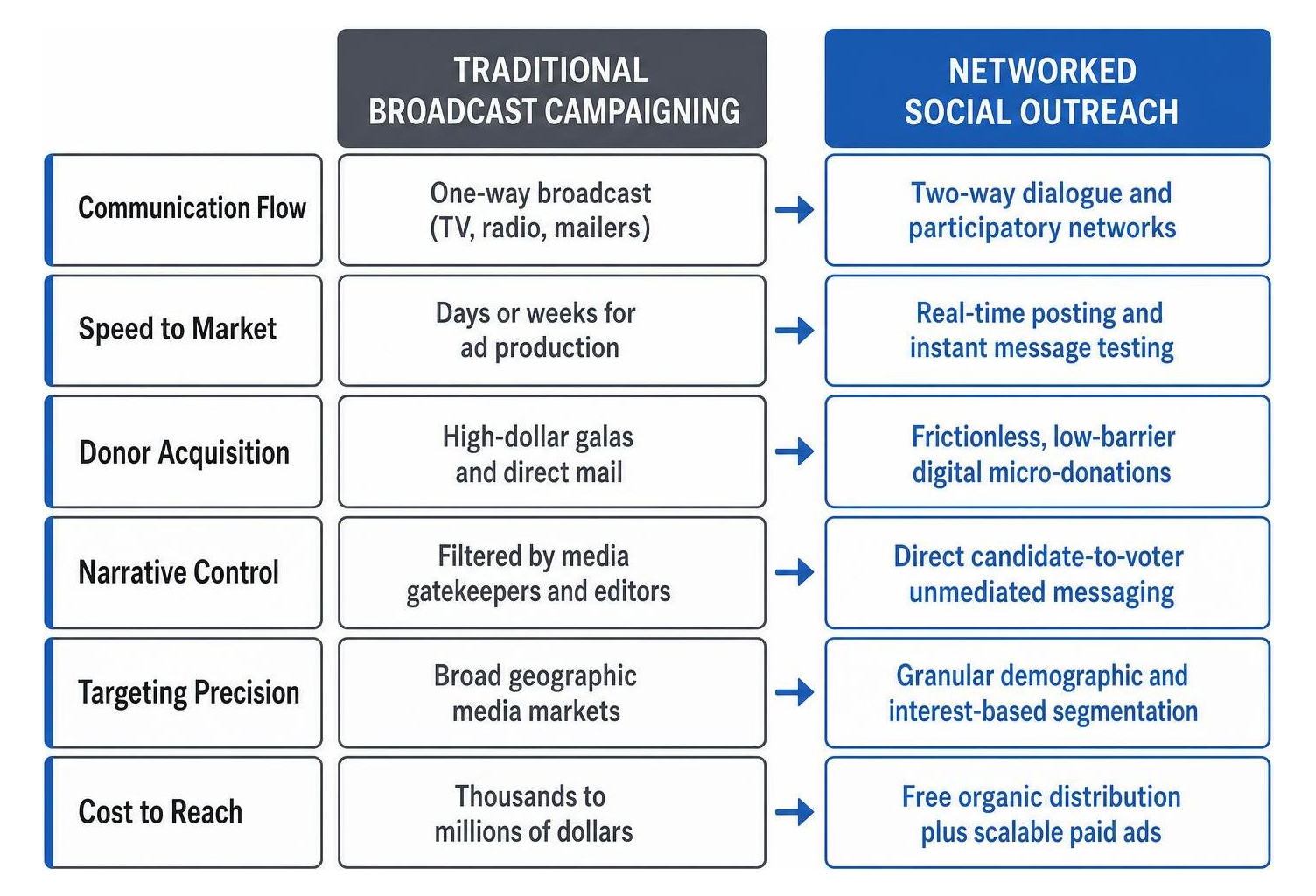
When campaign managers ask what are the advantages of social media for politics, the answer goes far beyond posting daily updates. Digital networks provide structural advantages that fundamentally reshape how campaigns organize, fundraise, and win.
| Strategy Dimension | Traditional Broadcast Campaigning | Networked Social Media Outreach |
|---|---|---|
| Communication Flow | One-way broadcast (TV, radio, mailers) | Two-way dialogue and participatory networks |
| Speed to Market | Days or weeks for ad production | Real-time posting and instant message testing |
| Donor Acquisition | High-dollar galas and direct mail | Frictionless, low-barrier digital micro-donations |
| Narrative Control | Filtered by media gatekeepers and editors | Direct candidate-to-voter unmediated messaging |
| Targeting Precision | Broad geographic media markets | Granular demographic and interest-based segmentation |
| Cost to Reach | Thousands to millions of dollars | Free organic distribution plus scalable paid ads |
What Are the Advantages of Social Media for Politics in Grassroots Fundraising?
Money makes campaigns run, but chasing big-dollar donors often isolates candidates from everyday voters. Social platforms provide an infrastructure where ordinary citizens pool financial support at scale.
The low barrier to entry means candidates can turn a viral moment or a passionate policy stance into immediate operational capital. In an analysis on digital campaign fundraising dynamics, academic research revealed that newcomers who opened a Twitter account raised between 1% and 3% of a full two-year campaign total within their first 30 days online. The boost came primarily from direct hyperlinks that funneled casual followers straight into payment processors for $5, $25, or $50 contributions.
Small-dollar digital fundraising creates financial parity. Instead of spending 80% of their working hours trapped in call rooms dialing wealthy donors, candidates can articulate clear visions online, rally thousands of small contributors, and fund field operations organically.
What Are the Advantages of Social Media for Politics Regarding Direct Voter Engagement?
Broadcasting polished soundbites is out; authentic, two-way dialogue is in. Modern voters want accessible leaders who listen rather than lecture.
Through short-form video, direct replies, and informal livestreams, candidates can field constituent questions in real time. According to a modern framework for politician-citizen digital interaction, while managing high comment volumes requires discipline, online engagement serves as an essential channel for discovering real-world public concerns. Reading community comments acts as continuous, unfiltered focus groups, providing candidates with organic qualitative feedback on local infrastructure, school policies, and neighborhood safety.
Bypassing Traditional Media Gatekeepers and Narrative Control
For decades, traditional news editors acted as political gatekeepers. They decided which candidates appeared on the evening news, how statements were framed, and whose scandals received airtime. If the press ignored your policy launch, your issue effectively did not exist to the broader electorate.
Social media allows campaigns to own their press room. Candidates publish detailed position papers, record behind-the-scenes walkthroughs of community visits, and respond instantly to breaking news without waiting for a press release to be picked up. For campaign managers looking to build an unmediated message apparatus, our social media politics guide 2026 covers how to organize content calendars, manage crisis communications, and maintain message discipline across channels.
Leveling the Field Against the Incumbency Advantage
In traditional American politics, incumbents enjoy a re-election rate of up to 90%. Established officeholders possess built-in name recognition, institutional donor networks, and reliable press coverage that challengers struggle to match.
Social media disrupts this historical dynamic. Because digital distribution rewards engaging storytelling over sheer budget size, underfunded challengers can generate millions of organic impressions without buying expensive television blocks. When an outsider produces sharp, relatable content that explains a local issue clearly, digital network effects amplify the message across town lines in minutes, eroding the default name-recognition advantage of incumbents.
Case Studies in Digital Campaign Strategy and Viral Network Effects

Effective social campaigning is not about chasing vanity metrics; it is about mobilizing people into action. When candidates understand how to tell human stories, digital momentum converts directly into volunteer sign-ups, grassroots dollars, and ballot box turnout.
Viral Storytelling and Grassroots Surges
Consider the rapid ascent of outsider campaigns in dense urban districts. In a Harvard Political Review analysis of outsider campaign strategy, researchers highlighted how local organizer Zohran Mamdani moved from polling at just 1% in February to winning the Democratic nomination by June.
Instead of relying on standard broadcast flyers, the campaign leaned into hyper-localized, visually engaging video content. By pairing clear policy breakdowns with humor and authentic community footage, he amassed ten times the Instagram following of his primary opponent. The content resonated because it rejected sterile corporate talking points in favor of genuine cultural fluency.
Targeted Demographics and Mobilizing Gen Z Turnout
Younger demographics represent massive voting blocs, yet they rarely consume linear television or answer unsolicited landline phone calls. Reaching these voters requires meeting them in their native digital spaces with content that respects their intelligence.
During Stacey Abrams' 2022 gubernatorial run in Georgia, targeted Instagram campaigns were deployed specifically to engage Gen Z and Black voters, two cohorts historically underserved by traditional political advertising. By focusing on direct policy impacts, practical voting mechanics, and student-led issues, the campaign drove substantial engagement among first-time voters.
This matches academic findings: an empirical study on candidates' networked digital campaign effects showed that candidates who earn genuine community engagement (retweets, shares, and comments) achieve measurable boosts in their eventual vote share, validating a networked model of voter persuasion over passive broadcasting.
Balancing Strategic Reach With Digital Risks and Platform Asymmetry
While the advantages of social media in politics are undeniable, operating in public feeds is not without hazards. Digital spaces are governed by proprietary algorithms, partisan dynamics, and high emotional volatility that demand careful strategy.

Algorithmic Amplification and Partisan Dynamics
Social algorithms are tuned for engagement, which frequently favors emotional, high-conflict, or ideologically charged posts. Research published in Frontiers on social media and political participation demonstrates that digital platforms function as potent public spheres that dramatically increase civic participation, yet user behavior remains deeply influenced by algorithmic curation (González-Bailón et al., 2022).
To avoid getting trapped in unproductive online echo chambers, campaigns need platform-specific strategies. Choosing the best social media for politics means matching your specific campaign goals with platform strengths: using visual networks for humanizing behind-the-scenes content, discussion forums for policy debates, and neighborhood apps for hyper-local constituent updates.
Managing Public Scrutiny and Over-Saturation
There is a fine line between being an accessible representative and being embarrassingly overexposed. A BBC analysis on the perils of politicians being too online cautions against the temptation to chase every trending audio track or jump into trivial internet squabbles.
When political figures try too hard to seem hip, they risk alienating voters who prioritize competence over internet celebrity. Authentic digital strategy focuses on substance, transparency, and regular constituent service, protecting the candidate from digital burnout and unforced public relations errors.
Frequently Asked Questions About Social Media in Politics
Can social media overcome traditional campaign spending deficits?
Yes, but it cannot do it on autopilot. Social media provides organic reach and low-cost ad targeting that significantly offsets large donor imbalances. However, digital attention must be systematically converted into offline assets: email subscribers, volunteer door-knockers, and small-dollar contributions. A viral post that does not gather contact information or mobilize field volunteers is just temporary noise.
How does real-time analytics improve campaign decision-making?
Native platform analytics give campaigns immediate feedback on what messaging resonates. Instead of waiting weeks for expensive private polling, campaign teams can monitor comment sentiment, video completion rates, and share counts across different message variations. If a short video addressing local property taxes generates three times the engagement of a general economic post, the field team knows to emphasize tax reform in upcoming mailers and town hall remarks.
Which platforms are most effective for political mobilization?
Platform effectiveness depends entirely on your demographic target. Meta platforms (Facebook and Instagram) remain unmatched for local community organizing, parent groups, and visual donor appeals. Short-form video networks are essential for reaching voters under 30 who rely on social feeds as their primary news discovery engine. Meanwhile, microblogging and text-based platforms remain useful for rapid-response press statements, local journalists, and policy influencers.
Elevating Your Campaign with Purpose-Driven Digital Strategy
Modern political campaigns cannot afford to treat social media as an afterthought or a bulletin board for stiff press releases. Winning elections in 2026 requires a structured, human-centered digital ecosystem that connects with constituents where they actually spend their time.
At So Fetch Consulting, we help purpose-driven leaders, non-profits, and local organizations turn digital communication into measurable real-world outcomes. Whether you need a high-converting digital presence, data-driven content systems, or hands-on strategic advisory, explore our proven digital marketing and content strategy services to build a campaign that cuts through the noise and connects with your community.
