
A Campaign Guide on How to Use Social Media for Politics
Strategic Blueprint: How to Use Social Media for Politics

Understanding how to use social media for politics begins with recognizing a fundamental shift in electoral dynamics: social platforms have decentralized political influence. Historically, candidates required massive financial backing and establishment support to bypass media gatekeepers. Today, digital channels allow grassroots campaigns to communicate directly with voters, reshaping how political influence is built, measured, and sustained across local and national elections.
A modern strategy relies on integrated frameworks such as the SCATTER model (Self/owned accounts, Clippables, Ads, Trends, Trusted local messengers, Endorsers, and Rapid response). Implementing a political social media strategy fit for 2026 means moving past isolated posts and operating a connected digital ecosystem designed to maximize community engagement.
Why Political Newcomers Need a Social Media Strategy
For political newcomers, social platforms provide a vital way to challenge established incumbency advantages. In traditional campaign models, incumbents benefit from high brand recognition, established donor lists, and up to a 90% reelection rate in legislative races. Establishing an active digital footprint early enables first-time candidates to share authentic personal stories and highlight local community concerns.
Academic research demonstrates that within their first month on channels like X (formerly Twitter), political newcomers can raise between 1% and 3% of the total capital typically gathered across an entire two-year traditional campaign cycle. Crucially, this early digital capital boost flows almost exclusively to non-incumbents. When posts contain direct hyperlinks to policy breakdowns and donation pages, candidates can convert curiosity into financial support, helping level the playing field early in the race. Furthermore, real-time engagement data allows challenger campaigns to adjust their core messaging quickly based on constituent feedback.
Direct Voter Engagement and Campaign Cost Efficiency
Digital channels offer unprecedented efficiency compared to traditional broadcast media. Broadcast television buys are expensive, blanket unvetted audiences, and reach only 23% of voters under age 40. In contrast, micro-targeted digital ads deliver messages to verified voting households at a fraction of the cost.
| Advertising Medium | Estimated Cost per 1,000 Voters (CPM) | Audience Precision | Under-40 Audience Reach |
|---|---|---|---|
| Broadcast Television | $45 - $80 | Broad Regional Market | Low (~23%) |
| Direct Print Mail | $30 - $60 | Zip Code / Precinct | Low to Moderate |
| Targeted Social Ads | $8 - $15 | Custom Voter File / Precinct | High (>75%) |
Digital outreach facilitates direct, bi-directional interaction. Live Q&A sessions on Instagram or Facebook allow candidates to address community concerns without third-party editing. By responding directly to comments and hosting digital town halls, campaigns build trust with voters who seek clear, unscripted communication.
Algorithmic Power, Echo Chambers, and Political Polarization

While digital platforms offer direct voter reach, they operate within an attention economy driven by engagement-maximizing algorithms. Understanding how to use social media for politics requires navigating these algorithmic incentives responsibly. Platforms prioritize content that drives watch time, shares, and comments, which can inadvertently amplify emotional, polarizing, or sensational posts over nuanced policy discussions.
Algorithmic Bias and Shaping Public Discourse
Platform algorithms curate user feeds based on historical behavior, creating confirmation bias loops often referred to as echo chambers. Research shows that 18% of U.S. adults receive their primary political news through social platforms. Within these digital spaces, content that criticizes or parodies political opponents frequently garners significantly higher engagement than posts explaining core platform goals.
This dynamic drives affective polarization, where voters view opposing political parties with heightened animosity. When campaign communication relies solely on outrage-driven hooks, it risks deepening societal divisions and eroding public trust in democratic institutions. Campaigns must balance attention-grabbing strategies with constructive, solution-oriented messaging.
How to Use Social Media for Politics Without Spreading Misinformation
Maintaining credibility requires proactive safeguards against false narratives, automated botnet interference, and deceptive synthetic media. Implementing actionable tips to make a successful social media political campaign in 2026 involves setting up an organized rapid-response protocol.
When addressing false claims, campaigns should publish clear, direct factual statements backed by primary sources rather than repeating the false narrative. Establishing a clear digital record protects the campaign's reputation and preserves voter trust.
Building a Candidate Brand and Driving Voter Turnout

Successful political social media operations translate online attention into offline civic action. Modern voters evaluate candidates based on authenticity, approachable leadership, and shared values. Applying recommendations from a practical guide to social media for political campaigns helps candidates build genuine personal connections with their constituents.
How to Use Social Media for Politics to Mobilize Young Voters
Reaching voters under 35 requires prioritizing short-form vertical video (15–45 seconds) on platforms like TikTok, Instagram Reels, and YouTube Shorts. Traditional political speeches rarely perform well in these spaces; short-form formats require clear, single-topic messages that open with an engaging hook within the first three seconds.
Campaigns can also partner with trusted local non-political messengers, such as neighborhood business owners, educators, or community leaders. These local voices often hold higher trust ratings within specific demographics than national figures, making them effective advocates for translating policy goals into clear community benefits.
Integrating Digital Air Cover with Ground Field Canvassing
Digital communications should operate in tandem with ground field operations. Running hyper-local, geo-targeted digital ads ("digital air cover") across specific precincts on the days volunteers knock on doors creates brand recognition that improves voter response rates.
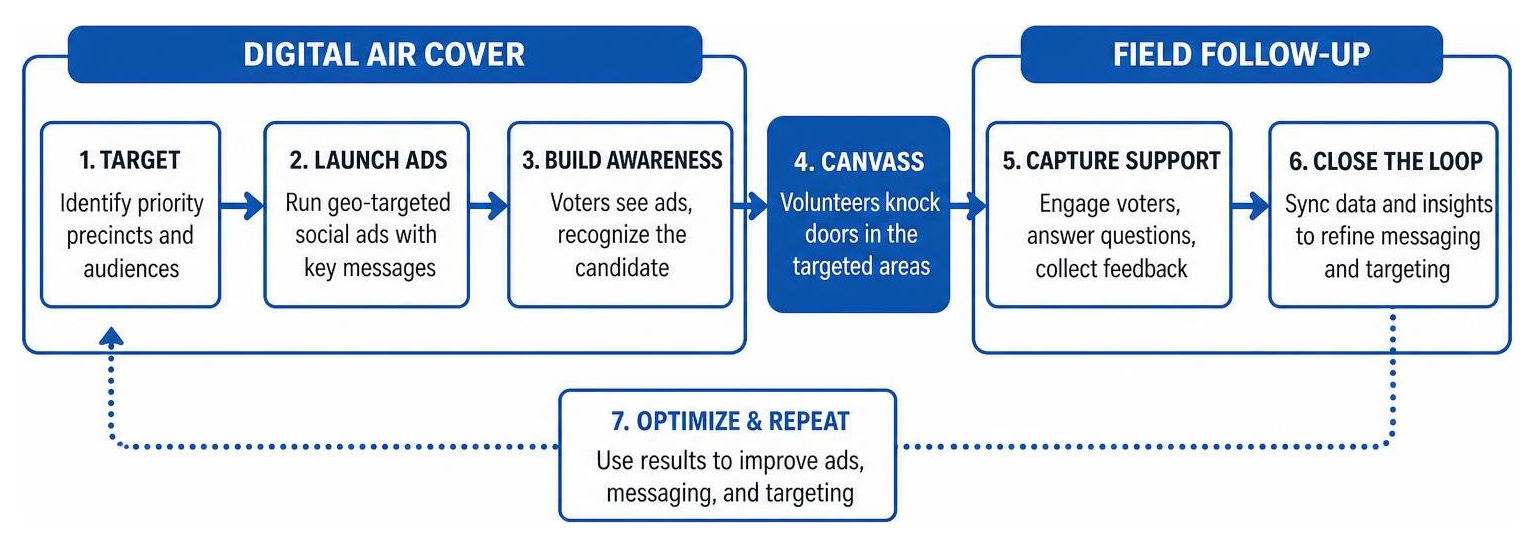
Field data shows that pairing digital ads with door-to-door canvassing can increase doorstep answer rates by 15% to 20%. Following advice from a comprehensive political digital marketing guide for winning campaigns, campaigns can connect digital messaging with offline field organizing to build an effective voter contact program.
Ethical Standards, AI Integrity, and Public Trust in Democracy
As artificial intelligence and automated tools become standard in campaign management, ethical standards are essential for maintaining public trust. Digital campaigns operate in an environment where 64% of U.S. adults feel social media has a net negative impact on democracy, making transparency a vital strategic asset.
Managing AI Disclosures and Campaign Disclaimers
The rise of generative AI allows campaigns to scale graphics, transcribe content, and personalize messaging rapidly. However, using synthetic audio or unverified deepfakes carries significant legal and ethical risks.
Regulatory bodies globally—such as Brazil's TSE Resolution 23.732/2024 and evolving legal frameworks in the U.S. and Europe—require explicit disclosures on political content that incorporates generative AI assets. Following the best practices outlined in the digital political marketing guide by Agência Kaizen helps ensure campaigns remain fully compliant with platform policies and local election laws.
Restoring Public Efficacy and Faith in Democratic Norms
Social media usage presents a clear civic paradox: while 44% of heavy social media users feel empowered to drive community change (compared to 30% of non-users), overall support for democratic systems drops from 72% among non-users to 57% among heavy social media consumers.
Campaigns have a responsibility to foster constructive debate rather than cynicism. By focusing on policy trade-offs, encouraging civil discourse, and highlighting clear avenues for civic participation, campaigns can use their digital presence to rebuild trust in democratic processes.
Frequently Asked Questions about Political Social Media Campaigns
Does social media use increase voter turnout and civic efficacy?
Yes, direct peer-to-peer mobilization messages on social channels can significantly increase voter turnout. Research indicates that non-partisan mobilization messages delivered online through personal relationships exert up to four times the influence on verified voter turnout compared to generic informational broadcasts.
Additionally, heavy social media users report higher feelings of personal political efficacy, with 44% believing ordinary citizens can affect real change, compared to 30% of non-users.
How can political underdogs leverage social media against incumbents?
Political underdogs can use social channels to bypass traditional broadcast media costs and build direct relationships with voters. By sharing unscripted video content, leveraging hyper-local hashtags, and executing targeted small-dollar fundraising drives, newcomers can build early name recognition and raise significant startup capital without relying on traditional political gatekeepers.
What is the 60-30-10 content rule for political social media?
The 60-30-10 rule provides a balanced content framework for political accounts:
- 60% Educational and Value-Driven Content: Policy breakdowns, local history, and community information.
- 30% Engagement and Humanizing Content: Behind-the-scenes moments, personal stories, voter Q&As, and community spotlights.
- 10% Direct Calls to Action (CTAs): Direct requests for campaign donations, volunteer sign-ups, event attendance, or votes.
Putting Your Political Social Strategy Into Action
Mastering how to use social media for politics requires balancing platform strategy with a commitment to transparent communication. By combining structured frameworks like the SCATTER system with authentic short-form video, clear AI disclosures, and hyper-local field integration, modern campaigns can build strong voter relationships that translate digital engagement into real-world turnout.
At SoFetch Consulting, we specialize in helping local organizations, public agencies, non-profits, and growing campaigns build sustainable digital systems. From custom website development on SquareSpace to micro-targeted paid search, search engine optimization (SEO), and custom social media strategy through our proven program, The S3 System™, we deliver clear strategies designed for real-world impact. Explore our strategic consulting services today to take full control of your digital communications.
