
Building a Data-Driven Marketing Strategy for Private Schools

A successful marketing strategy for private schools combines emotional storytelling, data-driven funnel tracking, and systematic word-of-mouth to turn curious parents into enrolled families. It starts with understanding why parents choose a school, then aligns your budget, digital presence, and campus experience to guide them from first inquiry to signed contract. Let's be real for a minute: hoping for full classrooms because your campus has pretty brick buildings is not a strategy. It is wishful thinking. In 2026, roughly 60% of American parents actively consider a new school for at least one of their kids. At the same time, about 32% of private schools report enrollment dips, with nearly half of those attributing the loss to family financial pressure.
When parents choose an educational home, they do not read brochures with pure logic. Human brains operate on a dual-process model described in Daniel Kahneman's theory of thinking. Parents first react with System 1 (fast, emotional gut feelings), and only later activate System 2 (slow, analytical reasoning) to justify the tuition bill.
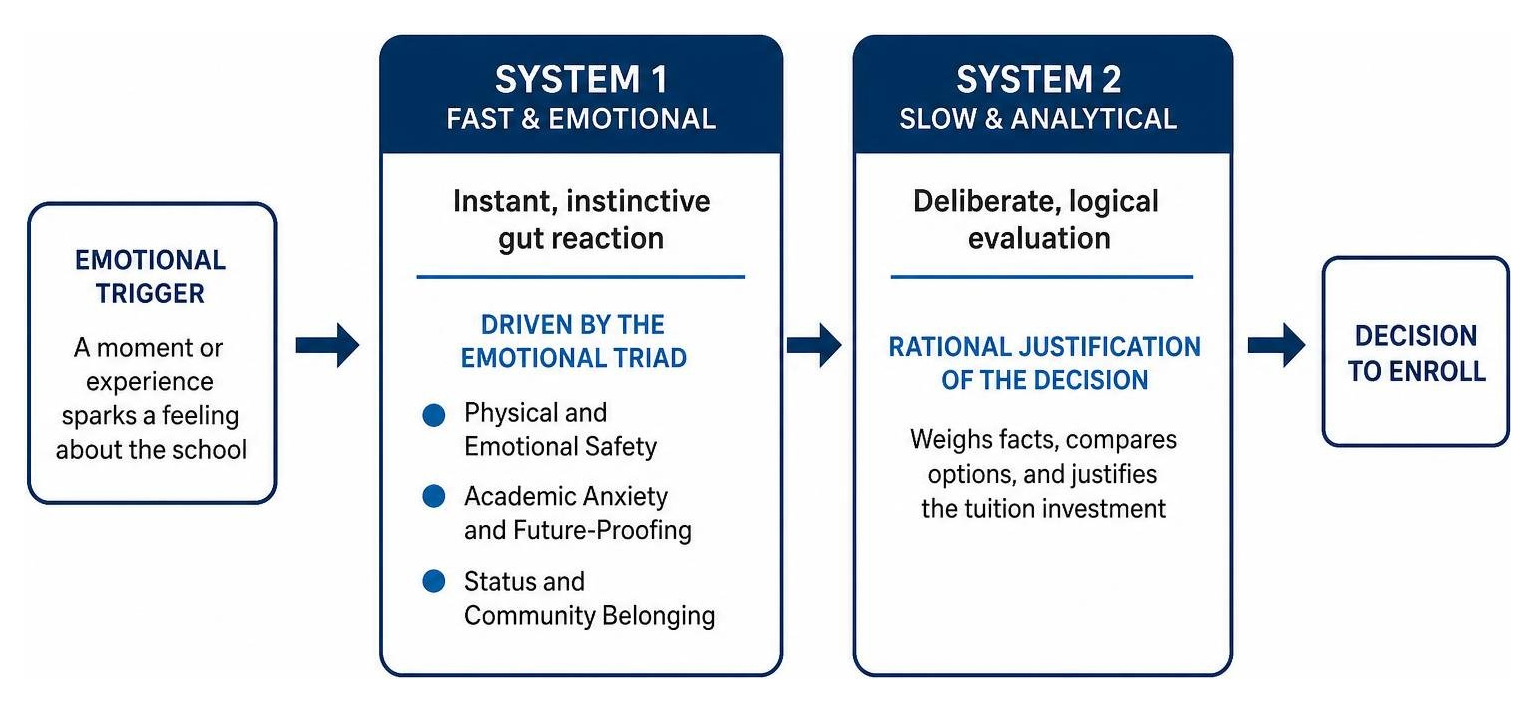
To build a message that actually hits home, you need to understand the Emotional Triad that drives modern school choice:
- Physical and Emotional Safety: Around 41% of K-12 parents actively worry about their child's physical and emotional safety at school. If parents do not feel their child will be safe and known, nothing else matters.
- Academic Anxiety and Future-Proofing: Parents want assurance that their investment creates capable, resilient problem-solvers who can thrive in college and beyond.
- Status and Community Belonging: Families want to know their children are surrounded by peers, mentors, and values that reflect their aspirations.
When you craft your value proposition, ditch generic statements like "academic excellence in a nurturing environment." Every single school website says that. Instead, anchor your message directly into those emotional drivers. For a complete blueprint on setting this up, check out this guide on building a private school marketing plan that actually drives enrollment, or review our Inbound Lead Generation Guide 2026.
Step 1: Mapping the Competitive Set and Family Motivations
Your competition is almost certainly broader than the other independent academy across town. Your real competitive set includes top-tier public magnet programs, rapidly expanding charter networks, micro-schools, and the popular fallback of "stay in the local public district and spend $8,000 a year on private tutoring."
You also have to recognize who is actively looking. Recent data highlights that 68% of Black parents and 63% of Hispanic parents are actively shopping for educational options, compared to 58% of white parents.
Segment your audience instead of spraying one message at everyone:
- The Aspirational Researcher: Driven by college outcomes, specialized STEM or arts tracks, and character development.
- The Relocating Family: Under serious time pressure, needing quick answers, seamless virtual walk-throughs, and clear community integration.
- The Frustrated System-Switcher: Seeking immediate safety, smaller class sizes, or specialized learning support because their current environment dropped the ball.
Step 2: Setting Funnel-Stage and Grade-Specific SMART Goals
Setting a goal like "increase enrollment by 10%" is vague. Real marketing plans use SMART goals tied to specific funnel stages and entry grades.
Look closely at your natural entry points (like Kindergarten, 6th grade, and 9th grade) as well as your transition drop-offs. If you need 40 new 6th graders, work backward using proven industry benchmarks:
- Inquiry-to-Application Rate: 25% to 35%
- Application-to-Acceptance Rate: Highly dependent on your selectivity, but needs constant monitoring
- Yield Rate (Accepted to Enrolled): 50% to 65%
- Annual Retention Target: 90% or higher
If your yield sits below 50%, pouring thousands of dollars into brand awareness ads won't solve the problem. Your leak is in the post-acceptance nurture phase. Fix the specific stage that is broken.
Aligning Budget Allocation and Multi-Channel Campaigns
Marketing works best as a synchronized push rather than random bursts of panic. Industry benchmarks show that 54% of independent schools invest over $70,000 annually in marketing, with 28% investing over $120,000. For established schools, marketing spend typically represents 3% to 6% of the operating budget, while newer or growing schools often invest 7% to 8%.
When enrollment dips, the natural knee-jerk reaction for a school board is to slash the marketing budget. That is a massive mistake. The private school recruitment cycle runs on a 12 to 18-month timeline. Cutting spend today guarantees an even worse enrollment deficit next year.
To get the most out of your resources, organize your efforts into a single, cohesive seasonal campaign framework.
High-Converting Channels: In-Person Tours and Local Search
Digital channels exist to drive families to physical interactions. A remarkable 89% of independent schools rate individual campus tours as their single most effective admissions touchpoint, followed by group open houses at 63%.
Before parents ever book that tour, they check local search results. Over 87% of consumers use Google to evaluate local options. Your Google Business Profile (GBP) is your digital curb appeal. Keep your profile updated with clear open house dates, high-resolution student life photos, quick links to schedule a tour, and fresh reviews from current parents.
Building a Digital Infrastructure into Your Marketing Strategy for Private Schools
Your website functions as an around-the-clock admissions counselor. If it loads slowly or hides tuition numbers behind five layers of navigation, families will leave.
Make your inquiry forms short and easy to complete on a phone. The moment a parent submits an inquiry form, an automated confirmation should hit their inbox, followed by immediate scheduling options.

If your website runs on modern website platforms, you can use specialized Squarespace Improve SEO techniques to ensure target keywords capture local families. When you need extra muscle behind search engine visibility, partnering with specialized SEO Services for Small Business helps you capture parents actively searching for private education in your area.
Systematizing Word-of-Mouth and On-Campus Touchpoints
Word of mouth remains the undisputed heavyweight of school recruitment. Roughly 92% of independent schools rely on word of mouth as their primary traditional marketing channel, and 92% of consumers trust referrals from people they know over traditional advertising.
The trouble is, most schools treat word of mouth as pure luck. You can systematize it.

Turning Current Families into Active School Ambassadors
Parents do not quote mission statements to their neighbors at weekend soccer games. They share specific stories and memorable experiences.
Build a structured Parent Ambassador program:
- Assign Buddies: Pair every prospective applicant family with a current parent who has a child with similar interests.
- Capture Authentic Stories: Use short, unpolished social video. Video generates 1,200% more shares than static text and images combined, and 81% of parents report social posts from friends influence their brand perception.
- Roll Out the Red Carpet: When a family tours your campus, personalize the visit. Put their child's name on a welcome chalkboard, introduce them to the robotics coach or theater director, and send a handwritten note from the student tour guide that afternoon.
Retention as an Enrollment Growth Engine
Retention is the most cost-effective enrollment strategy you have. It costs far less to keep an existing family than to market, tour, vet, and enroll a brand new one.
Do not fall into the satisfaction paradox, assuming quiet families are happy families. Run intentional re-recruitment campaigns before re-enrollment contracts go out. Focus heavily on transitional grades (such as moving from 5th to 6th or 8th to 9th grade), where parents often re-evaluate local school options.
Tracking Enrollment Funnel Metrics and Campaign ROI
A common complaint among school leadership is measuring marketing impact. In fact, 36% of school marketing staff cite measuring effectiveness as their biggest operational hurdle, and only 19% regularly present clear campaign ROI figures to their Head of School.
Stop reporting on vanity metrics like impressions and social post likes. Track conversion milestones through your enrollment pipeline using our guide on Marketing Lead Generation.
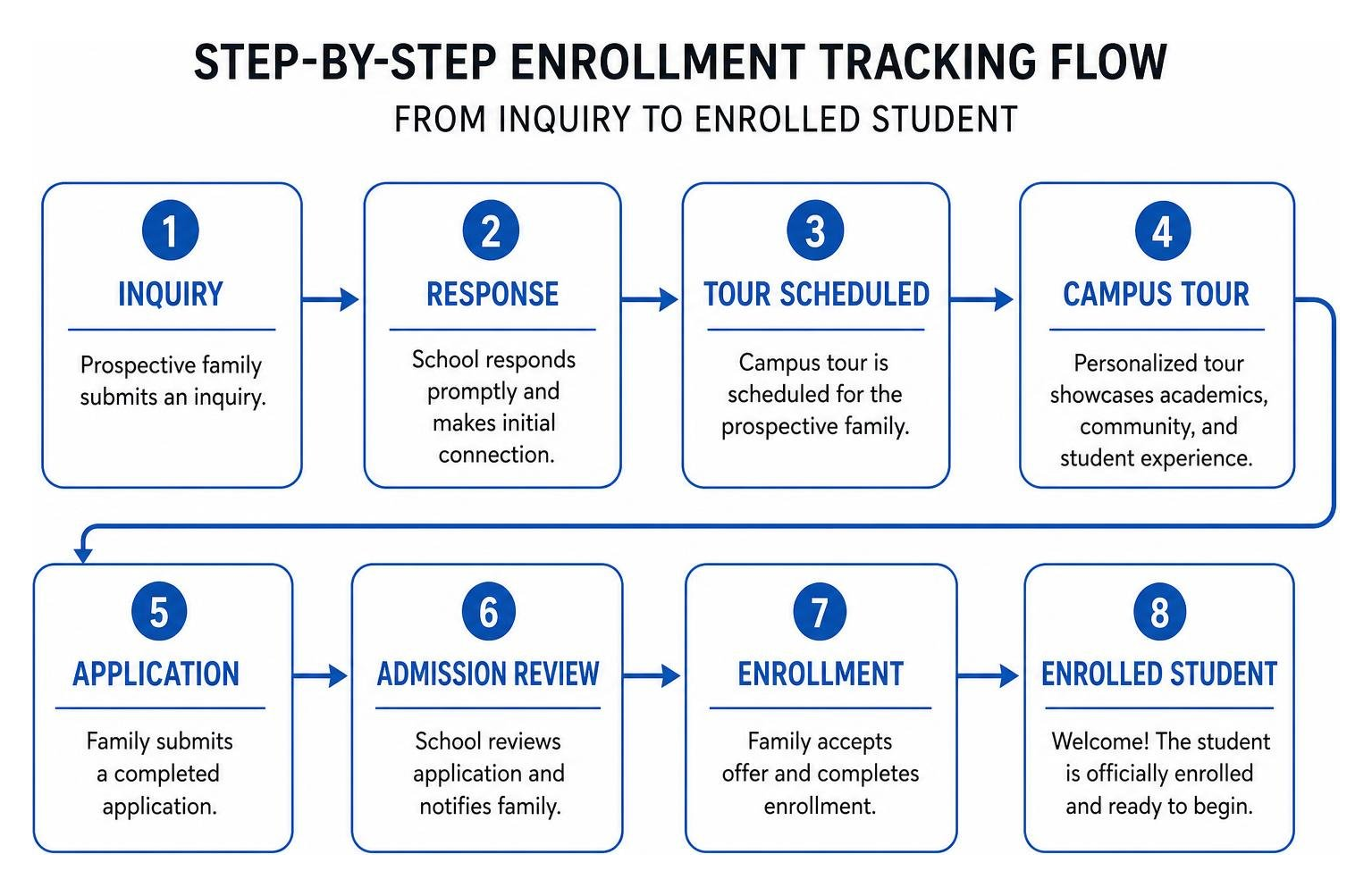
Measuring ROI to Refine Your Marketing Strategy for Private Schools
To evaluate your return on investment, measure your pipeline against established industry benchmarks.
| Funnel Metric | Private School Benchmark | Why It Matters |
|---|---|---|
| Median Cost Per Inquiry (CPI) | $697 | Measures top-of-funnel lead generation efficiency |
| Inquiry-to-Application Rate | 25% – 35% | Shows how well your nurturing moves families to apply |
| Yield Rate (Accepted-to-Enrolled) | 50% – 65% | Validates your value proposition and acceptance experience |
| Median Cost Per Enrollment (CPE) | $3,677 | Measures total marketing investment per enrolled seat |
| Target Revenue Multiplier | $7 to $1 | $7 in first-year tuition generated per $1 spent |
| Annual Student Retention | 90%+ | Protects your operating budget from costly student churn |
When presenting to your board, frame marketing spend as an investment engine. If spending $3,677 on marketing brings in a student paying $20,000 in annual tuition, that yields more than a 5x return in year one alone. When that student stays for four years, the lifetime value of that enrollment easily tops $80,000.
Frequently Asked Questions About Private School Marketing
How fast should private schools respond to new inquiries?
You should respond within 24 hours, but ideally within minutes during business hours. Research shows that 52% of prospective students enroll at the very first institution that responds to their inquiry. Speed signals attentiveness and operational excellence. If your staff is busy running campus tours, set up automated email and SMS workflows to instantly acknowledge submissions and offer direct tour booking links.
What is a healthy inquiry-to-enrollment conversion rate for private schools?
A healthy inquiry-to-enrollment conversion rate typically falls between 25% and 40%. If your conversion rate drops below 20%, you likely have an operational bottleneck: slow follow-up speeds, an impersonal tour experience, or confusing tuition and financial aid information on your website.
How can private schools market effectively on a lean budget?
Focus on high-impact, low-cost channels:
- Fully optimize your Google Business Profile to capture local organic search.
- Build an active parent ambassador referral network.
- Publish short, student-centered video stories on social media.
- Implement practical search strategies using our Nonprofit SEO Tips.
Elevate Your School’s Enrollment with Strategic Growth
Filling your classrooms requires a balanced strategy: understanding the emotional drivers of school choice, maintaining an optimized website, coordinating campaigns, and systematizing word-of-mouth recommendations.
At So Fetch Consulting, we help independent schools, small businesses, and mission-driven organizations build predictable marketing engines. Whether you want to refresh your web presence, launch high-converting search campaigns, or align your admissions funnel, explore our full suite of Marketing Services.
Ready to stop guessing and start growing your student body? Partner with us as your strategic growth partner and let's build an enrollment pipeline that fills every seat.
