
Analyzing the Effect of Social Media on Politics and Democratic Discourse
The effect of social media on politics is a double-edged sword: it hands everyday people a megaphone while simultaneously rewarding outrage, misinformation, and tribal loyalty over nuanced debate. Direct communication lets grass-roots campaigns bypass legacy media gatekeepers, organize volunteers, and raise funds without deep-pocketed corporate donors. At the exact same time, the underlying business model of major platforms relies on engagement maximization. When platforms optimize for clicks, retweets, and comments, emotional intensity beats nuanced policy analysis every single day of the week.
Recent scholarly work highlighted in a Frontiers review on platform-driven dynamics in political communication shows that platform architectures act as active participants in political discourse rather than neutral conduits. By favoring viral spikes, digital networks encourage affective polarization, where voters do not just disagree with policy opponents, but actively distrust and dislike them. To better understand the upside of this digital shift, you can explore what are the advantages of social media for politics when tools are used intentionally.
Algorithmic Amplification and the Structural Effect of Social Media on Politics
Social feeds are not chronological archives. They are finely tuned recommendation engines designed to keep your eyes glued to the screen. Because moral outrage drives intense user interaction, recommendation engines inadvertently promote hyper-partisan claims, sensational headlines, and conflict-driven posts.
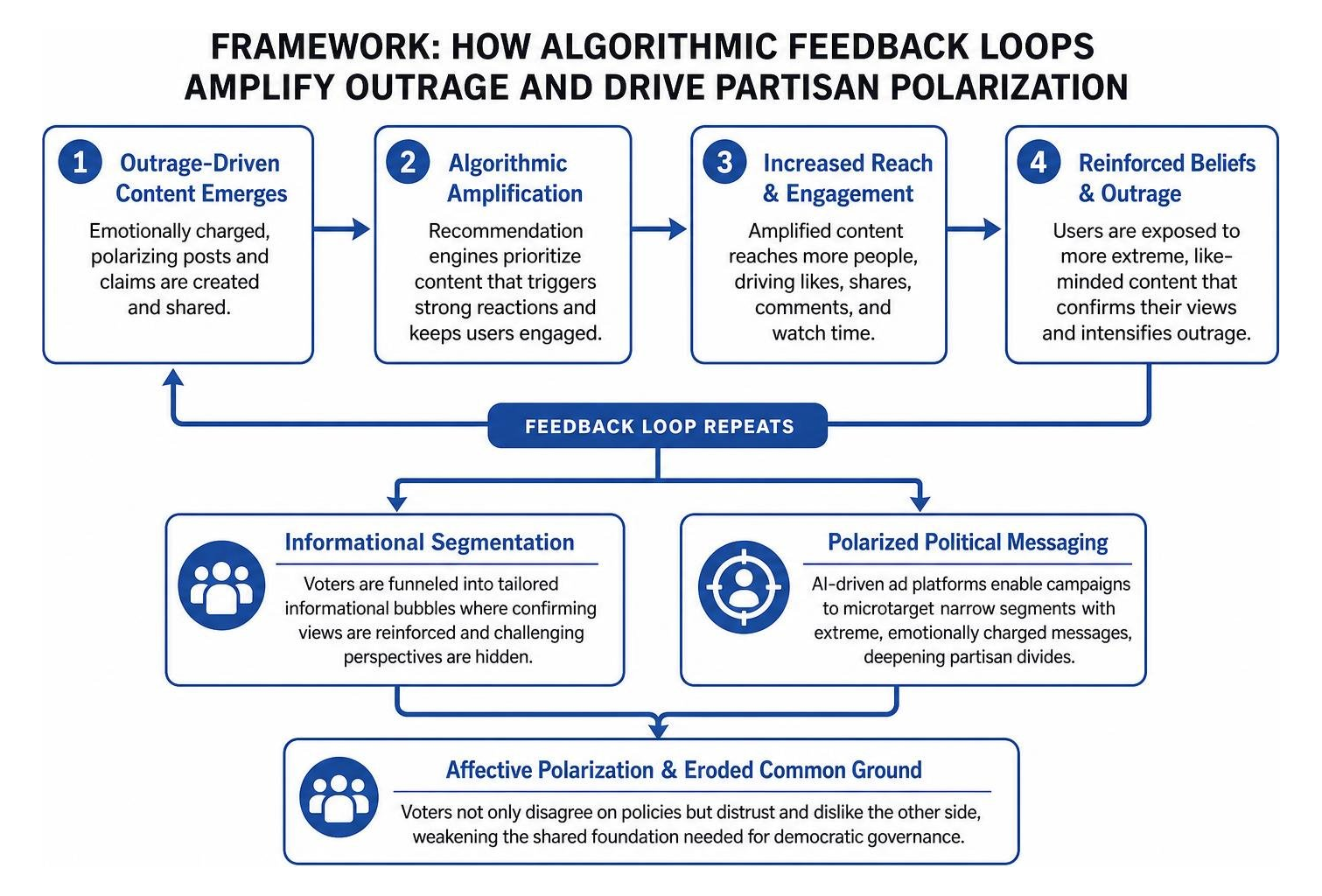
This algorithmic design creates two distinct structural channels of political polarization. First, it segments voters into tailored informational bubbles where confirming views are reinforced and challenging perspectives are hidden. Second, it fundamentally reshapes political advertising.
According to NBER research on AI, advertising, and political polarization, AI-driven ad platforms incentivize political parties and campaigns to adopt more extreme, targeted stances. Instead of pitching a broad coalition with moderate, compromise-driven language on television, candidates can microtarget narrow voter segments with custom, emotionally charged messaging. When campaigns can whisper separate, extreme promises to separate groups, the common ground required for democratic governance quickly erodes.
The Rise of Influencer Politics and Affective Polarization
The collapse of broadcast gatekeeping gave rise to a new political power player: the partisan creator. Political commentary is no longer restricted to Sunday morning panel shows. Instead, it plays out across livestreams, short-form video clips, and serialized podcasts where influencers feel like close friends to their followers.
Unlike traditional journalists who at least attempt institutional balance, digital creators build direct financial models around partisan loyalty. Their income depends on subscriptions, tipping, and views, which means watering down opinions or admitting the other side has a fair point can lead to immediate audience drop-off.
As detailed in a longitudinal study on the evolution of social media in presidential elections, campaigning evolved from simple broadcast messaging in 2008 to an AI-influenced, short-video ecosystem by 2024. Influencers now drive political narratives faster than formal party committees, shifting debates toward high-arousal cultural controversies. This direct dynamic makes civic life feel urgent and personal, but it also locks audiences into constant ideological battles.
The Civic Paradox: Voter Empowerment Versus Institutional Skepticism
Social media creates a fascinating political paradox. On one hand, regular people feel more capable than ever of influencing policy, coordinating protests, and speaking out. On the other hand, widespread exposure to online political infighting erodes faith in fundamental democratic processes.
The data reveals a stark contrast in how digital exposure shapes civic attitudes. When examining usage habits across modern representative samples, heavy users express powerful personal agency alongside deep skepticism of democratic norms.
| Civic Attitude Metric | Heavy Users (5+ Hours/Day) | Light / Non-Users (≤1 Hour/Day) | Practical Implication |
|---|---|---|---|
| Agreement that democracy is the best form of government | 57% | 70%+ | Heavy digital immersion correlates with declining confidence in institutional democracy. |
| Belief that citizens have moderate or great power to create change | 44% | 30% | Social channels foster strong feelings of personal civic efficacy and direct influence. |
| Perception that government is responsive to their interests | Significantly Higher | Baseline | Direct interaction creates an expectation of immediate, unmediated political representation. |
| Acceptance of political violence as a viable tactic | Elevated | Low | Exposure to zero-sum online rhetoric softens resistance to anti-democratic behaviors. |
This divide highlights why selecting the right communication channels matters for public discourse. For organizations navigating these waters, evaluating the best social media for politics is critical for engaging communities without driving unnecessary cynicism.
Measuring the Generational Effect of Social Media on Politics
Generational divides heavily influence how citizens consume political information. In the UK, 58% of adults under 35 rely on social media as their primary gateway for political news, compared to just 8% of individuals aged 55 and older.
This digital migration brings historically underrepresented demographics, including younger, working-class, and minority citizens, into the political conversation. However, it also alters civic trust. While 53% of digital news consumers rate social platforms as reliable, 54% actively cross-check claims against other outlets. Despite this healthy skepticism, digital-first news consumers frequently report lower general interest in traditional party politics and reduced trust in core public institutions like courts and legislatures.
Civic Efficacy and Democratic Erosion
Why do citizens feel personally empowered while losing respect for democratic institutions? When feeds give individuals direct access to elected leaders, the slow, compromise-heavy nature of legislative democracy feels broken by comparison.
An insightful MDPI study on how social media impacts democratic functionality explains that digital platforms dismantle traditional political cues without replacing them with deliberative structures. Instead of viewing political compromise as a pragmatic victory, online audiences often interpret any concession as a betrayal.
This friction creates real-world risks. Heavy social media users show higher openness to executive overreach and political radicalization. When people believe standard democratic systems are too corrupt or sluggish to deliver results, radical solutions begin to look acceptable. Social networks provide an unprecedented venue for collective action (Olaniran & Williams, 2020), but without civic norms, that same energy can undermine democratic stability.
Global Perspectives: Cross-National Differences in Digital Political Impact
The political impact of digital technology is not identical across the globe. Public sentiment varies sharply depending on national wealth, institutional strength, and historical stability.
Global research from the Pew Research Center across 37 nations reveals a world divided over digital media:
- Manipulation Concerns: A median of 79% of adults say social media and the internet make it easier to manipulate the public with false narratives.
- Societal Division: A median of 68% believe digital networks have made their nations significantly more divided.
- Democratic Discontent: In the United States, 64% of adults view social media as actively harmful to democracy, while in the Netherlands, that figure hits 70%.
- Rapid Shifts: In Germany, the proportion of citizens viewing social media as bad for democracy surged from 41% in 2022 to 61% by 2026.
High-Income Versus Developing Nation Sentiment
Wealthier, established democracies consistently express the deepest pessimism regarding social media's civic impact. In mature democracies, voters primarily perceive online channels as breeding grounds for computational propaganda, institutional erosion, and ideological echo chambers.
By contrast, developing nations and emerging economies often view digital networks with genuine optimism. In countries where state-controlled broadcast monopolies dominate traditional news, social media represents an indispensable tool for accountability, organizing protests, and challenging corruption. In Ghana, for instance, 79% of younger adults view social channels as beneficial to democratic life, valuing direct communication over institutional gatekeeping.
Misinformation, Computational Propaganda, and Gatekeeper Decline
The structural vulnerability of social networks stems from low distribution costs and algorithmic incentives. During the final stretch of the 2016 US presidential election, fabricated stories from hoax websites generated more raw user engagement than reported pieces from major investigative news outlets.
Unfiltered networks also reward asymmetric messaging styles. In 2016, Donald Trump's tweets achieved three times the retweet volume of Hillary Clinton's posts, while his Facebook updates saw five times more shares. A causal analysis on social media effects in national elections reveals that platform dynamics can measurably sway voter sentiment, particularly among moderate voters during volatile campaign cycles.
When automated bot networks and foreign troll farms flood digital feeds with inflammatory rumors, fact-checking initiatives struggle to keep up. Meta's decision to retire its third-party fact-checking programs in 2025 further decentralized truth verification, placing the burden directly onto individual users.
Technological and Policy Solutions for Healthier Discourse
Fixing digital political discourse requires a combination of algorithmic redesign, public policy, and user empowerment. Expecting platforms to voluntarily abandon engagement-driven ad models is unrealistic, which is why regulatory and technical reforms are gaining momentum.
Governments worldwide are establishing enforceable transparency mandates. Europe's Digital Services Act (DSA) requires platforms to audit recommendation algorithms and explain content moderation practices to users. In the United States, recent legislation like the Take It Down Act focuses on corporate accountability and user protections. For campaigns trying to communicate responsibly within these evolving boundaries, our comprehensive social media politics guide 2026 outlines compliant engagement strategies.
Algorithmic Redesign and Feed Diversification
One of the most promising avenues for reducing hostility is changing feed architectures. Standard algorithms boost content that provokes anger because anger generates instant replies and shares. However, alternative ranking methods can foster healthier deliberation without destroying user engagement.
Groundbreaking Nature research on algorithmic redesign during national elections tested a "diversified extremity algorithm" during an active campaign cycle. By down-ranking fringe accounts and deliberately surfacing moderate, cross-ideological discussions, the platform reduced users' toxic exposure and corrected distorted perceptions of political norms. Crucially, participants reported platform satisfaction equal to those on standard engagement feeds, proving that social platforms do not need outrage to remain entertaining.
Middleware Tools, Digital Literacy, and Regulatory Frameworks
Beyond centralized regulations, empowering individual users with custom filtering tools offers a bottom-up solution. Third-party middleware software allows users to choose their own curation rules rather than accepting an opaque corporate algorithm.
- Middleware Applications: Tools like Block Party allow citizens to filter out coordinated harassment campaigns and mute partisan agitators.
- Crowdsourced Fact-Checking: Community Notes systems crowdsource contextual corrections across diverse ideological groups before flagging misleading content.
- Digital Verification Literacy: Media literacy initiatives educate voters to spot bot activity, check sources, and avoid sharing unverified claims during election cycles.
Frequently Asked Questions About Digital Political Communication
How do social media algorithms accelerate political polarization?
Recommendation engines are built to maximize time on platform. Emotional, moralizing, and divisive content naturally triggers higher engagement signals (likes, comments, reshares) than measured policy proposals. Algorithms boost this inflammatory content, creating feedback loops that trap users in echo chambers and amplify intergroup animosity.
Why do heavy social media users report high efficacy but low faith in democracy?
Heavy users experience immediate, unmediated interactions online, leading them to feel personally capable of driving political conversations. However, when they compare this instant digital feedback to the slow, compromise-dependent machinery of real-world democratic governance, they view traditional legislative processes as inefficient, corrupt, or obsolete.
What role does third-party middleware play in mitigating political misinformation?
Third-party middleware acts as a customizable filter between the platform's raw firehose and the user's screen. It lets individuals apply custom moderation rules, subscribe to independent fact-checking feeds, or use diversity algorithms, restoring personal control over what information reaches their feed.
Building a Healthier Digital Civic Landscape
Social networks are not going anywhere, and neither is digital campaigning. The challenge moving forward is learning how to use these platforms for transparent, authentic community building rather than outrage-driven division. For local candidates, educational institutions, non-profits, and civic groups, communicating with clarity and integrity is essential for restoring public trust.
At So Fetch Consulting, founded by Karin Wright, we use our proven S3 System™ content strategy to help organizations navigate digital outreach ethically and effectively. Whether you are managing local government communications, growing a non-profit, or running a mission-driven small business, we build digital strategies that connect with real people. Explore our digital marketing and content strategy services to create clear, impactful messaging that stands out in a crowded feed.
References
Bolane Olaniran, Indi Williams. "Social Media Effects: Hijacking Democracy and Civility in Civic Engagement." Platforms, Protests, and the Challenge of Networked Democracy, 2020. PMCID PMC7343248.
