
Why Strategic Marketing for Local Government Matters

Strategic marketing for local government means building a proactive, resident-first communication system that boosts public service adoption, civic participation, and long-term trust. Core tactics include plain-language updates, accessible digital and offline channels, consistent branding, and measurable outreach tied to fewer repetitive calls and more community engagement.
Most folks do not wake up thinking about their local municipal council. Let us be honest: people usually remember local government exists only when their trash gets skipped, a pothole swallows their front tire, or the property tax assessment lands in their mailbox. That is totally normal, but it means that without intentional outreach, silence becomes your default brand.
Strategic communication ensures that public resources do not sit unused. When you build a proactive system, you replace confusion with clarity. Transparent governance is not just a high-minded philosophical goal; it is a practical habit that saves staff hours, reduces frustrated calls to city hall, and gets community members actively involved in public decisions.
Bridging the Gap Between Commercial and Civic Marketing
Commercial marketing focuses on convincing consumers to buy a product or service to generate a financial profit. Civic marketing operates under a completely different set of rules. In local government, your audience already pays for the services through their tax dollars, so your job is to maximize adoption, provide value, and foster genuine trust.
| Commercial Marketing Principles | Municipal Outreach Realities |
|---|---|
| Focuses on generating revenue and profit | Focuses on public service adoption and community safety |
| Targets specific, high-value consumer niches | Serves every single resident, regardless of background or tech literacy |
| Leverages hype, scarcity, and emotional impulse | Prioritizes clarity, accessibility, and plain-language facts |
| Measures success via sales volume and customer lifetime value | Measures success via civic participation, compliance, and reduced service friction |
| Can choose to ignore non-profitable demographics | Legally obligated to maintain open access, transparency, and inclusion |
Understanding this divide helps municipal teams stop feeling like used-car salespeople. You are not trying to sell anyone a shiny widget. You are delivering essential updates, explaining where tax dollars go, and inviting people to participate in the local democratic process.
Cultivating Long-Term Trust Through Transparent Messaging
Trust is not something you magically build during an emergency. If residents do not hear from their local officials during calm times, an urgent alert during a snowstorm or water main break will feel disorienting. Trust accumulates through hundreds of boring, consistent, everyday interactions.
When you openly share how decisions get made, link directly to council agendas, and explain project timelines without sugarcoating delays, residents take notice. Two-way dialogue is vital here. If the public shows up to a town hall or leaves comments on a survey, closing the loop by explaining what happens next proves that their voices actually matter. Establishing structured public trust strategies shows how steady, transparent communication protects institutional credibility over time.

Core Components of an Accessible Municipal Strategy
A dependable local outreach strategy does not require a Madison Avenue budget. It requires structure, predictability, and a serious commitment to making information usable for real humans who do not speak bureaucratic jargon.
Developing Plain-Language and Accessible Content Standards
If your municipal updates read like an arcane legal brief, nobody will read them. Worse, people will misinterpret important guidelines. Plain-language writing is an equity tool. It ensures that busy parents, non-native speakers, and elderly residents can immediately understand what actions they need to take.
Accessibility also means adhering to digital standards like WCAG 2.1 AA. That includes:
- Writing descriptive alt text for all website images and social graphics.
- Structuring pages with proper heading tags (H2, H3) so screen readers can navigate easily.
- Maintaining high color contrast on public notices and digital flyers.
- Providing direct access to translation tools for non-English-speaking communities.
Applying basic content structure also boosts search engine visibility, making it easier for residents to find municipal forms via Google rather than calling customer service desks. You can apply our proven nonprofit SEO tips to municipal web pages to improve readability, organize metadata, and ensure resident-facing portals answer search queries efficiently.
Establishing Consistent Brand Guidelines Across Departments
Nothing confuses residents faster than receiving an official document with three different logos, five clashing fonts, and conflicting contact information. When the Parks and Recreation department looks completely unrelated to Public Works, people struggle to verify whether an announcement is legitimate.
Creating a unified visual identity gives your municipality an authoritative, recognizable voice. This includes standardizing your municipal seal usage, defining primary and secondary color palettes, and picking clear fonts for both print and digital assets. For practical steps on assembling these standards, review this step-by-step municipal marketing guide to establish consistent visuals across every municipal department.
High-Impact Multi-Channel Engagement Tactics
Residents do not all hang out in the same digital corners. Some check neighborhood groups on social media, some read local newsletters, and others only pay attention to the paper bill that arrives in their physical mailbox. An effective communication strategy coordinates these touchpoints so the core message remains consistent everywhere.
Coordinated Digital Channels: Web, Social, and Email Outreach
Your municipal website should serve as the central source of truth. Every social media post, digital ad, and email newsletter should point back to a dedicated, mobile-responsive page on your official domain.
When managing social platforms, different networks serve distinct civic functions. A quick traffic detour works brilliantly on text-based alert feeds, while an upcoming community park opening shines on visual platforms. To avoid burnout, maintain a clear editorial calendar and prioritize platforms where your community is already active. For a deeper look at tailoring political and civic messaging to online audiences, explore our guide on the best social media for politics to navigate algorithms, schedule public alerts, and encourage constructive comments.
Activating Community Touchpoints and Behavioral Campaigns
Digital outreach is fantastic, but ignoring offline channels leaves a massive chunk of your population behind. Physical touchpoints often have the highest open rates because they meet people right in their daily routines.
Consider pairing your digital notices with:
- Utility Bill Inserts: Short, one-page summaries about municipal budget allocations or seasonal leaf-collection schedules.
- Community Signage and QR Codes: Placing physical signs with scannable links at trailheads, dog parks, and bus stops linking directly to feedback forms or permit portals.
- Neighborhood Ambassador Programs: Partnering with local librarians, neighborhood association leaders, and school coordinators to distribute critical public health notices.
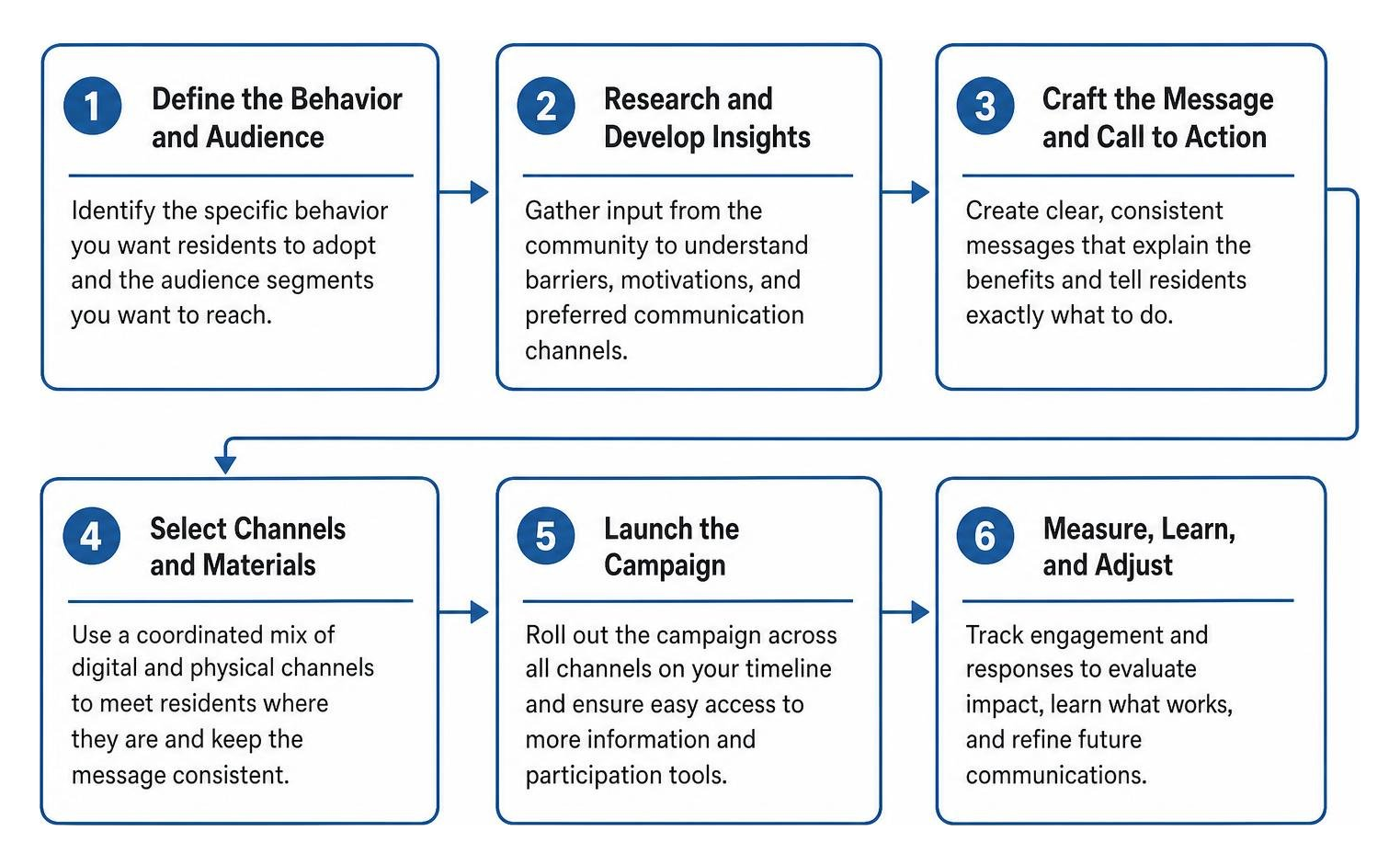
For larger civic initiatives, like increasing recycling compliance or water conservation, you need campaigns designed to motivate specific behavioral changes rather than passive reading. Focusing on community research, relatable messaging, and clear calls to action turns passive awareness into active civic participation.
Practical Implementation and Performance Measurement
Executing high-quality marketing for local government does not demand a massive team. With organized workflows and basic tracking, even a solo communications officer can run an efficient, impactful system.
Implementing Practical Marketing for Local Government on a Lean Budget
When staffing is tight, content repurposing is your best friend. A single city council recap can easily become:
- A brief website news update answering common community questions.
- An automated email newsletter blast sent to local subscribers.
- Three distinct social graphics highlighting key votes and timelines.
- A printed summary sheet posted on library and community center bulletin boards.
Standardizing templates inside design tools allows non-design staff across departments to generate on-brand flyers without starting from scratch. Utilizing college interns for social scheduling and basic photography also brings fresh perspectives while keeping operational overhead low.
Measuring ROI in Marketing for Local Government
How do you prove that your outreach efforts are working when you are not tracking product sales? You track operational efficiency, public participation, and service usage.
Key performance indicators for municipal communication include:
- Inbound Call Reductions: A drop in repetitive phone calls to 311 or municipal desks after publishing clear digital guides.
- Online Form Completions: An increase in online permit applications or park shelter bookings versus paper submissions.
- Email Engagement: High open and click-through rates on monthly city digests.
- Meeting Attendance and Feedback Volume: The number of unique residents participating in public comment periods or completing digital community surveys.
When you present these metrics to elected officials and budget committees, you demonstrate that proactive communication directly reduces staff workloads and improves operational outcomes.
Frequently Asked Questions About Local Civic Outreach
Who should manage marketing and communications within a municipality?
Ideally, a designated communications director or public information officer leads the overall strategy. However, in smaller towns and boroughs, communication responsibilities often fall on a city clerk, assistant manager, or a shared departmental team. The key is establishing a clear editorial approval process so all published notices maintain brand consistency, plain language, and legal compliance before going live.
How do local governments handle legal compliance and public records online?
Public sector communications must comply with Freedom of Information Act (FOIA) requests, sunshine laws, and public records retention policies. Every social media post, comment, and email sent through official channels is generally considered a public record. Municipalities should use automated archiving software to preserve records and maintain a published social media policy that clearly defines acceptable comment moderation standards without violating First Amendment protections.
What is the fastest way to improve resident engagement across digital channels?
Start by conducting a plain-language audit of your top five most-visited website pages. Rewrite bureaucratic paragraphs into short, scannable sentences with clear headings and bulleted action steps. Next, add a simple newsletter signup field across your site so you can build a direct, owned communication channel with residents that does not depend on unpredictable social media algorithms.
Building Future-Ready Civic Engagement Strategies
Modern civic outreach is about respect: respecting your residents' time, their intelligence, and their right to know what is happening in their community. When you replace confusing red tape with helpful, accessible information, everyone wins. Staff spend less time answering repetitive questions, residents feel informed and valued, and community projects move forward with genuine public support.
If your agency, borough, or municipality needs help designing a clean website, building an actionable content roadmap, or organizing your digital presence, we are here to help. Discover our marketing services to see how our team creates customized strategies, search-optimized websites, and sustainable content systems that connect with your community.
