
Financial Foundations: Unit Economics and Profit-First Pricing

To market a new dog training business, start with three moves: set up a Google Business Profile, package outcome-driven offers, and build local pet-business referral partners. These steps put you in front of owners who are already searching for help, and they work without burning cash on ads. Once that engine is running, the financial math decides which marketing channels are worth scaling.
Before you buy Facebook ads, print glossy business cards, or agonize over color swatches, let's look at the financial math. The biggest trap new dog trainers fall into is confusing raw revenue with real, spendable profit.
A solo dog training business is an absolute margin powerhouse. With minimal physical overhead and almost zero cost of goods sold, a solo trainer can easily achieve a 70% to 85% profit margin. A serious solo launch requires only $3,000 to $15,000 in startup capital. In your first year of operation, a disciplined solo business can realistically serve 50 to 200 clients, generating $45,000 to $110,000 in revenue, which translates into $30,000 to $80,000 in clean owner profit.
The trick is knowing what you actually earn for every hour of your life spent working.
| Service Format | Price Point | Trainer Time Investment (Teaching, Drive, Admin) | Real Revenue Per Worked Hour |
|---|---|---|---|
| Single Private In-Home Session | $110 / session | 2 to 2.5 hours (session, travel, notes) | $40 - $55 / hour |
| Structured Multi-Week Program | $1,200 (6 sessions) | 7 to 8 hours total working time | $160 - $200 / hour |
| Six-Dog Group Class | $200 / dog ($1,200 total) | 9 hours total (six 90-min classes + setup) | $110 - $130 / hour |
| Two-Week Board-and-Train | $2,800 / 14 days | 7 to 14 active hands-on hours | $200 - $400 / hour |
Why Knowing How to Market a New Dog Training Business Starts with Unit Economics
If you sell single sessions for $110, you spend an hour driving across town, an hour training the dog, fifteen minutes writing follow-up notes, and ten minutes chasing invoices. You just worked two and a half hours for $110 before taxes and gas. That puts your real hourly rate around $44.
That is not a business. That is an exhausting, low-paying job with extra pet hair.
To build a sustainable income, package your services into outcome-driven programs. Instead of offering single pay-as-you-go sessions, offer comprehensive 4-week to 8-week packages, group classes, or board-and-train programs. A group class with six dogs at $200 each brings in $1,200 for nine total hours of work, yielding roughly $120 per worked hour.
Solid unit economics must be built into your dog training business plan before you launch your first ad campaign. When your pricing supports healthy profit margins, every marketing dollar works significantly harder.
Customer Acquisition Cost (CAC) vs. Profit Per Client
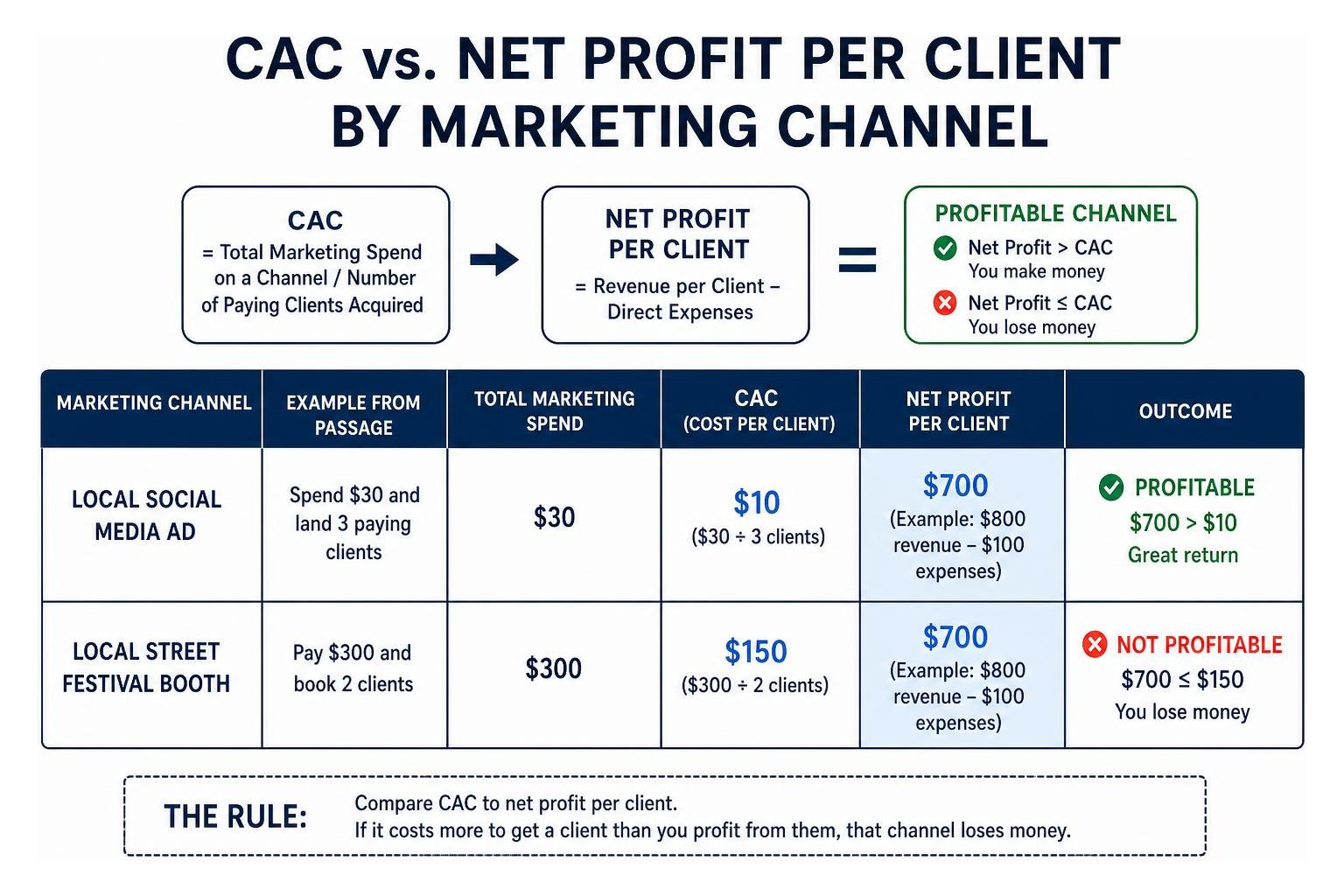
Customer Acquisition Cost (CAC) tells you how much money you spend to get one paying client through the door:
CAC = Total Marketing Spend on a Channel / Number of Paying Clients Acquired
If you spend $30 on a local social media ad and land three paying clients, your CAC is $10 per client. If you pay $300 for a booth at a local street festival and only book two clients, your CAC is $150 per client.
Compare your CAC to your net profit per client. If a client enrolls in an $800 package that costs you $100 in direct expenses, your profit per client is $700. Spending $50 to acquire that client is an incredible return. If you sell a single session for $110 with a $40 profit margin, a $50 CAC puts you in the red.
Audience Segmentation: Marketing to the Owner, Not Just the Dog
Dogs do not carry credit cards. Owners do.
Too many new trainers fill their websites with deep dives into operant conditioning, quadrants, and marker training. While training theory is important, potential clients are rarely searching for the mechanics of negative punishment. They are searching for relief from constant barking, chewed furniture, or the embarrassment of their dog lunging at neighbors.
When you market to the owner, you address the human emotional experience:
- Frustration over ruined rugs and disrupted work calls.
- Embarrassment when guests visit and the dog jumps frantically.
- Fear that a reactive dog might get hurt or cause an incident.
- Guilt that they are not giving their dog the life they promised.
Your marketing should show them what life looks like on the other side: peaceful walks, relaxed evenings, and a companion they can take anywhere.
Crafting an Irresistible, Outcome-Based Offer
An irresistible offer answers three fundamental questions simply and directly:
- What specific problem do you solve?
- How do you deliver the solution?
- What concrete result can the client expect?
Instead of listing a generic service like "60-Minute Private Dog Training Session," create an outcome-driven offer like:
The Calm Canine In-Home Program: We help busy families stop leash pulling, jumping, and door-dashing in 4 weeks using gentle, force-free routines so you can enjoy peaceful walks and stress-free gatherings at home.
When you need focused guidance on structuring your packages, getting hands-on dog training business help ensures your offers resonate with high-intent buyers in your area.
Tailoring Campaigns to Key Demographics
Different pet owners face entirely different everyday problems:
- Millennials (32% of US pet owners) and Gen X (27%): These groups represent the largest pet-owning demographics and often juggle kids and dogs under one roof. They need reliable household manners, impulse control around toddlers, and streamlined training schedules.
- Gen Z: Interestingly, 41% of Gen Z dog parents report hiring a professional dog trainer, which is the highest percentage of any generation. They value force-free methodologies, mental enrichment, separation anxiety support, and transparent digital communication.
- Empty Nesters and Retirees: These owners often care for strong or high-energy dogs and want safety, loose-leash walking, and dependable manners without physical wrestling.
Credibility matters across every demographic. In fact, 80% of pet parents are more likely to hire a business that carries dedicated pet business insurance. Display your credentials, background, and insurance badges prominently across your digital channels.
Core Digital Engine: How to Market a New Dog Training Business Online
To establish steady visibility, you need an online presence that captures clients actively looking for help. When an owner reaches their breaking point with problem behavior, they do not wait for a flyer. They search the web.
Step-by-Step Blueprint on How to Market a New Dog Training Business Locally
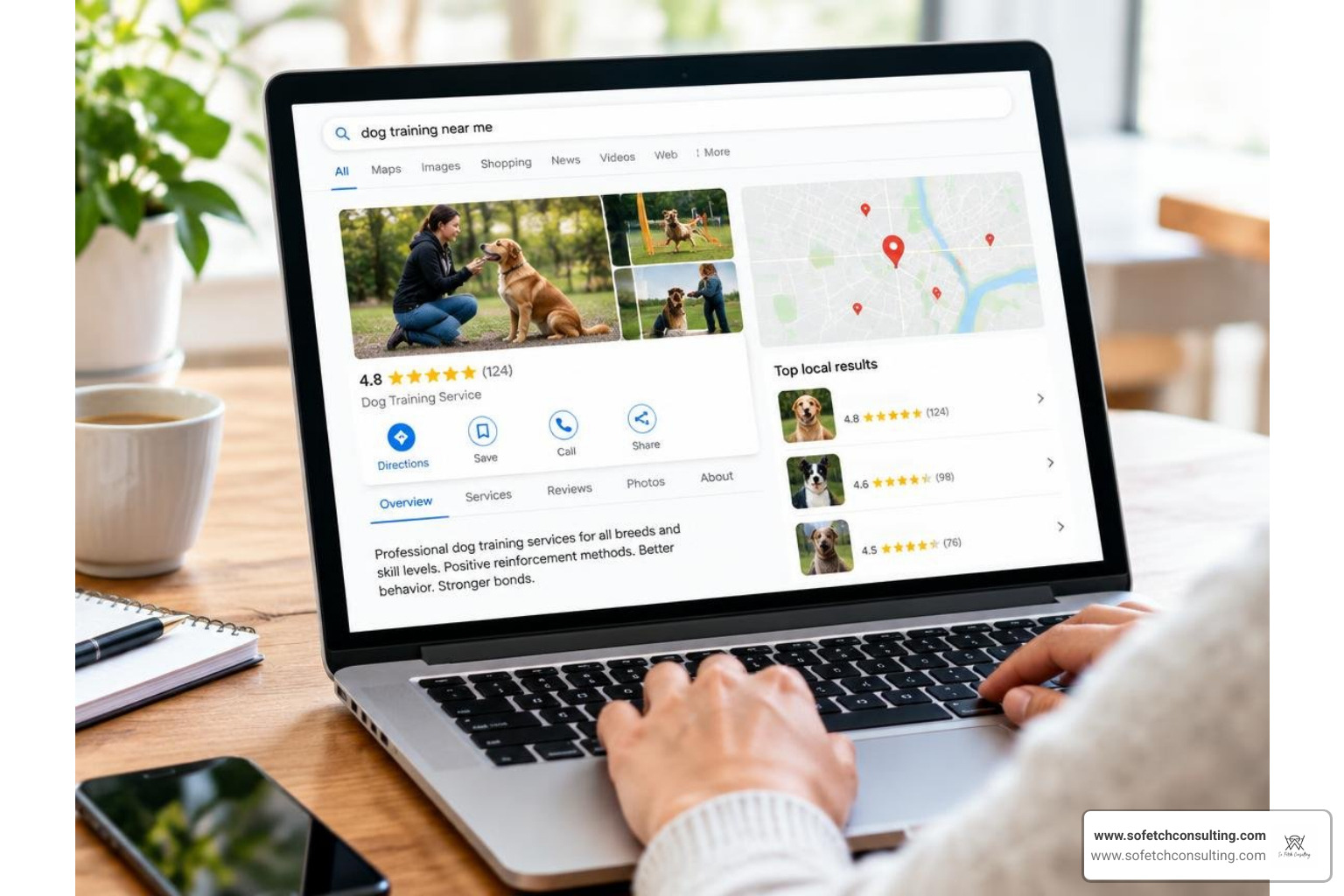
The most valuable online marketing asset for a local dog trainer is a Google Business Profile (GBP). An optimized GBP listing can generate 20 to 50 local inquiries per month without paid advertising.
- Claim and Verify Your Profile: Set your primary category to "Dog Trainer" and select relevant secondary categories like "Pet Trainer" or "Dog Day Care Center" if applicable.
- Optimize Business Name and Bio: Use your registered business name, write a clear description featuring your service cities, and list your core offerings. If you are still naming your venture, check out our dog training name guide for ideas that balance branding with local search value.
- Publish Real Photos Weekly: Upload high-quality pictures of training sessions, client dogs working in real environments, and your team.
- Collect Detailed Reviews: Ask every happy client to mention their dog's specific issue, the program they completed, and the results they achieved in their Google review.
- Post Weekly Updates: Treat your profile like a mini-feed by sharing training tips, client win stories, and open class spots.
High-Converting Website Architecture and Local SEO
Your website serves as your digital sales hub. To convert visitors into clients, structure your site with clean navigation and high-intent local search optimization:
- Clear Hero Section: State who you help, where you operate, and the primary result you deliver, paired with a direct call-to-action button.
- Dedicated Service Pages: Build individual pages for each core program (e.g., Puppy Training, Leash Reactivity, In-Home Manners) rather than squeezing everything onto one page.
- Local Service Area Pages: Target nearby towns and neighborhoods with localized content, embedded maps, and regional client testimonials.
- Proof and Case Studies: Feature before-and-after stories, client reviews, and video clips demonstrating real-world progress.
- Friction-Free Contact Flow: Use a short, mobile-friendly intake form that takes less than two minutes to complete.
If you want an authoritative breakdown of digital customer acquisition systems, explore our guide to marketing for dog trainers.
Low-Cost Local Tactics and Reciprocal Referral Networks
Digital marketing works best when paired with offline community roots. Local referral networks create steady, high-trust client pipelines at little to no financial cost.
Building High-Yield B2B Referral Partnerships
Local pet professionals interact with your target clients every single day. Connect with:
- Veterinary Clinics: Vets regularly see reactive dogs, hyperactive puppies, and stressed owners. Drop off introduction packets with client handouts and host a short lunch-and-learn for their staff on how your training methods reduce clinic stress.
- Animal Shelters and Rescues: Offer post-adoption workshops or discounted transitional training for newly adopted dogs. Shelters will happily recommend trainers who keep adopted pets in their homes.
- Pet Groomers and Dog Walkers: Groomers frequently handle dogs with handling sensitivities or table anxiety. Establish a two-way referral agreement where you help resolve grooming stress and recommend their services to your training clients.
- Pet-Adjacent Businesses: Connect with local pet photographers, pet-friendly apartment managers, and independent pet supply retailers.
Grassroots Guerrilla Tactics That Fill Schedules Fast
When your calendar is completely open, low-cost local outreach can generate immediate traction:
- QR Code Informational Cards: Distribute small display cards with QR codes linking to helpful guides, like "5 Steps to Stop Leash Pulling," at dog-friendly coffee shops and pet supply stores.
- Live Community Demos: Partner with a dog-friendly brewery or public park to run free, 30-minute manners demos. Working with dogs in public highlights your expertise in real time.
- Neighborhood Groups: Participate in local Facebook groups and Nextdoor communities by answering pet behavior questions with helpful, non-promotional advice.
To dive deeper into the economics of launching in the modern pet care space, read the operational guide on how to start a dog training business in 2027. If you are building out your complete business architecture, the detailed financial modeling inside the dog training business plan complete guide will help you budget your launch.
Building a Leak-Proof Client Acquisition Funnel
A marketing funnel is simply the journey a stranger takes from discovering your business to booking a service. When trainers struggle to land clients, the issue is rarely a lack of love for dogs; it is usually an unnoticed leak in their funnel.
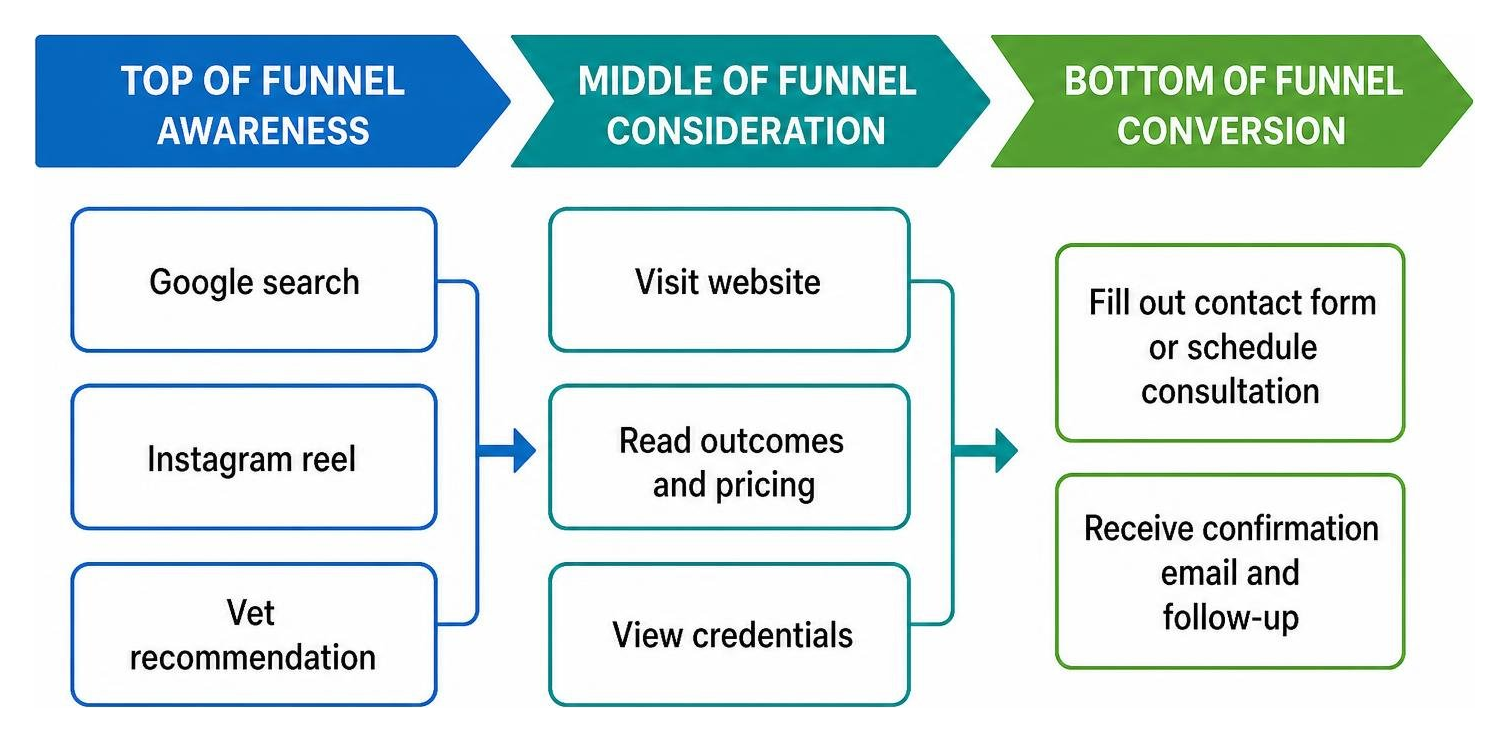
Funnel touchpoints should connect naturally:
- Awareness: An owner discovers your business via a Google search, Instagram reel, or vet recommendation.
- Consideration: They visit your website, read your service outcomes, look over your pricing, and view your credentials.
- Inquiry: They fill out a short contact form or schedule a phone consultation.
- Follow-Up: You send an automated confirmation email with next steps and follow up promptly.
- Conversion: During the discovery call, you assess their needs and enroll them in the right program.
If you want to scale this engine efficiently as your roster fills up, explore our step-by-step strategies on how to grow your dog training business. If your background includes work with breeding programs, you can also apply our insights on SEO for dog breeders to expand your local search visibility.
Common Marketing Mistakes That Derail New Trainers
Avoid these frequent pitfalls when launching your marketing campaigns:
- Marketing to Everyone: Promoting generic "all-breed obedience" makes you blend into the background. Choose a clear specialty, such as puppy manners, off-leash recall, or fear and reactivity.
- Relying Solely on Social Media Algorithms: Social platforms are borrowed land. If an algorithm changes, your reach can disappear overnight. Build an email list and optimize your search assets so you own your audience.
- Slow Follow-Up Times: Pet owners who submit an inquiry often contact two or three trainers at once. If you take 48 hours to reply, they will likely book whoever answers first. Aim to follow up within two to four hours.
- Hiding Your Pricing and Process: Forcing potential clients to jump through confusing hoops just to find basic pricing creates unnecessary friction and hurts conversion rates.
Frequently Asked Questions About Marketing a Dog Training Business
Which marketing channel should a new dog trainer prioritize first?
Set up and optimize your Google Business Profile first. When local dog owners face urgent behavior problems, they turn to Google search and the local map pack. An optimized profile with clear photos, service listings, and five-star client reviews captures high-intent searches in your community immediately without requiring paid advertising spend.
How much should a new dog training business spend on marketing?
A solo trainer can start with a very lean marketing budget of $50 to $200 per month for basic website hosting, software tools, and business cards while focusing on organic channels like Google Business Profile optimization and local referral networking. If you choose to run targeted Google Ads, a modest budget of $20 to $30 per day can generate daily inbound leads once your landing pages are properly set up.
What is the primary reason new dog training marketing funnels leak leads?
The most common funnel leak is slow response times combined with complicated booking processes. When a stressed dog owner reaches out, taking days to respond or requiring multiple back-and-forth emails just to schedule an introductory call causes high drop-off rates. Streamlining your website intake form and using automated calendar booking links fixes this issue quickly.
Scaling Your Practice and Filling Your Roster
Marketing a dog training business does not require trick algorithms, endless social media trends, or huge advertising budgets. It simply takes a clear understanding of your unit economics, an offer focused on the human owner's real-life needs, and consistent execution across local search and referral channels.
By Year 2 and Year 3, a trainer who adds structured group classes, board-and-train options, and one or two contracted trainers can grow their revenue from $150,000 to $450,000.
Building a thriving pet care business is entirely achievable when you follow a structured roadmap. If you are preparing to open your doors, review our foundational guide on how to start a dog training business and learn more about our background as a dog trainer turned marketer. With solid systems in place, you can build a predictable client roster that supports your passion for the long haul.
