
Dog Training Business Plan Template and Step-by-Step Guide
Build a Dog Training Business Plan That Actually Guides Decisions

A strong dog training business plan turns your skills with dogs into a clear plan for making money, serving clients safely, and growing without chaos. Start by writing down your niche, ideal clients, services, prices, startup costs, marketing channels, and monthly revenue goal. Then use those numbers to test a simple question: Can this business pay its bills before it eats your weekends alive?
Your plan does not need to look like it was written for a bank on day one. But it should help you make smart choices about whether to offer private lessons, group classes, puppy programs, behavior work, board-and-train, or a mobile service. It should also cover the less-fun-but-very-real stuff: insurance, local permits, client contracts, cash flow, and how you will get leads beyond hoping Instagram notices you.
The best plan is a working document, not a file you make once and abandon in a desktop folder. Use it to set realistic milestones, compare your prices with local competitors, track expenses, and adjust when demand tells you something different than your original guess.
I'm Karin Wright, and I've trained dogs professionally since 2008 while building businesses in training, rescue, walking, boarding, grooming, and a large-scale LA training facility. I now help founders build practical marketing systems, and this dog training business plan guide is built for people who want a real business, not a cute logo and a prayer.
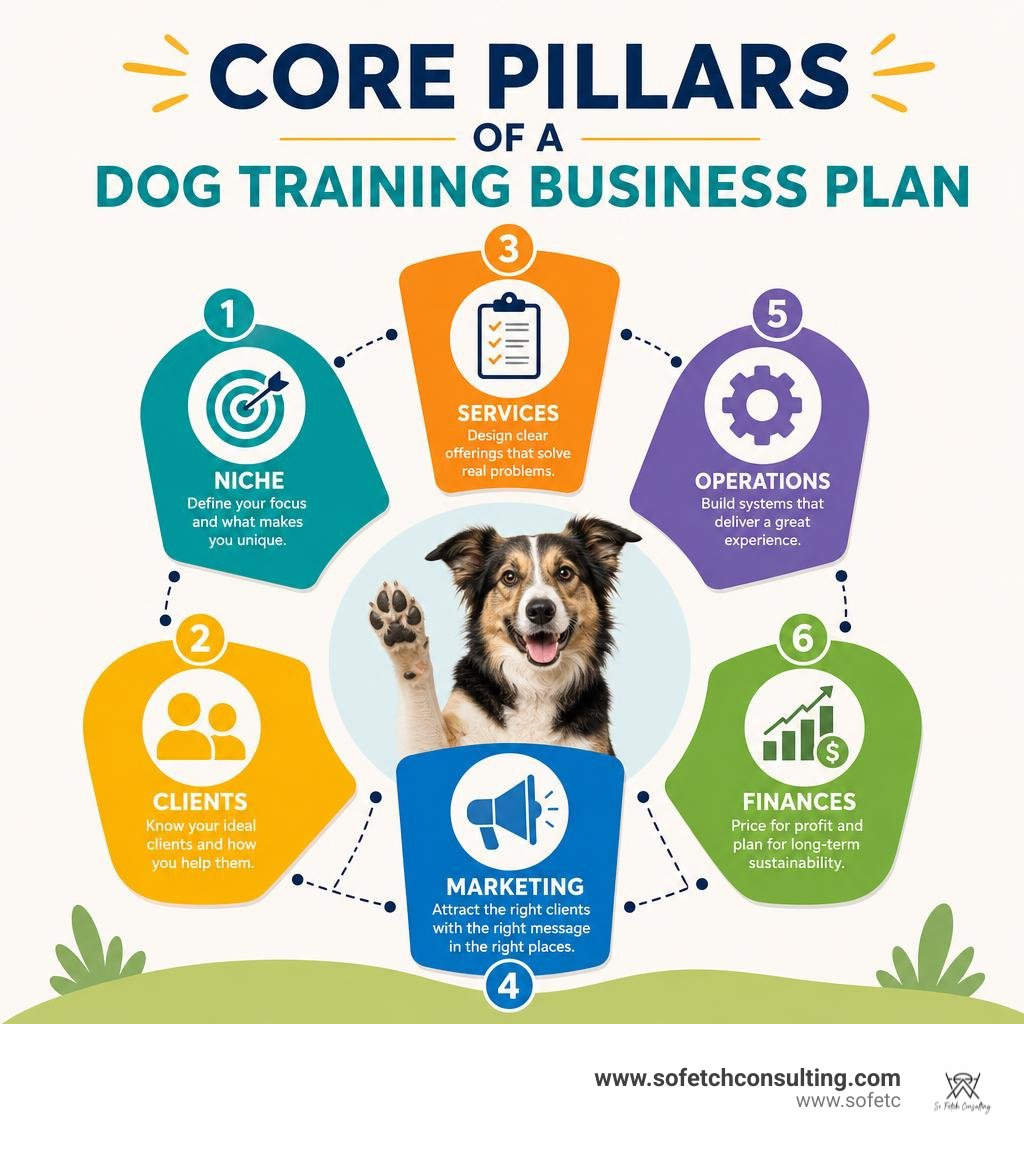
Why You Need a Strategic Business Plan for Your Training Business
Let us be completely honest for a second: most trainers get into this field because they love dogs, understand animal behavior, and want to help pet parents stop crying into their morning coffee over chewed-up baseboards. Almost nobody wakes up shouting with joy about cash flow projections, municipal zoning codes, or tax entity classifications.
However, running on pure passion is the fastest route to professional burnout. A strategic roadmap protects your time, safeguards your sanity, and makes sure you get paid what you are actually worth.

Writing an actionable plan forces you to bridge the gap between working in your business and working on your business. If you ever plan to approach a commercial bank for equipment financing or secure a lease on a dedicated training facility, lenders will want to see your numbers, your risk mitigation strategies, and your operational workflows.
Even if you fund the business out of pocket, mapping out your capital allocation upfront keeps you from blowing your emergency savings on fancy branded swag before you have secured your first three paying clients.
Defining Your Niche and Training Philosophy
Trying to be everything to every dog owner in your zip code is the quickest way to end up exhausted, underpaid, and stressed. When you market to everyone, you end up appealing to no one.
Your business plan needs to clearly articulate your specific training methodology and core service focus:
- Puppy Foundation and Socialization: Working with excited first-time dog owners during critical development windows to build house manners, bite inhibition, and crate confidence.
- Household Manners and Basic Obedience: Teaching loose-leash walking, reliable recall, and impulse control for busy families who need a polite household companion.
- Behavior Modification: Addressing complex behavioral challenges like dog reactivity, separation anxiety, resource guarding, and fear-based aggression.
- Board-and-Train Bootcamps: Intensive, immersive training programs hosted at your facility or home, offering fast results for busy owners willing to pay premium rates.
- Specialized Coaching: Agility, scent work, therapy dog preparation, or service dog task training.
Picking a defined lane does not mean you can never take on different clients. It simply gives your brand an unmistakable identity and protects you from competing on rock-bottom prices against generalists.
Target Market Segmentation and Customer Personas
The pet services industry continues to expand rapidly, with dog training showing steady market growth across distinct pet-parent segments. We generally divide potential clients into two primary groups:
- Proactive Dog Parents (growing at roughly 9% annually): These clients bring home a new puppy or rescue dog and immediately budget for structured training. They are motivated by prevention, love structured homework, and happily invest in progressive obedience packages.
- Reactive Dog Parents (growing at roughly 8% annually): These clients reach out when an acute issue emerges, such as lunging on leash, jumping on guests, or destroying furniture. They need fast, empathetic, and highly actionable problem-solving.
Overall, target market segments in the canine services space average a compound annual growth rate of 8.52%.
To build realistic pricing, look at regional household demographics. High-performing independent trainers frequently target households with annual incomes exceeding $60,000 to $100,000, where owners view their pets as integral family members and prioritize professional behavioral guidance over quick DIY internet tips.
Key Components of a Dog Training Business Plan
Every solid business plan relies on a clear, standard structure. In the United States, your venture falls under the North American Industry Classification System (NAICS) code 812910 (Pet Care Except Veterinary Services) and Standard Industrial Classification (SIC) code 0752 (Animal Specialty Services).
Understanding these industry classifications helps you evaluate performance metrics, benchmark your overhead against national averages, and frame your plan for lenders.
A complete plan includes:
- Executive Summary: A high-level overview of your business concept, target demographics, competitive advantages, and long-term financial vision.
- Company Overview & SWOT Analysis: An honest assessment of your internal strengths and weaknesses, alongside external market opportunities and competitive threats.
- Services & Pricing Menu: Detailed service breakdowns, packaging tiers, and hourly rate calculations.
- Market & Competitor Analysis: An objective breakdown of direct and indirect competitors in your immediate territory.
- Operations & Risk Management: Standard workflows, intake procedures, booking technology, software, and insurance coverage.
- Marketing & Client Acquisition Strategy: Proven channels for driving consistent client inquiries.
- Financial Plan: Itemized startup expenses, a break-even formula, 12-month cash flows, and 3-to-5-year pro forma statements.

To help position your services effectively, map out both your direct and indirect competitors:
| Competitor Category | Competitor Types | Typical Strengths | Key Weaknesses | How You Differentiate |
|---|---|---|---|---|
| Direct Competitors | Independent trainers, local obedience schools, franchise training centers | Established local reputation, dedicated facilities, brand recognition | Rigid curriculums, crowded group classes, impersonal client support | Customized training plans, flexible scheduling, direct owner coaching |
| Indirect Competitors | Dog daycares, boarding kennels, dog walkers, DIY books & video channels | Lower upfront cost, high daily convenience, passive pet management | No true behavioral modification, inconsistent handling, zero owner education | Structured behavioral transformation, long-term habit change, certified expertise |
Executive Summary: Pitching Your Dog Training Business Plan
Although the executive summary sits right at the front of your completed document, you should always write it last. Think of it as your two-minute elevator pitch.
Keep it sharp, concise, and focused on four core points:
- Mission Statement: Why your business exists and how your training methodology solves critical pet-parent struggles.
- Company Structure: Your legal operating entity, ownership team, and physical base of operations (in-home, mobile, leased facility, or commercial property).
- Unique Value Proposition: What sets your approach apart, whether that is specialized credentials, a focus on owner education, or proprietary follow-up systems.
- Financial Snapshot: Projected startup costs, target date for operational profitability, and three-year top-line revenue targets.
Service Menu, Pricing Structure, and Revenue Streams
Do not sell yourself short by charging low hourly rates that barely cover your driving time and liability insurance.
Experienced trainers quickly learn that selling one-off hourly lessons often leads to client drop-off before real behavioral changes take hold. Instead, package your offerings into structured programs that deliver measurable results:
- Private In-Home Coaching Packages: Bundles of 4 to 8 sessions tailored to household manners, door manners, and neighborhood walking skills.
- Group Class Series: 4 to 6-week progressive programs covering Puppy Kindergarten, Level 1 Manners, and AKC Canine Good Citizen prep.
- Day Training or Board-and-Train Programs: High-ticket, intensive options where you handle the foundational repetitions and transfer the handling skills to the owner during structured transition lessons.
- Maintenance Memberships & Alumni Clubs: Monthly subscription drop-in sessions, pack walks, or virtual refresher Q&A calls to keep lifetime client value high.
- Curated Training Retail: Selling essential training tools directly to clients, including long lines, treat pouches, appropriate walking harnesses, and mental enrichment toys.
Legal Entity, Licensing, and Insurance Requirements
Protecting your business assets is non-negotiable when working with animals. Before scheduling your first consultation, address these legal and administrative steps:
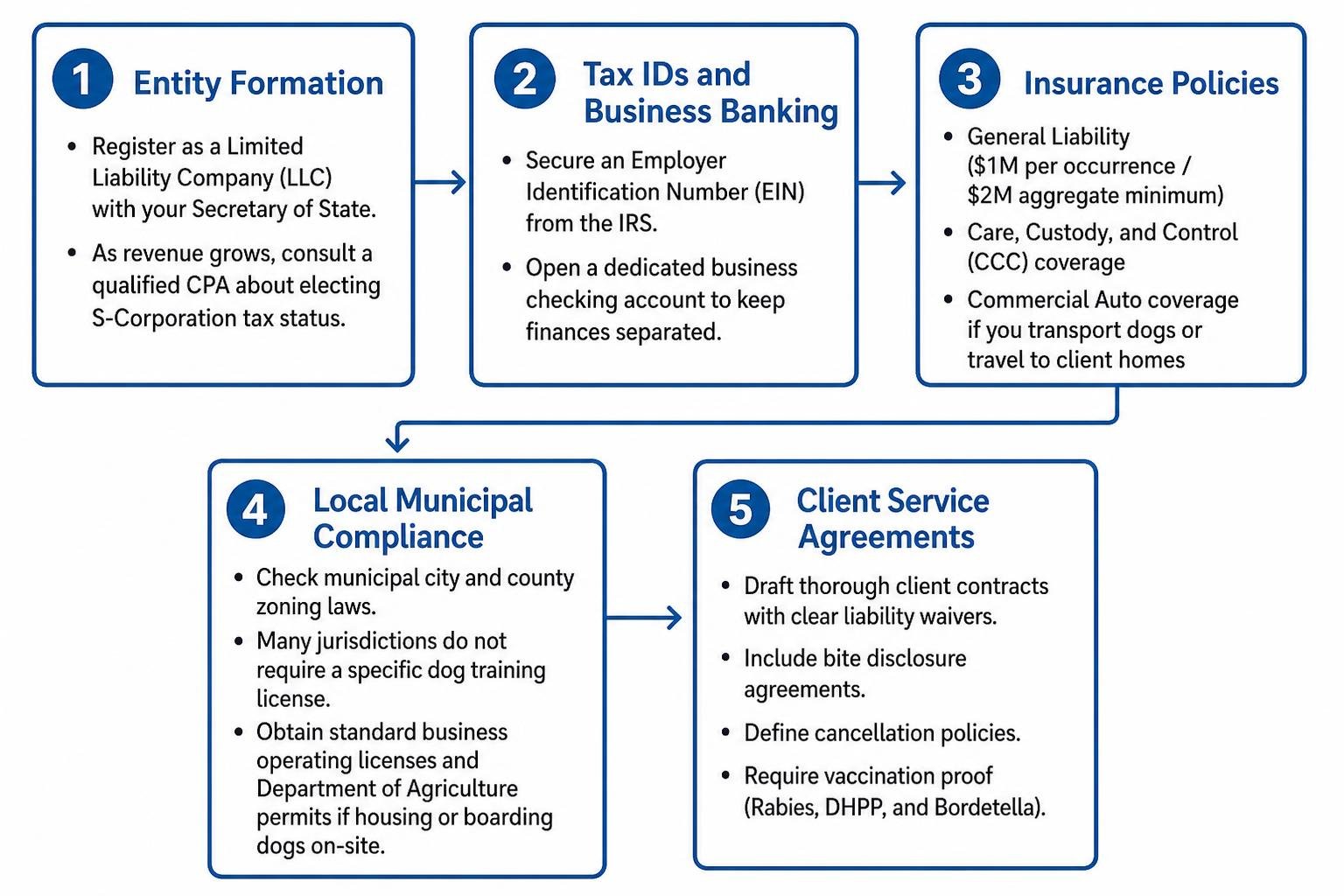
- Entity Formation: Register your business as a Limited Liability Company (LLC) with your Secretary of State to separate personal assets from business liabilities. As revenue grows, consult a qualified CPA about electing S-Corporation tax status to optimize self-employment taxes.
- Tax IDs and Business Banking: Secure an Employer Identification Number (EIN) from the IRS and open a dedicated business checking account to keep your personal and business finances strictly separated.
- Insurance Policies: Carry comprehensive commercial coverage. You will want General Liability ($1M per occurrence / $2M aggregate minimum), Care, Custody, and Control (CCC) coverage to protect against injury or loss of a client's pet while in your care, and Commercial Auto coverage if you transport dogs or travel to client homes.
- Local Municipal Compliance: Check municipal city and county zoning laws. Many local jurisdictions do not require a specific dog training license, but they do require standard business operating licenses and Department of Agriculture permits if you house or board dogs on-site.
- Client Service Agreements: Draft thorough client contracts with clear liability waivers, bite disclosure agreements, cancellation policies, and vaccination proof requirements (such as Rabies, DHPP, and Bordetella).
Financial Projections, Startup Costs, and Pricing Strategies
A lean, mobile or in-home dog training business can launch successfully with $6,000 to $15,000 in total initial funding.
If you avoid signing a high-rent commercial lease immediately, your upfront startup capital will look something like this:
- Legal Registration, Licensing, and Contracts: $500 to $1,200
- Initial Business Insurance Premiums: $600 to $1,200 annually
- Core Training Equipment & Supplies: $1,000 to $3,000 (leashes, crates, safety barriers, bait bags, clickers, place cots, agility ramps)
- Branding, Website Setup, and Digital Marketing Assets: $1,500 to $3,500
- Operating Software & Tech Subscriptions: $300 to $600 (booking systems, accounting software, email hosting)
- Working Capital Cash Reserve: $2,500 to $6,000 (a vital buffer to cover monthly operating costs while you ramp up client volume)
To build robust, lender-ready cash flow and profit-and-loss forecasts, use established standard financial planning models as your structural baseline.
Unit Economics and Break-Even Analysis
A service-based dog training venture benefits from exceptionally high gross profit margins, typically ranging between 60% and 90% once foundational gear is purchased.
Let us look at a realistic baseline financial model for a solo operator:
- Average Transaction Value (Package Price): $400 to $800
- Target Customer Acquisition Cost (CAC): $40 to $70 per client
- Estimated Monthly Fixed Operating Overhead: $1,800 to $3,500 (insurance, software, marketing, fuel, vehicle depreciation, admin expenses)
- Monthly Break-Even Revenue Threshold: Approximately $3,600
At a $600 average package value, you only need 6 new package clients per month to cover all operational fixed costs. Every client enrolled past that break-even threshold contributes directly to owner pay and business profit.
Milestones and Reviewing Your Dog Training Business Plan
Do not write your plan, save it as a PDF, and never open it again. Reviewing your actual performance against planned targets keeps you on track.
Set clear operational milestones:
- Month 1 to 3: Complete brand setup, establish local SEO assets, secure insurance, and onboard initial testimonial clients.
- Month 4 to 6: Scale inbound marketing, hit consistent lead volume, and reach consistent operational break-even.
- Month 7 to 9: Reach consistent operational profitability, optimize weekly calendar capacity, and build recurring referral volume.
- Month 12: Hit year-one revenue targets (typically $60,000 to $100,000 for full-time solo operators) and evaluate whether to add your first associate trainer or facility space.
Using structured pet industry startup templates allows you to compare your real-world progress against industry benchmarks during quarterly reviews.
Marketing, Lead Generation, and Operations Setup
A great training curriculum will not save your business if nobody knows you exist. High-performing training businesses rely on predictable operational systems to convert incoming inquiries into happy, paying clients.
Streamline your client journey with an automated intake process:
- Discovery Form: A quick intake questionnaire on your website screening the dog's breed, age, behavioral history, and bite history.
- Initial Consultation: A paid in-person or virtual behavioral assessment to evaluate the dog, establish training goals, and recommend the right program.
- Digital Onboarding: Automated contract signing, payment collection, and scheduling via pet-business software such as PetExec, Gingr, or PocketSuite.
- Service Delivery & Follow-Up: Hands-on training combined with clear client homework sheets, video recaps, and scheduled check-ins.
- Review & Referral Request: An automated email sequence sent within 48 hours of package completion asking for a Google review and offering a referral incentive.
Local SEO and Digital Brand Presence
Local search is the primary engine of your client pipeline. In the pet services industry, an optimized Google Business Profile paired with local SEO drives roughly 35% of all inbound customer leads.
To maximize your local search visibility:
- Optimize Your Google Business Profile: Choose primary categories like Dog Trainer and secondary categories like Pet Trainer, upload high-quality training photos weekly, and systematically collect 5-star client reviews.
- Build a Fast, Mobile-Friendly Website: Highlight your training philosophy, transparent service packaging, real before-and-after case studies, and clear booking buttons on every page.
- Publish Proof on Social Media: Share authentic short-form video clips demonstrating loose-leash transformations, calm settle behavior, and real client progress rather than static graphics.
Referral Networks and Community Partnerships
Referral partnerships represent about 30% of organic growth for local pet businesses, and they convert at a significantly higher rate than cold paid traffic.
Build relationships with local pet professionals who interact with dog owners every day:
- Veterinary Clinics: Drop off educational flyers and connect with clinic practice managers so they have a trusted behavioral resource for stressed pet owners.
- Independent Pet Boutiques: Host free 30-minute puppy socialization workshops or leash-handling demos in their retail spaces.
- Rescue Groups and Shelters: Provide discounted post-adoption manners classes to help keep newly adopted dogs in their forever homes.
- Double-Sided Referral Programs: Offer existing clients and local partners a simple incentive, such as a $25 credit toward future services or a gift card for every referred client who books a full package.
Frequently Asked Questions About Building a Dog Training Business
How much does it cost to start a dog training business?
Starting a mobile or in-home dog training business typically requires between $6,000 and $15,000. This capital covers professional liability insurance, legal entity formation, core gear (leashes, cots, clickers, long lines), website design, local SEO, and a 3-to-6-month operating cash reserve buffer. Opening a dedicated commercial facility or board-and-train kennel will require higher startup capital ($40,000 to $100,000+) to handle leasehold buildouts, kennel runs, and commercial security fencing.
Do I need a special license or certification to train dogs professionally?
In most jurisdictions, there are no mandatory state or federal licensing requirements to work as a professional dog trainer. However, reputable industry certifications from organizations like the Certification Council for Professional Dog Trainers (CCPDT), the International Association of Animal Behavior Consultants (IAABC), or the Association of Professional Dog Trainers (APDT) build instant trust and credibility with clients. You will still need standard local municipal business licenses, state tax registrations, and facility or kennel permits if you house dogs overnight.
How long does it take for a dog training business to become profitable?
A lean, service-based dog training business can reach monthly operational break-even within 3 to 4 months and achieve consistent profitability between months 7 and 9. Because solo training businesses carry low variable product costs and maintain gross margins between 60% and 90%, reaching profitability primarily depends on filling your weekly client roster and keeping your fixed marketing and travel overhead manageable.
Build a Scalable Brand and Unleash Your Business Potential
Starting and growing a successful dog training business is one of the most rewarding career moves you can make. It allows you to build a schedule that works for your life, earn great money doing work you genuinely care about, and create lasting changes for pets and their families.
Writing a comprehensive business plan is the very first step toward turning that passion into a profitable reality. When you know your exact numbers, understand your niche, and implement reliable operational workflows, you take all the stressful guesswork out of entrepreneurship.
If you are ready to craft a high-converting website, dominate local search in your market, and build a dependable client pipeline, explore our proven pet business marketing strategy. We help pet professionals build sustainable, scalable brands that consistently stand out and thrive.
