
What Are the Disadvantages of Social Media for Politics?
The key disadvantages of social media for politics are algorithmic polarization, rampant misinformation, voter manipulation through bots and microtargeting, and slacktivism that replaces durable civic action with performative outrage. These dynamics erode democratic trust, deepen affective hostility between voters, and make it harder for campaigns to build the kind of real-world coalitions that actually govern.
Let us be completely honest for a second. If you spend more than five minutes scrolling through your timeline during an election year, you probably feel like the world is on fire. You are definitely not alone. A whopping 64% of Americans say social media has a mostly negative effect on the way things are going in the country. When you look at partisan breakdowns, 78% of Republicans and 53% of Democrats agree that these platforms are doing more harm than good.
Globally, the mood is just as grim. According to global survey data on social media and democracy, people across 37 nations overwhelmingly report that digital platforms breed political division, manipulate voters, and spread outright falsehoods. In fact, roughly 28% of concerned users point straight to misinformation and fake news as the biggest culprit, while 16% cite skyrocketing hate speech, harassment, and raw extremism.
The underlying issue is that algorithmic amplification rewards high arousal emotions. Outrage drives clicks, clicks drive ad impressions, and nuance dies quietly in the corner. Instead of debating tax policy or infrastructure bills, platforms turn civic discourse into high stakes reality television. They fuel affective polarization, which is the academic way of saying we do not just disagree with political opponents anymore; we actively despise them.
| Metric / Dimension | Organic Civic Discourse | Algorithmic Social Media Manipulation |
|---|---|---|
| Primary Goal | Mutual consensus and practical policy solutions | Attention capture, user dwell time, and ad revenue |
| Information Delivery | Nuanced context, local debate, and compromise | Sensational hooks, rage bait, and simplified memes |
| Audience Relationship | Shared community members and neighbors | Polarized in-groups pitted against demonized out-groups |
| Feedback Loop | Deliberative compromise and accountability | Viral grievance, instant dopamine, and outrage cycles |
| Voter Impact | Measured civic duty and trust in institutions | Affective hostility, political fatigue, and cynicism |
Understanding What Are the Disadvantages of Social Media for Politics and Democratic Deliberation
How did we get here? It comes down to what researchers call epistemic agency hijacking. When platforms optimize for pure engagement, their machine learning models quickly figure out that feeding you incendiary content keeps your eyeballs glued to the screen.
As explored in research on AI engagement algorithms, these feeds artificially manufacture cognitive fluency. When you see the same partisan claim repeated dozens of times with thousands of likes, your brain experiences a false feeling of rightness. You become totally overconfident in questionable information, which completely destroys your willingness to compromise with your actual neighbors.
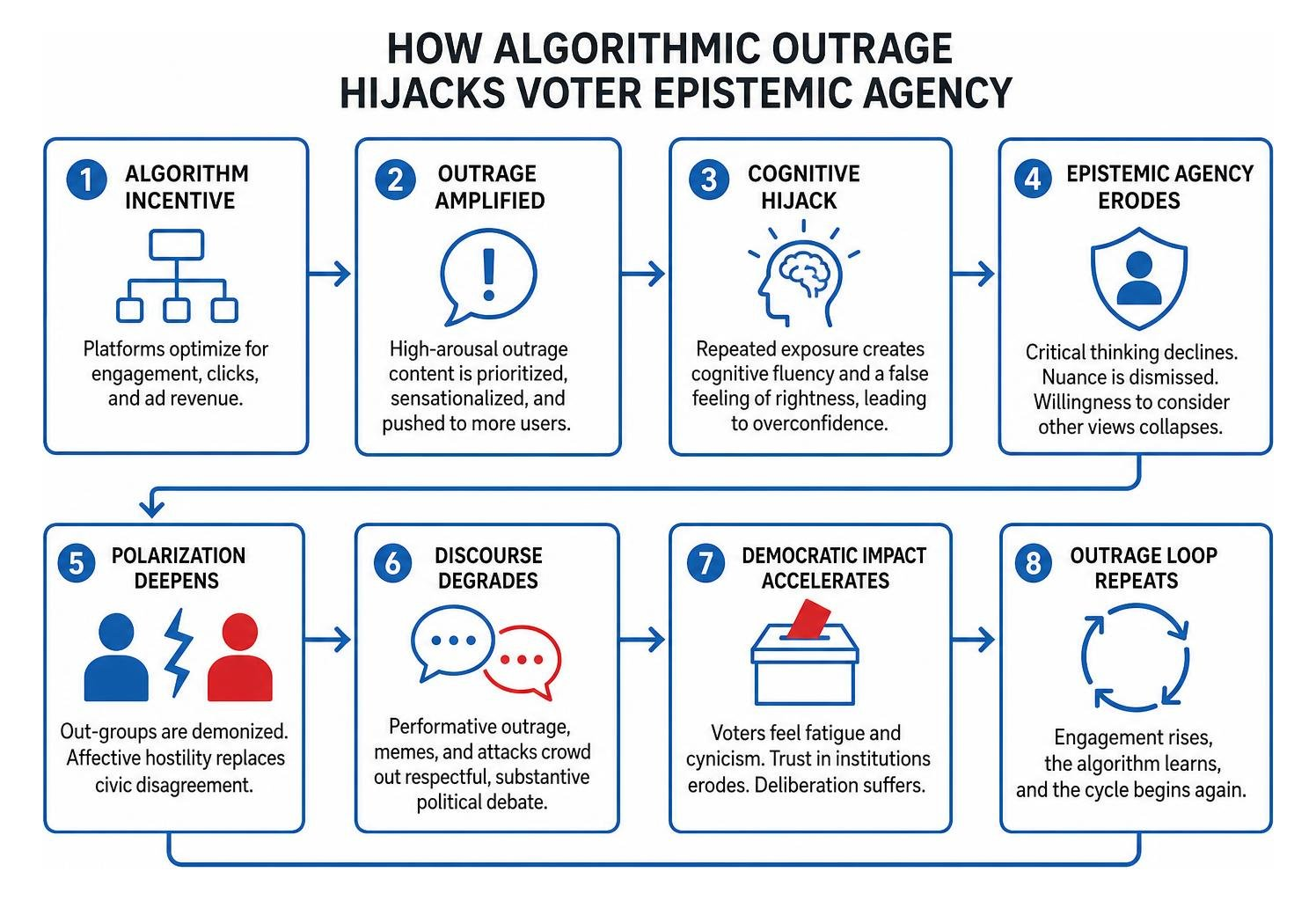
This algorithmic design creates thick filter bubbles where out-group animosity thrives. Research on the decline of political discourse in the digital age shows that formal, respectful political debate has been largely replaced by performative stunts, snarky meme dumps, and personal attacks. When elected officials discover that posting an unhinged mudslinging video gets ten times more retweets than explaining a local zoning ordinance, they follow the incentives. Democratic deliberation requires patience and mutual respect, two things that algorithms chew up and spit out.
How Bots, Sock Puppets, and Microtargeting Distort Electoral Outcomes
It gets worse once bad actors weaponize these mechanics. The digital public square is crawling with synthetic manipulation. Back during the 2016 US presidential election, fake election stories from hyper-partisan blogs generated dramatically more engagement than legitimate reporting from established news organizations. At that time, Donald Trump’s posts were shared exponentially more than Hillary Clinton’s, driven by an ecosystem tuned for sensationalism.
Behind the scenes, bot networks and sock puppets tilt the playing field. During that same cycle, researchers estimated that automated accounts generated up to 20% of pro-Clinton tweets and 33% of pro-Trump tweets. Even earlier, in 2013, Twitter acknowledged having roughly 10.75 million fake or non-genuine accounts. When anyone can buy a few thousand bots for pocket change, manufacturing artificial consensus becomes terrifyingly easy.
Look at what happened with the Brexit referendum, where leave supporters were seven times more active on Twitter and five times more active on Instagram than remain supporters. Data firms like Cambridge Analytica bragged about microtargeting 13.5 million voters across 16 battleground states with bespoke psychological profiling designed to suppress opponent turnout while riling up their own base (Olaniran & Williams, 2020).
These practices present severe threats to democratic functionality because they bypass traditional journalistic gatekeeping. When running a modern political campaign strategy, knowing the difference between authentic voter sentiment and artificial noise is the difference between genuine community trust and a total communications disaster.
The Illusion of Power: Slacktivism, Outrage, and Failed Reform
Here is a tough pill to swallow: going viral is not the same thing as building political power. Social platforms excel at generating symbolic engagement and performative outrage, giving you a quick dopamine rush every time you drop a scathing reply or share a witty infographic.
A sharp critique of political social platforms points out that platforms transform politics into an aesthetic hobby. You get the emotional satisfaction of venting your frustration without ever having to do the boring, gritty work that actual democracy demands, like attending town halls, knocking on doors, reading dry policy briefs, or compromising with people you disagree with.
What Are the Disadvantages of Social Media for Politics in Mobilization and Slacktivism?
Digital campaigns often run straight into the wall of slacktivism. A clever hashtag can trend globally in an hour, yet produce zero durable legislative reform.
Think back to the Arab Spring. While social feeds were praised for coordinating massive street protests, many of those movements lacked the deep institutional infrastructure needed to govern afterward, leaving vacuums that authoritarian regimes quickly reclaimed. Similarly, the #MeToo movement brought massive awareness and high-profile accountability, but translating that online momentum into lasting systemic legal protections required years of traditional, grueling legislative lobbying.
When we evaluate digital efforts by contrasting online drawbacks with real-world campaign advantages, the pattern becomes crystal clear. Social media is great for rapid top-of-funnel awareness, but terrible at holding coalitions together when the hard work of governing begins.
Why Decentralized Alternatives Fail to Fix Anti-Political Dynamics
Whenever users get fed up with big tech platforms, everyone starts talking about escaping to decentralized spaces like Mastodon, Bluesky, or the broader Fediverse. The idea sounds great on paper: remove corporate ad incentives and give power back to the users.
Unfortunately, decentralized networks inherit the exact same cultural baggage. Mastodon quickly developed its own subcultural drama and hyper-sensitive moderation disputes, with several community servers collapsing under outside harassment campaigns. Bluesky, while avoiding some algorithmic traps, still concentrates the vast majority of its active user base on its primary default server.
The root problem is not just corporate architecture; it is the format itself. When political discourse is reduced to short, individualized, text-based hot takes, the resulting dynamic is inherently anti-political. It prioritizes personal branding and righteous posturing over the messy collective organizing required to change laws.
Content Moderation, Free Speech, and the Limits of Platform Governance

Every time an election rolls around, the public demands that platforms clean up their act. But regulating online political speech is an absolute legal minefield, especially in the United States.
Under the First Amendment, the government cannot dictate what political opinions private companies allow on their servers. Section 230 of the Communications Decency Act provides tech companies with broad legal immunity to moderate content as they see fit without being treated as traditional publishers. When governments attempt to force speech guidelines onto platforms, they risk establishing dangerous precedents for state censorship.
On the other hand, relying on private platform governance has obvious limits. Tech CEOs regularly change moderation policies on a whim, reinstating suspended accounts, gutting trust and safety teams, or sunsetting third-party fact-checking partnerships. Scholarly frameworks for democratic platform reform argue that platforms must adopt genuine deliberative capacities, including independent transparency, community-driven accountability, and features that reward thoughtful argumentation over raw outrage.
For organizers trying to cut through the digital noise, identifying the most effective political communication channels is essential for keeping campaigns focused on measurable outcomes rather than platform-induced panic.
Frequently Asked Questions About Digital Politics
How does social media fuel political polarization and populism?
Social feeds rely on recommendation engines that elevate sensationalist, emotionally charged content because outrage generates maximum user retention. This dynamic creates affective polarization, where voters view opposing political groups with intense hostility. Populist leaders exploit these direct communication channels to bypass journalistic checks, positioning themselves as lone defenders against villainous out-groups while radicalizing everyday political discussions.
Does online political activism translate into durable policy change?
Rarely on its own. While digital channels excel at raising visibility and crowdfunding money quickly, they often promote slacktivism, where liking, sharing, or posting takes the place of tangible civic action. Real policy change demands sustained institutional lobbying, in-person coalition building, and the willingness to accept imperfect legislative compromises, none of which can be replaced by a trending hashtag.
Can government regulation fix the political drawbacks of social platforms?
Direct government regulation of content moderation faces strict First Amendment hurdles in the US, as private platforms possess editorial discretion. Overly broad speech laws risk political weaponization and censorship. Meaningful improvements are far more likely to stem from enforceable algorithmic transparency, privacy protections that restrict predatory microtargeting, and updated civic literacy initiatives.
Rebuilding Civic Dialogue and Navigating Digital Campaigns Responsibly
Social media is not going anywhere, but we have to stop treating feed engagement as a stand-in for healthy democratic life. Genuine political power is built at the local level through real relationships, media literacy, and showing up for your community when nobody is holding a camera.
At So Fetch Consulting, Karin Wright and our team help small businesses, local government entities, non-profits, and educational groups cut through online chaos with clear, intentional messaging. Whether you need grounded social media content strategy built through The S3 System™, high-converting SquareSpace web design, or data-driven SEO, we focus on the metrics that actually matter.
If you are ready to stop chasing vanity metrics and build authentic engagement that drives real-world results, explore our strategic digital marketing and communication services to start making a measurable impact today.
References
Bolane Olaniran, Indi Williams. "Social Media Effects: Hijacking Democracy and Civility in Civic Engagement." Platforms, Protests, and the Challenge of Networked Democracy, 2020. PMCID PMC7343248.