
Core Foundations of SEO for Private Schools
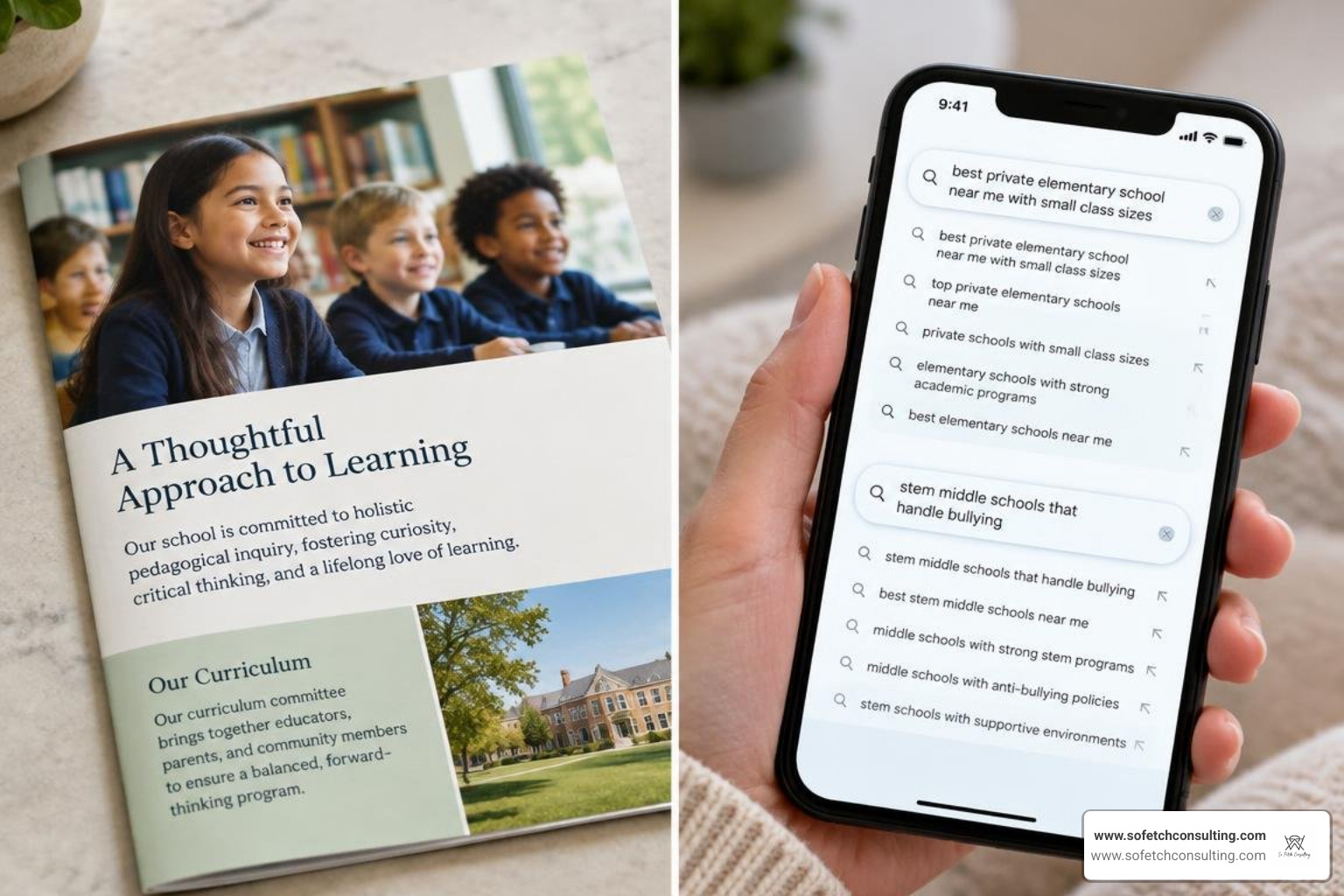
To fix private school search visibility before the next admissions cycle, schools must optimize their Google Business Profile for local map packs, create dedicated academic program pages targeted to natural parent search queries, and resolve technical site speed issues. Focusing on practical SEO for private schools connects your campus with prospective families right when they begin researching educational options.
Let us be completely honest with each other for a second. Most private school websites read like a collection of academic bylaws and board meeting minutes. Your curriculum committee might love words like "holistic pedagogical inquiry," but anxious parents sitting on their couches at 9:00 PM are not typing that into Google. They are typing things like "best private elementary school near me with small class sizes" or "stem middle schools that handle bullying."
This disconnect between institutional jargon and actual parent search behavior is the primary reason great schools remain totally invisible online. When parents go hunting, more than 90 percent of those online experiences begin on a search engine, and over half of all clicks go straight to the top three results. If you are not sitting in those top spots, you simply do not exist to the 25 percent of families who discover their future school via organic search.
Another massive issue we see constantly is thin content. A single page titled "Academics" with three vague bullet points about character building will never outrank an active competitor. Search engines crave depth, context, and clear intent.
On-Page SEO for Private Schools: Metadata, Headings, and URLs
If you want search engines to understand what you offer, you need to clean up your basic on-page elements. That means structuring your page so both search engine bots and tired parents can scan it in three seconds flat.
- Title Tags: Keep them under 60 characters and lead with the most important details. Instead of "Home | Welcome," use something like "Private K-8 Academy | Austin Independent School."
- Meta Descriptions: You have about 150 characters to convince a parent to click. Highlight what makes your community unique, mention your neighborhood, and end with an invitation to book a tour. While meta descriptions do not directly boost rankings, they make or break your click-through rate.
- URL Structure: Keep URLs clean, readable, and short. Something like
/middle-school-curriculumworks infinitely better than/?page_id=402&cat=academics. - Header Hierarchy: Use a single H1 tag for the main topic of the page, followed by logical H2s and H3s for subtopics.
When your headings answer specific questions, you stop parents from immediately hitting the back button. That quick bounce, often called pogo-sticking, signals to Google that your page failed to provide what the searcher needed. If your site runs on a platform like Squarespace, taking time to improve SEO on Squarespace by cleaning up metadata fields and organizing header hierarchy will give your admissions pages an immediate lift.
Developing High-Converting Academic Program Pages
Lumping your early childhood, lower school, middle school, and high school programs into one giant scrolling page is a fast track to ranking nowhere. Every distinct academic level needs its own dedicated landing page.
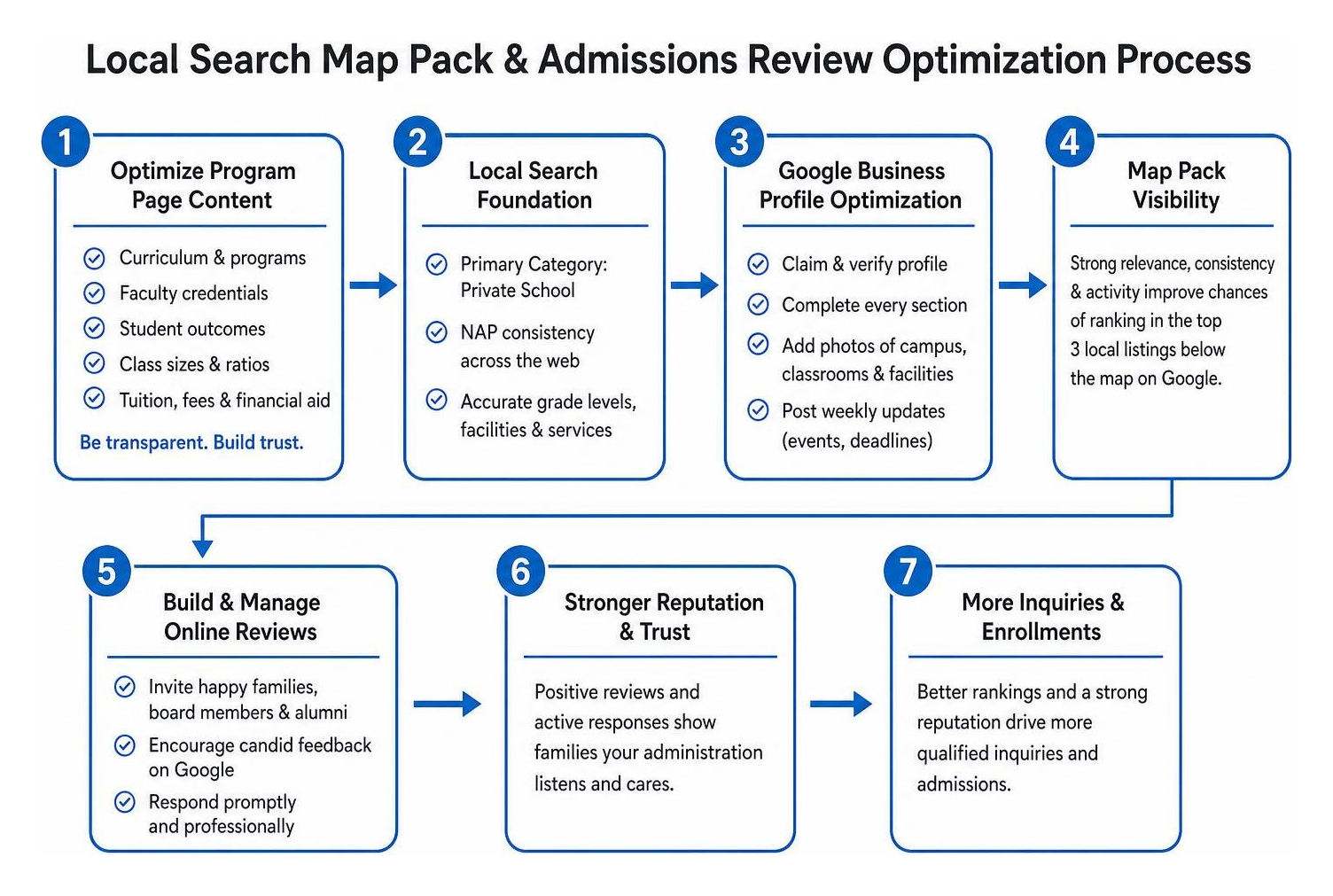
A high-converting program page should give prospective families everything they need to visualize their child thriving in your classrooms:
- Detailed curriculum overviews that highlight your specific teaching philosophy, STEM programs, arts, and languages.
- Faculty credentials, certifications, and teaching experience.
- Real student outcomes, including high school placement, college acceptances, or standardized testing highlights.
- Class sizes and student-to-teacher ratios.
- Clear information on tuition, fees, and financial aid options.
Transparency is critical here. When schools bury tuition details behind three contact forms, parents leave. Being upfront about costs and aid opportunities builds trust instantly and keeps visitors engaged on your site longer.
Local Search Dominance and Map Pack Optimization
Private schools are inherently local institutions. Unless you operate a world-famous boarding school, your prospective families live within a specific driving radius. Winning local search is all about dominating the map pack, the top three local business listings that appear right beneath the map on Google.
To show up there, your Name, Address, and Phone number (NAP) data must match perfectly across the entire web. Inconsistencies like using "Street" on your website and "St." on an education directory can confuse search engines about your actual physical location.
| Google Business Profile Factor | Impact Level | Practical Action for Schools |
|---|---|---|
| Primary Category Selection | Critical | Set as "Private School" or "Private Elementary School" rather than generic "School" |
| NAP Consistency | High | Match address formatting across site, GBP, and local business directories |
| Review Score and Velocity | High | Build a consistent pipeline of genuine parent and alumni reviews |
| High-Res Campus Photos | Medium | Upload exterior signage, active classrooms, and campus facilities regularly |
| Weekly GBP Updates | Medium | Post about open houses, admission deadlines, and campus events |
Google Business Profile and Reputation Management
Your Google Business Profile (GBP) is often the very first thing a parent sees when they search for your school by name or category. Leaving it unclaimed, half-filled, or neglected is like leaving your front admissions gate locked during morning drop-off.
Claim the profile, verify ownership, and flesh out every single section. Add your exact grade levels, athletic facilities, and special services. Upload crisp, bright photos of your campus, science labs, and community spaces.
Online reputation matters immensely in this process. A staggering 89 percent of parents say online reviews heavily influence their school enrollment decisions. You cannot afford to leave your review section to chance or to the one disgruntled parent whose kid did not make the varsity soccer team three years ago.
Create a simple, ethical system to invite happy families, board members, and alumni to leave candid feedback on Google. When reviews come in, respond to them swiftly and professionally. Thank the reviewer, highlight the program they mentioned, and show the world that your administration listens and cares.
Technical SEO for Private Schools: Speed, Mobile, and Site Architecture
Your website can have gorgeous campus photography and world-class copy, but if it takes ages to load, nobody will stick around to read it. Research shows that 53 percent of mobile visits are abandoned if a page takes longer than three seconds to load. If your load time stretches past five seconds, the chance of that parent bouncing skyrockets by 90 percent.
Technical maintenance keeps your site fast, mobile-friendly, and accessible to search bots:
- Image Compression: High-resolution campus photos are great, but uncompressed 15MB camera files will grind your mobile speed to a halt. Compress every image before uploading.
- Mobile-First Experience: The majority of your inquiries will originate on a phone while a parent is waiting in a carpool line. Ensure menu navigation, application links, and tour forms are thumb-friendly.
- 301 Redirects and 404 Errors: When you delete old event pages or update program URLs, set up proper 301 redirects. Broken links lead to frustrating 404 error pages that ruin user experience and waste search engine crawl budget.
- Internal Linking Architecture: Build logical paths between your pages. Your tuition page should link naturally to financial aid, your athletics page should link to specific sports schedules, and your home page should link directly to admissions.
If your administrative team wants to sharpen its overall digital footprint without getting buried in technical jargon, reviewing some nonprofit SEO tips will help clarify how mission-driven organizations can streamline site structure and boost visibility on a budget.
Advanced Search Visibility: E-E-A-T, AI Overviews, and Rich Results
Search engines evaluate educational websites under strict Quality Rater Guidelines established by Google Search Central because school decisions directly affect children's well-being and family finances. This means your site needs to exhibit high levels of Experience, Expertise, Authoritativeness, and Trustworthiness (E-E-A-T).
Beyond traditional rankings, modern search engine result pages feature rich snippets, knowledge panels, FAQs, and AI Overviews that pull quick answers directly from authoritative sites.
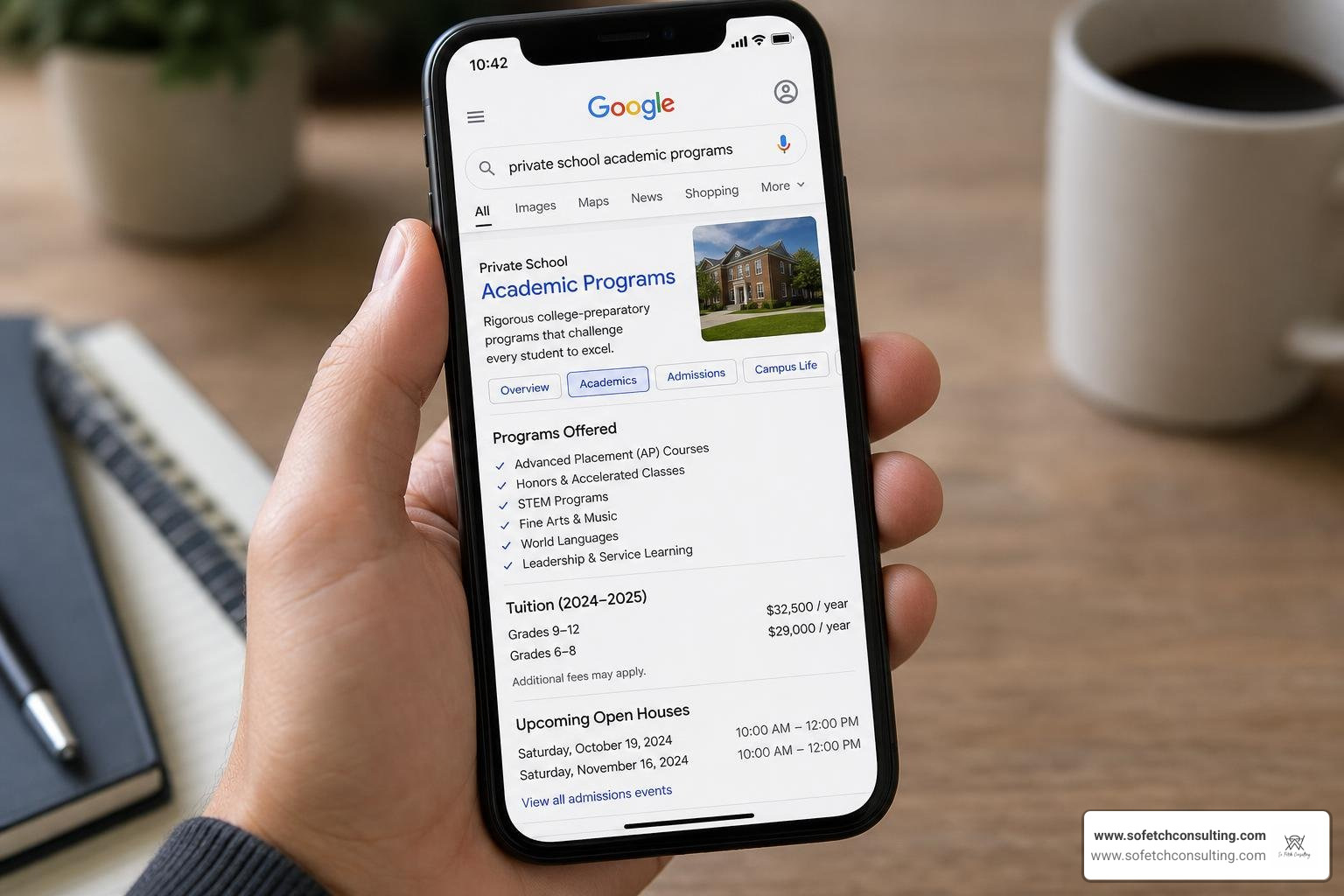
Implementing structured data (schema markup) on your site allows search engines to understand the exact nature of your events, tuition costs, and course listings. When you format open house dates or special curriculum offerings with proper schema, search engines can display those details right in the search results, reducing friction for prospective families.
Demonstrating E-E-A-T and Thought Leadership
To prove to search engines that your school is a legitimate educational authority, you must highlight the real humans behind your curriculum. Here is how you can practically showcase E-E-A-T across your domain:
- Firsthand Experience: Feature student-led campus tours, classroom project logs, and authentic parent stories.
- Faculty Bios: Build out individual profiles for teachers and department heads that include their degrees, certifications, years in education, and subject-matter publications.
- Institutional Authority: Highlight accreditations, educational associations, and state board approvals prominently in your website footer and about pages.
- Trust Signals: Provide explicit safety policies, transparent tuition schedules, and verified contact details with real staff email addresses.
Strategic Link Building and Content Expansion
Search engines treat backlinks as votes of confidence. When reputable, external websites link to your domain, your overall authority climbs, helping every single page on your site rank higher.
Forget shady link schemes. Sustainable link building for schools happens naturally through community connections:
- Local Partnerships: Collaborate with local youth sports leagues, community arts centers, libraries, and science museums that list community partners on their websites.
- Local News and Press: Share notable student achievements, robotics competition wins, or community service initiatives with local journalists to earn high-authority regional backlinks.
- Alumni and Feeder School Connections: Connect with feeder preschools, local universities, and alumni-owned businesses willing to feature your school.
You can also expand your reach by publishing helpful content around shoulder niches. A shoulder niche is a topic closely related to education that parents care about, such as childhood development milestones, managing homework stress, or choosing age-appropriate literature.
When your faculty writes authoritative guides on these topics, parents share them, local blogs link to them, and your school earns massive search credibility. If managing this level of ongoing strategy feels overwhelming for your admissions staff, partnering with an experienced team for SEO services for small business can help you create and execute a sustainable content roadmap.
Measuring Admissions Search Performance and ROI
You cannot manage what you do not measure. Setting up clear tracking ensures you are not just guessing whether your search optimization is working as the next enrollment deadline approaches.
Connect your site to Google Analytics and Google Search Console so you can monitor real metrics:
- Organic Traffic: Track the volume of visitors arriving via search engines to ensure your visibility is trending upward month over month.
- Top Landing Pages: Identify which academic program pages, blog posts, and admissions guides attract the most prospective families.
- Click-Through Rates (CTR): Check Search Console to see which search queries bring up your school and whether your titles and meta descriptions entice users to click.
- Inquiry Conversions: Set up event tracking for open house registrations, virtual tour views, and inquiry form submissions.
- Competitive Benchmarking: Periodically check search results for your primary target keywords to see how your visibility compares to peer schools in your geographic area.
Reviewing these numbers quarterly allows you to spot underperforming pages early and refresh them before your primary admissions cycle kicks into high gear.
Frequently Asked Questions About School Search Strategy
How soon should a private school start SEO before admissions open?
You should begin optimizing your website at least six months before your primary admissions season opens. Search engine bots require time to discover, crawl, and evaluate new content and structural updates. Starting in the spring or early summer ensures your refreshed program pages, local listings, and metadata are indexed and ranking well by the time parents actively search for fall enrollment.
What is the biggest SEO mistake independent schools make?
The single biggest mistake is using internal academic terminology instead of the everyday phrases parents actually search for. Schools frequently label pages with abstract concepts rather than straightforward terms like "private middle school in Austin" or "kindergarten admissions." This creates a disconnect that leaves high-quality programs hidden from prospective families.
How do online reviews impact school search rankings?
Online reviews directly influence both local map pack rankings and parental trust. Search algorithms reward profiles that demonstrate steady review velocity, strong overall ratings, and active administrative responses. Because nearly nine out of ten parents factor reviews into enrollment decisions, consistent positive feedback acts as both a ranking signal and a high-converting trust factor.
Preparing Your Admissions Funnel for Next Year
Fixing your school's search visibility is not a one-and-done summer chore that you check off and forget forever. Search algorithms change, competitors launch new campaigns, and parent search habits continue to evolve. Dominating the search results in your area requires a clear, consistent approach that blends technical health, smart on-page structure, authentic reviews, and high-value educational content.
Take a hard look at your admissions pages today. Are your titles descriptive? Are your grade-level pages rich with real curriculum details, teacher credentials, and transparent tuition information? Is your Google Business Profile active and filled with glowing reviews from happy families?
If your internal team needs a reliable game plan, exploring proven nonprofit SEO tips can provide actionable steps to align your mission with modern search visibility.
At So Fetch Consulting, we help independent schools and mission-driven organizations build digital marketing strategies that attract qualified families and keep classrooms full. Start auditing your digital presence now, make the necessary improvements before the application rush begins, and set your school up for a banner admissions cycle.
