
Make Your Dog Training Business Website Easy to Compare

A dog training business website should help local dog owners answer three questions fast: Can you help my dog? What will it cost? How do I get started? Show your service area, training methods, credentials, services, starting prices, reviews, and a clear way to book. Give private lessons, group classes, and intensive programs their own descriptions so visitors can compare them without guessing.
You can explain complex behavior work without making puppy owners feel like they walked into the wrong place. Clear choices build trust; a maze of vague packages does not.
I'm Karin Wright. I've trained dogs professionally since 2008 and run dog training businesses, so I know a dog training business website has to work for both clients and the person answering the inquiries.
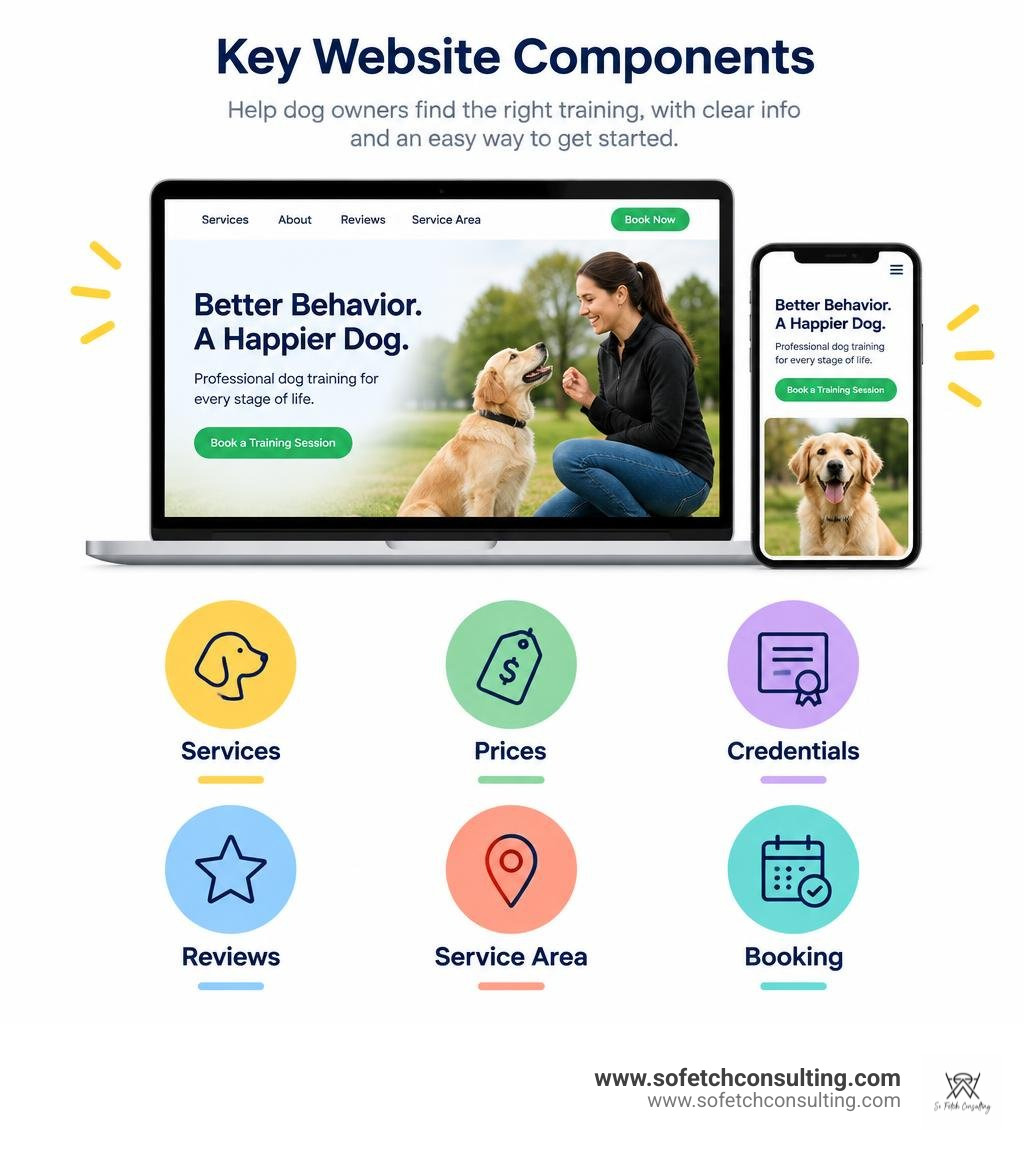
Essential Elements of a High-Converting Dog Training Business Website
Let us be real for a second: most dog owners land on your page in a state of mild panic. Their six-month-old doodle just ate a baseboard, or their rescue dog is barking at every stroller within a three-block radius. If your homepage looks like an abandoned blog from 2012 with tiny unreadable text and a broken contact form, they will bounce straight over to your competitor down the street.
A high-performing site needs rock-solid fundamentals. That means fast loading times on mobile devices, clear navigation, direct contact information, and local search signals that tell search engines exactly which neighborhoods you serve. When you map out actionable marketing for dog trainers, your website is the engine that turns casual local searches into booked training packages.

Building Credibility with Certifications, Badges, and Philosophy
Dog training remains an unregulated industry, which means anyone with a treat pouch and a social media account can call themselves a behavior specialist. Savvy pet parents know this, and they actively look for proof that you know what you are doing.
Displaying your credentials front and center builds immediate authority. The Certification Council for Professional Dog Trainers (CCPDT) has certified thousands of professionals worldwide as a benchmark of knowledge and ethics. Highlighting credentials like CPDT-KA, CPDT-KSA, IAABC behavior consulting titles, or Karen Pryor Academy (KPA) qualifications reassures clients that your methods are rooted in science.
Do not just drop an acronym on the page without context. Briefly explain what your positive reinforcement philosophy means for their dog: humane, effective handling that builds reliable skills without fear or intimidation. Add local veterinary endorsement quotes and professional association badges in your footer and about page to reinforce that trust.
Structuring Service Menus on a Dog Training Business Website
When visitors click on your services page, they should instantly understand which program fits their situation. Grouping your offerings into logical buckets prevents decision paralysis.
A clean service structure usually features three or four distinct tiers:
- Puppy Foundations: Early socialization, house training, bite inhibition, and crate comfort for young pups.
- Basic Manners and Obedience: Leash manners, recall, polite greetings, and impulse control for adolescent and adult dogs.
- Behavior Modification: Targeted protocols for leash reactivity, separation anxiety, resource guarding, and fear.
- Specialty and Advanced Work: Off-leash reliability, therapy dog prep, or day school programs.
For inspiration on organizing multi-trainer offerings and territorial coverage, look at how urban in-home training program structures present clear service areas alongside individualized private lessons and group classes.
Evaluating Service Formats, Curriculum Types, and Pricing Models
One of the most debated topics among pet professionals is whether to post rates online. Keeping your pricing a complete mystery frustrates potential clients and wastes your time on phone consultations with people who cannot afford your services.
Publishing transparent rates or clear starting points filters out bad-fit inquiries and attracts serious buyers. When developing your overarching dog training business plan, setting your pricing tiers accurately helps you forecast revenue while setting realistic client expectations.
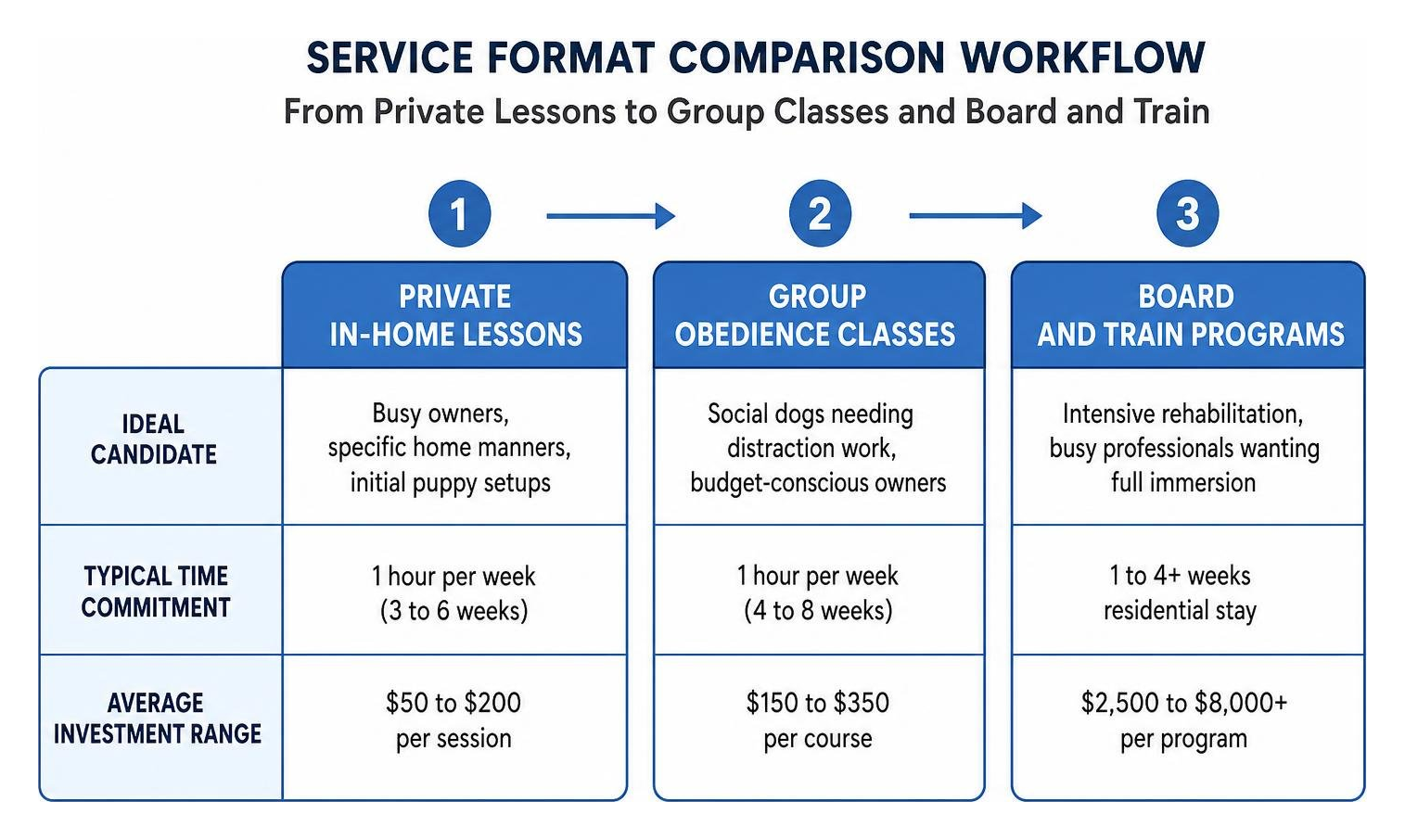
| Training Format | Ideal Candidate | Typical Time Commitment | Average Investment Range |
|---|---|---|---|
| Private In-Home Lessons | Busy owners, specific home manners, initial puppy setups | 1 hour per week (3 to 6 weeks) | $50 to $200 per session |
| Group Obedience Classes | Social dogs needing distraction work, budget-conscious owners | 1 hour per week (4 to 8 weeks) | $150 to $350 per course |
| Day Training / Day School | Owners who lack time to build initial mechanical repetitions | 3 to 5 days per week (drop-off) | $1,200 to $2,500 per package |
| Board and Train Programs | Intensive rehabilitation, busy professionals wanting full immersion | 1 to 4+ weeks residential stay | $2,500 to $8,000+ per program |
Private In-Home vs. Group Classes vs. Board and Train
Every training format solves a different problem for the owner. Private lessons are fantastic for teaching human mechanics and solving context-specific issues right where they happen, like counter-surfing or door-dashing. Group classes offer structured distractions, but they can be overwhelming for dogs that are not yet comfortable around unfamiliar peers.
Board and train programs require significant trust because owners hand over their dogs for extended stays. If you offer residential training, break down what each tier covers. As an example, facilities offering tiered board and train program packages clearly differentiate foundational one-to-two-week routines from intensive multi-week behavior transformations so owners understand why prices range from $2,500 to well over $6,000.
Balancing Severe Behavior Modification with General Obedience
Around 66% of dogs show some signs of reactivity, according to research across more than 4,000 dog owners. That means a huge portion of your local market needs specialized behavioral help.
However, if your homepage exclusively features warning labels, bite histories, and intense rehabilitation imagery, the family with an energetic golden retriever puppy might think you only deal with dangerous cases.
Balance your messaging by creating dedicated subpages for reactivity and aggression while keeping your main homepage warm, friendly, and accessible. Use empathetic language that validates the stress of managing a reactive dog without turning your site into an intimidating medical chart.
Integrating Core Software: Scheduling, Payments, and Client Intake
Running a dog training business involves plenty of admin, from tracking vaccine records to collecting signed liability waivers. Patching together separate apps for scheduling, invoices, email marketing, and forms can cost anywhere from a few hundred to $1,000 a month in software fees.
Streamlining these tools directly into your website saves your sanity and gives your clients a smooth checkout experience.

| Software Type | Popular Tools | Approximate Monthly Cost | Primary Purpose |
|---|---|---|---|
| Scheduling | Acuity, Vcita, SuperSaaS | $10 to $85 / month | Automated calendar booking and appointment reminders |
| Payment Gateways | Square, Stripe | 2.6% to 3.9% + transaction fee | In-person mobile card readers and online checkout processing |
| E-Signatures | DocuSign, built-in form builders | Free (native) to $85 / month | Liability waivers, training terms, and veterinary release forms |
| Email Marketing | Mailchimp, Constant Contact | $45 to $50 / month | Nurture sequences, client updates, and class launch announcements |
| Video & Course Hosting | Kajabi, Thinkific, Teachable | $100+ / month | Housing client homework videos and on-demand courses |
Automating Bookings, Electronic Waivers, and CRM Systems
When a client decides to hire you, remove all friction. Let them pick an open evaluation slot, fill out their dog's behavioral intake questions, sign your terms of service, and submit their deposit in one seamless flow.
Acuity Scheduling or Vcita embedded on a Squarespace page can handle intake questions and payment processing via Stripe or Square automatically. If you need hands-on help structuring your operational tech stack, getting professional dog training business help ensures you do not waste money on bloated software suites you will never use.
Managing In-Person vs. Virtual Training Workflows
Virtual training gained massive traction out of necessity and has proven to be an incredible tool, especially for easily distracted puppies or fearful dogs that become unglued when a stranger enters their home.
Remote sessions allow you to coach human handling mechanics, review owner-submitted video clips, and explain behavioral theory without adding environmental stress to the dog. If you offer remote consultations, look at virtual Zoom canine training protocols to see how trainers successfully structure nationwide private video instruction alongside their local offerings.
Maximizing Conversion Rates Through Social Proof and Strategic Design
You can have the cleanest website layout in town, but without social proof, pet owners will hesitate to hit the buy button. They want to see that you have solved problems for dogs just like theirs.
Combining clear calls-to-action with authentic customer stories bridges the gap between curious browser and paying client. Learning how to grow your dog training business comes down to building a reliable pipeline where happy clients consistently generate your next batch of inquiries.
Highlighting Testimonials, Video Case Studies, and Reviews
Text reviews are good, but detailed case studies and short video clips are unbeatable. A twenty-second clip showing a dog learning loose-leash walking or calmly disengaging from a trigger demonstrates your skill faster than three paragraphs of text.
To build an impressive review catalog across your site:
- Send an automated review link via email three days after a client completes their package.
- Ask clients to mention their dog's breed and specific issue in their feedback so future readers find relatable stories.
- Embed Google business reviews directly on your service pages rather than hiding them on an unvisited testimonials tab.
- Feature short quote callouts next to your primary pricing tables.
Optimizing Lead Capture on Your Dog Training Business Website
Every page on your site should guide visitors toward a single next step. Avoid generic contact forms that simply ask for a name and message. Use structured intake forms that capture essential details upfront:
- Dog's name, breed, and age
- Main training goals or behavioral concerns
- Prior training history and bite history disclosures
- Preferred lesson format (in-home, day training, group class)
Place prominent call-to-action buttons in your navigation header and at the bottom of every service section so visitors never have to hunt for the booking link.
Common Website Pitfalls and Best Practices for Sustainable Growth
Even experienced trainers often make basic website missteps that cost them local visibility and client bookings:
- Hiding Your Location: If search engines and visitors cannot figure out your primary service towns within five seconds, your local search rankings will tank. Always list your service radius clearly in your footer and contact pages.
- Overcomplicating the Menu: A navigation bar with twelve drop-down items overwhelms mobile users. Stick to Home, About, Services, Pricing, FAQs, and Book Now.
- Wall-of-Text Syndrome: Break up long explanations of behavioral science into scannable bullet points, clear subheadings, and engaging visuals.
- Ignoring Page Speed: Large, uncompressed video files uploaded directly to your hosting platform can grind your mobile load speed to a halt. Host videos on YouTube or Vimeo and embed them cleanly instead.
Frequently Asked Questions About Evaluating and Building Canine Training Services
What certifications should I look for on a professional trainer's site?
Look for independent credentials like the CPDT-KA or CPDT-KSA from the Certification Council for Professional Dog Trainers, behavior titles from the IAABC, or graduation badges from reputable academies like the Karen Pryor Academy. These confirm the trainer has verified field hours, passed rigorous examinations, and adheres to continuing education requirements.
How much should I expect to pay for private lessons versus board and train programs?
Private lessons generally run between $50 and $200 per hour depending on your local market, travel distance, and the trainer's specialization. Comprehensive board and train programs typically start around $2,500 for foundational stays and can exceed $6,000 to $8,000 for complex multi-week behavioral rehabilitation.
Can virtual dog training sessions be as effective as in-person lessons?
Yes, especially for foundational mechanics, separation anxiety protocols, and reactive dogs that struggle with unfamiliar visitors. Because the trainer is coaching you over video rather than holding the leash, you build better handling mechanics and confidence right from your very first session.
Scaling Your Canine Services and Website Strategy in 2026
Building a sustainable dog training business means moving away from chaotic manual admin and setting up digital systems that consistently fill your schedule. A solo trainer trading hours for dollars on individual lessons hits an income ceiling fast; expanding into structured packages, day schools, or group offerings unlocks long-term stability.
At So Fetch Consulting, we help pet professionals build high-performing Squarespace websites, dominate local search with modern SEO and GEO visibility, and implement content strategies using The S3 System. Whether you are expanding your team or learning how to start a dog training business from scratch, your website should work as hard as you do to bring the right clients straight to your calendar.
