
The Core Pillars of SEO for Dog Trainers in 2026

To rank your dog training services locally, focus on four things: optimize your Google Business Profile, add technical schema to your site, build dedicated service pages for specific problems, and generate a steady stream of reviews. These are the core pillars of SEO for dog trainers in 2026.
Relying purely on word-of-mouth is great until you hit a slow season and your inbox goes dead. In 2026, roughly 46% of all Google searches carry local intent, and mobile searches with "near me" have jumped over 250% in recent years. If someone's lab mix just dragged them across a muddy park, they aren't waiting for a neighbor's recommendation. They pull out their phone, type their frustration into Google, and call whoever shows up in the top three map results.
Search demand across dog training keywords sits at roughly 49,500 monthly searches with an average keyword difficulty of KD 44. Running Google Ads can bridge the gap, but at an average cost-per-click of $2.70, ad spend adds up quickly if your landing pages fail to convert. When you build sustainable visibility, organic traffic runs on autopilot. You can explore how to grow your dog training business to see how organic traffic feeds into a predictable booking pipeline.

Dominating local search comes down to six core pillars:
- Google Business Profile (GBP) Optimization: Your local anchor that captures high-intent map searches.
- On-Page Technical Architecture: Clean site code, fast load times, and structured data.
- Problem-Specific Service Pages: Targeted landing pages for puppies, reactivity, and board-and-train.
- Location Pages: Clear geographical signals for every suburb or city you cover.
- Review Generation & Velocity: A continuous stream of authentic social proof.
- Off-Page Local Authority: Citations, veterinary partnerships, and neighborhood backlinks.
Google Business Profile Optimization and Local Map Pack Dominance
Your Google Business Profile is the single most valuable local asset you own. If you optimize nothing else, fixing your profile can generate immediate inquiries because it powers the local three-pack on Google Maps.
Start with your primary category. It must be set to "Dog Trainer." If you also offer boarding or daycare, add "Pet Boarding Service" or "Dog Day Care Center" as secondary categories, but never dilute your primary focus.
Your business description gives you 750 characters. Use that space to clearly describe what you do, who you help, and which neighborhoods you serve. Skip the fluff and list exact training programs, methodology highlights, and your service radius.
High-quality visual proof is non-negotiable. Profiles with strong photo galleries get 42% more direction requests and significantly more website clicks than sparse profiles. Upload at least 20 sharp photos showing real dogs working in your local environment, your facility, and your training sessions.
Keep your profile active by using these built-in features:
- Weekly Google Posts: Share training wins, graduate photos, and seasonal tips with direct call-to-action buttons.
- Service Menu Listings: Break out every program with accurate pricing and city-specific descriptions.
- Q&A Seeding: Ask and answer common owner questions directly on your listing, such as vaccination requirements, tool usage, and aggressive dog intake policies.
Mastering Schema and Technical SEO for Dog Trainers
Google needs explicit context to understand who you are, what credentials you hold, and where you work. Schema markup provides that context through structured code placed on your website.
When you configure schema, use a combination of LocalBusiness, Person, and Service types. You can establish your trainer profile using Person schema with specific credential properties, and link your offerings using hasOfferCatalog. For in-home trainers, properly setting the areaServed property ensures Google knows you travel to client homes rather than hosting them at a commercial address.
| Schema Type | Key Properties | Purpose for Dog Trainers |
|---|---|---|
| LocalBusiness | name, address, telephone, priceRange, areaServed |
Tells search engines your exact local footprint, operating hours, and service radius. |
| Person | name, jobTitle, hasCredential, knowsAbout |
Highlights trainer certifications like CPDT-KA or KPA CTP to build industry authority. |
| Service | serviceType, provider, hasOfferCatalog, offers |
Connects specific training programs directly to problem-based search terms. |
| FAQPage | mainEntity, question, acceptedAnswer |
Displays rich snippet drop-downs in search results for high-intent behavioral questions. |
On the technical side, mobile optimization is vital. Mobile devices generate over 60% of all Google searches, and 53% of mobile visitors leave a site that takes longer than 3 seconds to load. Compress your images, host videos externally, and maintain clean site speed across all pages.
Designing High-Converting Service and Location Architecture
A messy website confuses both search engines and stressed dog owners. If you toss puppy basics, aggression modification, and two-week board-and-train programs onto a single page called "Our Programs," you miss out on high-intent search traffic. You can see how strategic structure fits into building a solid dog training business plan that supports steady client acquisition.
Structure your site with a clear hierarchy that routes specific behavioral problems to dedicated URLs:
yoursite.com/services/puppy-training/yoursite.com/services/reactive-dog-training/yoursite.com/services/board-and-train/yoursite.com/locations/downtown/
This structure allows you to build targeted internal links. When you publish a blog post about leash reactivity, you can point that traffic straight to your reactive dog training program page rather than a generic contact form.
Structuring Pages for Puppy Classes, Reactivity, and Board-and-Train
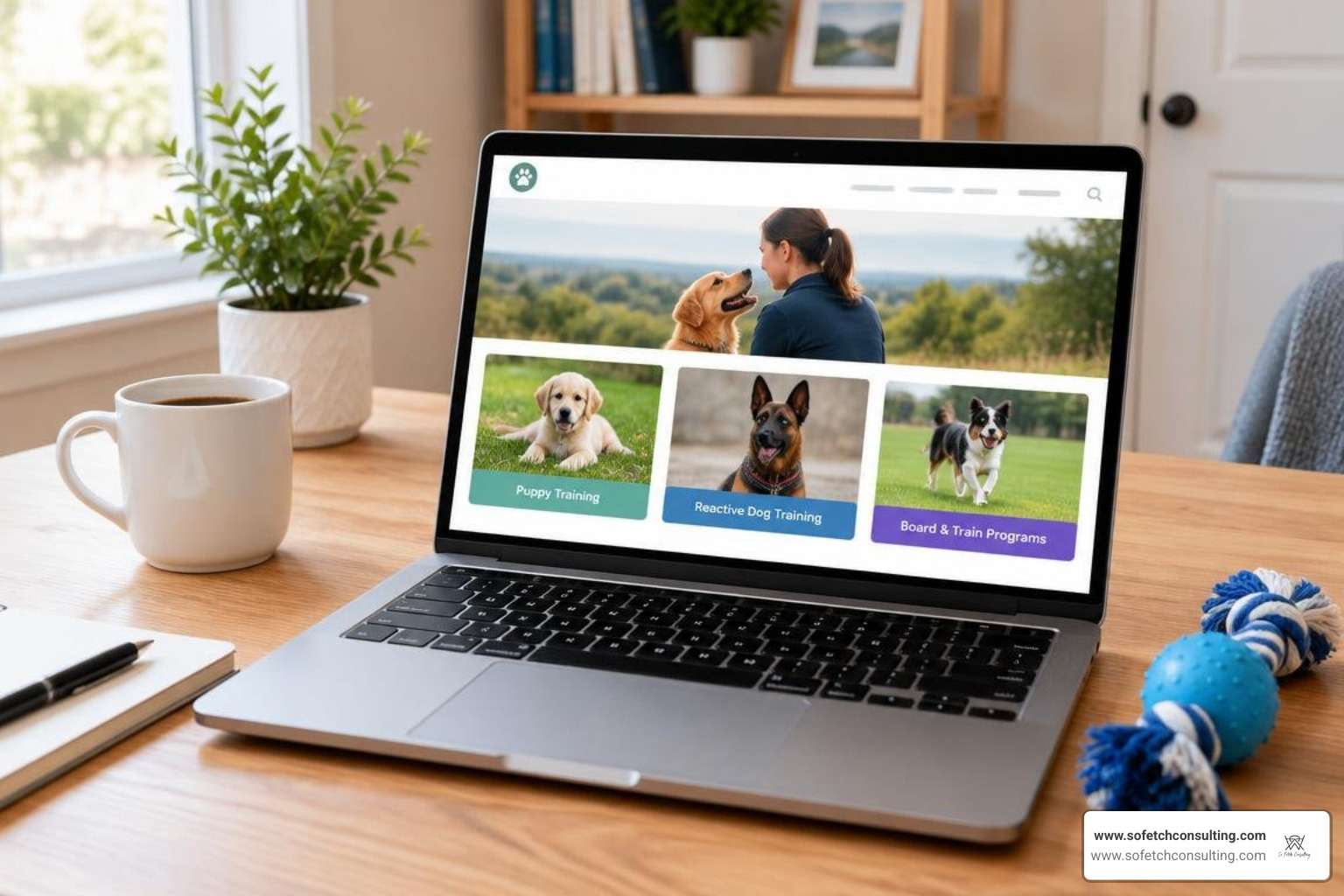
Each service page should address the specific emotional state and intent of the owner searching for it. An owner looking for puppy socialization has completely different priorities than an owner dealing with severe resource guarding.
| Program Type | Primary Search Intent | Essential Page Elements | Key Trust Signals |
|---|---|---|---|
| Puppy Classes | Prevention, socialization, basic manners | Age brackets, start dates, vaccination policies, class sizes | AKC S.T.A.R. Puppy alignment, clean training facility photos |
| Reactive Dog Training | Safety, stress relief, bite prevention | Assessment steps, management protocols, bite history intake FAQ | IAABC or behavior credentials, video proof of calm handling |
| Board-and-Train | Convenience, rapid progress, busy schedules | Daily routines, kennel setup, owner transfer sessions | Video updates policy, trainer-to-dog ratios, facility security |
On your board-and-train pages, walk owners through a typical day. Explain where the dogs sleep, how many training sessions happen daily, and how you transfer those skills back to the owner.
For reactivity and aggression pages, include clear FAQs addressing bite histories, muzzle conditioning, and veterinary behaviorist referrals. Back up your claims with short transformation clips rather than relying on marketing jargon.
Multi-City Location Pages and Local NAP Citations
If you offer in-home training across multiple suburbs, create unique location pages for each key market. Avoid churning out duplicate, low-quality doorway pages. Each location page needs at least 600 words of original content highlighting neighborhood parks you visit, local leash laws, embedded Google Maps, and reviews from clients in that specific zip code.
Your Name, Address, and Phone Number (NAP) must remain identical across the web. Clean up your business listings across primary directories:
- Yelp
- Association of Professional Dog Trainers (APDT) directory
- International Association of Animal Behavior Consultants (IAABC)
- Thumbtack
- Local Chamber of Commerce listings
Inconsistent phone numbers or outdated suite addresses confuse Google's local index and dilute your ranking power. Review our naming considerations for local visibility to make sure your branding supports strong geographical signals.
Methodology Keywords, Professional Certifications, and AI Search Optimization
Dog owners increasingly search for specific training philosophies. Terms like "force-free dog trainer," "positive reinforcement puppy class," and "balanced dog training" carry high search intent. Be clear and upfront about your approach. State your methodology in your header, about page, and service descriptions.
Display your professional certifications prominently. Credentials like CPDT-KA, CPDT-KSA, KPA CTP, and IAABC-ADT signal expertise to owners and search engines alike. Link your badge images to the verifying directory, and mention these credentials within your site's structured schema markup. For personalized guidance on aligning your messaging with local search demand, check out our dedicated dog training business help.
Optimizing for AI Overviews and Modern SEO for Dog Trainers
AI search tools like Google AI Overviews and ChatGPT extract direct answers from structured, authoritative web pages. When an owner asks, "Why does my rescue dog growl at the food bowl?", AI systems look for concise, expert explanations to summarize.
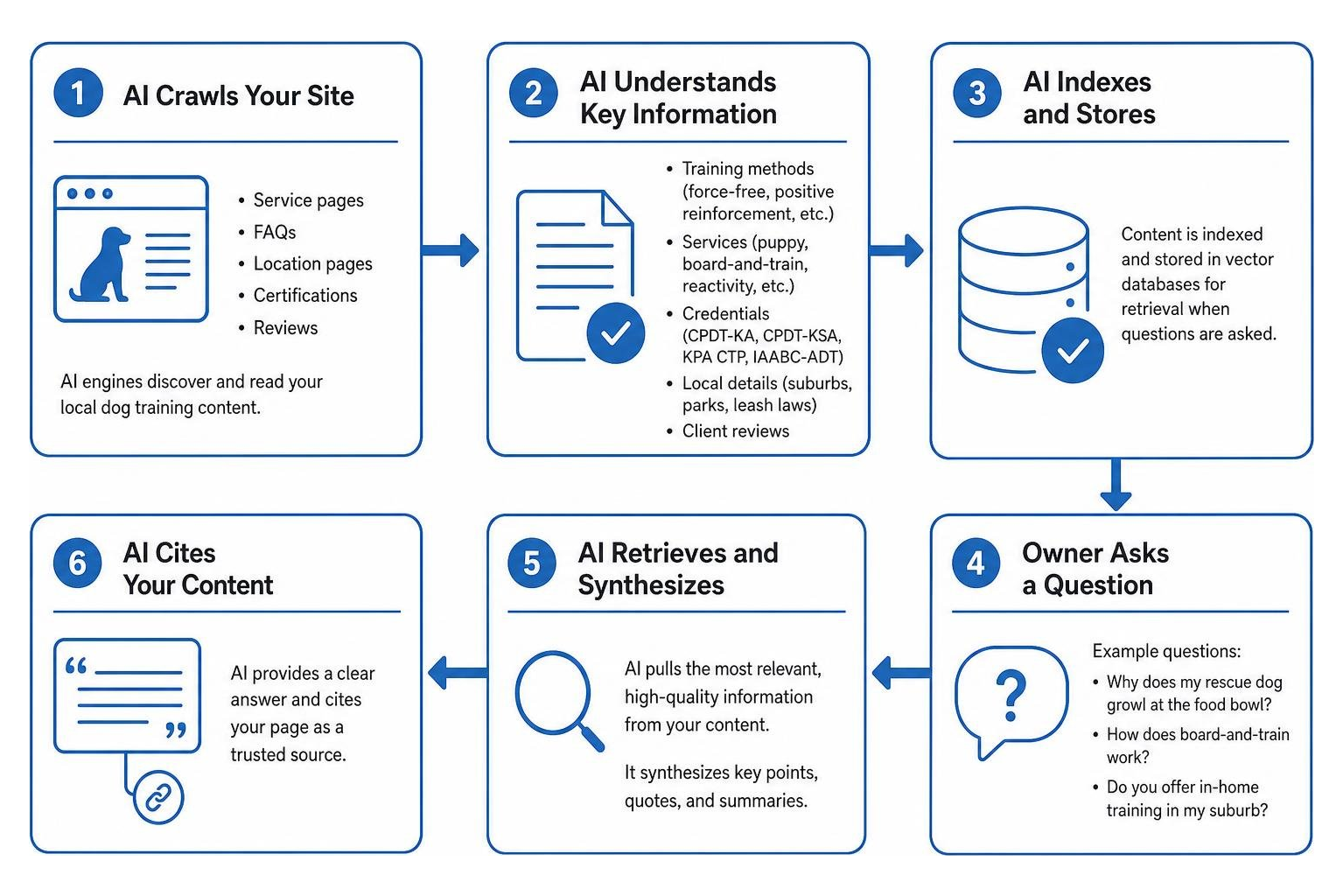
To capture visibility in AI search summaries:
- Answer Questions Directly: Place concise, two-to-three sentence definitions directly beneath your H2 and H3 subheadings before diving into deeper explanations.
- Use Clear Lists: Break complex training protocols into step-by-step formats that AI engines can extract easily.
- Target Specific Problems: Create content around exact behavioral issues like separation anxiety, counter surfing, and crate distress.
When your site explains behavioral science simply and accurately, AI platforms are far more likely to cite your business as a trusted local source. You can read more about balancing industry expertise with search strategy from our insights from a professional dog trainer turned marketer.
Review Velocity and Local Referral Partnerships

Collecting reviews is not a one-and-done task. Review velocity, or the steady pace at which you receive new reviews, is a major local ranking signal. A trainer with 40 reviews collected steadily over two years often outranks a competitor who gathered 50 reviews three years ago and went silent.
Set up a simple system to gather reviews consistently:
- Send an automated text message with your direct Google review link within 24 hours of a client finishing a program.
- Send an email follow-up two weeks later checking in on their progress.
- Encourage clients to mention the specific problem you solved, such as "leash pulling" or "crate training," as well as their general neighborhood.
Build local backlinks to strengthen your off-page SEO. Connect with local veterinarians, independent pet supply shops, groomers, and rescues. Offer to write guest articles for their newsletters, host free puppy workshops, or set up reciprocal referral programs. A backlink from a trusted local veterinary clinic passes strong geographic and industry relevance to your website.
Frequently Asked Questions About Dog Training SEO
How long does SEO take for a dog training business?
You can expect initial ranking movements within 3 to 6 months of optimizing your site and Google Business Profile. Achieving top map pack placements in competitive markets usually takes 6 to 12 months of consistent review generation, technical cleanup, and content publication.
How many Google reviews do dog trainers need to rank in the map pack?
In small to mid-sized markets, 20 high-quality reviews provide a competitive baseline. Reaching 50 reviews establishes strong local authority, while 100 or more reviews makes your position difficult to displace. Consistency matters just as much as your total count, so aim for at least one or two new reviews each month.
What are the most common SEO mistakes dog trainers make?
The most common mistakes include grouping all programs onto a single generic service page, hiding their training methodology, letting NAP details become inconsistent across directories, and uploading large image files that slow down mobile page speeds.
Transform Your Local Search Visibility and Fill Your Training Calendar
Ranking your dog training business at the top of local search is not about tricks or quick hacks. It comes down to building a clean, mobile-friendly website, structuring your programs around the real problems owners face, and actively maintaining your Google Business Profile.
When your website pairs clear training expertise with strong local optimization, you stop chasing cold leads and start welcoming owners who are ready to work with you. If you want a tailored strategy built specifically for pet professionals, explore our specialized marketing for dog trainers to get started.
