
The Financial and Strategic Impact of Email Marketing for Private Schools

Let's talk numbers, because tuition revenue is the lifeblood of your campus. Email marketing generates an average of $36 to $42 for every single dollar invested. That is an eye-popping 3,600% ROI. While social media algorithms change on a whim, your email list is an owned asset that connects you directly to moms and dads who asked to hear from you.
The average private school converts roughly 25% to 30% of raw inquiries into enrolled students. But when schools deploy automated, strategic nurture sequences, that inquiry-to-enrollment rate jumps to 45% or even 55%.
A modest 15% improvement in conversion can bring in 60 to 100 additional enrolled students. For a mid-sized school, that translates to $1.5 million to $3 million in recurring annual tuition revenue.
| Strategy Element | Standard Email Blasts | Automated Drip Sequences |
|---|---|---|
| Send Trigger | Manual, ad-hoc whenever staff has time | Automated instantly based on parent actions |
| Personalization | Generic school-wide updates | Dynamic tags (grade level, program interest) |
| Conversion Rate | 25% - 30% inquiry-to-enrollment | 45% - 55% inquiry-to-enrollment |
| Staff Workload | High manual effort, repetitive tasks | Built once, runs automatically in background |
| Parent Experience | Overwhelming newsletter dump | Timely, relevant answers to current worries |
Why Email Marketing for Private Schools Outperforms Social and Paid Ads
Paid search ads and social media campaigns are great for getting eyes on your school, but they do not close the deal. In fact, 41% of marketers state that email is their most effective channel, far outstripping social media and paid search, which sit around 16% each.
Today's parents do a massive amount of self-directed research in what marketers call the dark funnel. They browse your site silently, chat in neighborhood Facebook groups, and read local reviews long before filling out an inquiry form.
When a parent finally hands over their email address, they are inviting you into their personal space. Relying on paid ads to nurture that lead is like buying a billboard across the street from someone you already invited inside for coffee. Email gives you the runway to build trust, answer quiet concerns, and guide families through a high-stakes, highly emotional decision.
Key Benchmarks: Open Rates, CTR, and CTOR in Education
To know if your campaigns are pulling their weight, you need to understand education industry benchmarks:
- Average Open Rate: 45.32% (K-12 education consistently beats broader commercial sectors).
- Click-Through Rate (CTR): Around 3.00%.
- Click-to-Open Rate (CTOR): 5.96% to 6.76% (high-performing nurture sequences should aim for 8%+).
- Unsubscribe Rate: 0.06% to 0.18%.
Apple's Mail Privacy Protection (MPP) pre-fetches images and can artificially inflate open rates. Use clicks, tour bookings, and application starts as your true north star metrics.
The Psychology of Admissions: Segmenting by Parent Anxiety and Persona
Private school enrollment is not an impulse purchase. It is a deeply personal, high-involvement choice driven by an emotional triad of parental concerns. If you send the exact same email to every prospective family, you miss what actually keeps parents awake at night.
Dynamic segmentation using first-party data allows you to group families by their real motivations:
- Safety and Belonging: "Will my child be physically protected, emotionally supported, and free from bullying?"
- Academic Rigor and Future Proofing: "Will this program challenge my student, prepare them for college, and foster critical thinking?"
- Social Identity and Community: "Does this school match our family values, and will my child make friends who elevate them?"
Marketers report a 760% increase in revenue when switching from bulk emails to segmented campaigns. When your emails speak to the specific worry a parent is chewing on, your messages get read.
Addressing the Core Parent Anxieties: Safety, Academics, and Status
Parents viewing kindergarten admissions have vastly different stress points than parents exploring a college-prep high school. Tailor your storytelling to match those stages.
For academic-focused parents, showcase alumni outcomes, STEM lab tours, and student-teacher ratios. For safety-conscious families, highlight small class sizes, advisory programs, and emotional wellness resources.
Tuition anxiety is universal. With 24% of private day school students and 43% of boarding school students receiving tuition assistance, you must normalize the financial conversation early. The average grant for a day school student receiving aid is $11,500, while boarding schools average $24,787. Frame financial assistance as an investment in student potential, and provide clear guides on how your process works to avoid losing great families to sticker shock.
Structuring Contact Segments Across the Funnel
Keep your audience organized in one central CRM with clear segmentation tags:
- New Inquiries (0–14 days): Families who just asked for information and need immediate answers.
- Active Explorers: Families who downloaded a curriculum guide or clicked specific links but have not scheduled a visit.
- Tour Completed: Parents who visited campus and need a gentle push toward the formal application.
- Admitted Students: Families holding an offer letter who need reassurance before signing contracts (the yield phase).
- Current Families: Parents needing community updates, re-enrollment reminders, and reassurance of ongoing value.
- Alumni and Donors: Long-term community members engaged for mentorship, events, and advancement.
How to Build a High-Converting Inquiry Drip Sequence Step-by-Step
An inquiry nurture sequence bridges the gap between casual curiosity and a submitted application.
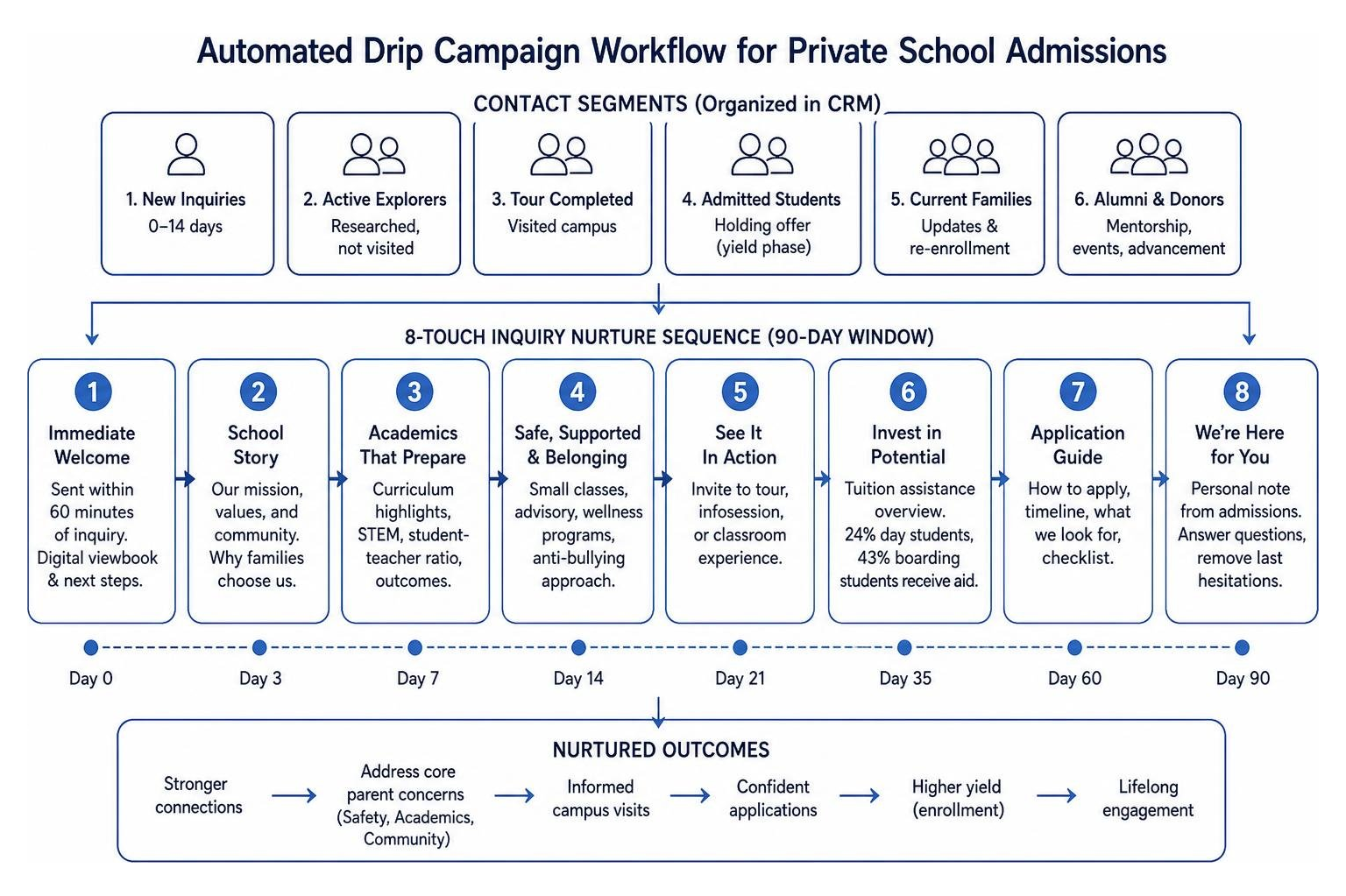
A comprehensive breakdown of this multi-phase strategy can be explored in The Practical Guide to School Email Marketing in 2025, providing additional context on journey mapping. To get the highest conversion rate, implement an 8-touch sequence delivered over a 90-day window.
Phase 1: Rapid Response and Brand Storytelling (Days 0–14)
- Email 1 (Sent within 60 minutes of inquiry): Immediate confirmation and digital viewbook download. Keep it warm, casual, and signed by a real admissions director, not "The Admissions Office."
- Email 2 (Day 3): Campus culture spotlight. Share a 60-second video of student life or a letter from a current parent sharing what surprised them most during their first year.
- Email 3 (Day 7): Virtual tour invitation or open house sign-up. Show, don't just tell, what makes your classrooms buzzing environments.
- Email 4 (Day 14): Student ambassador introduction. Feature a brief profile of a student who shares similar interests to the grade level the parent inquired about.
Phase 2: Overcoming Objections and Academic Deep Dives (Days 15–45)
- Email 5 (Day 21): Academic outcomes and faculty spotlights. Highlight your teaching philosophy, college matriculation list, or innovative experiential learning projects.
- Email 6 (Day 30): Financial aid demystified. Provide a straightforward breakdown of scholarships, flexible payment plans, and typical aid packages to eliminate financial intimidation.
- Email 7 (Day 45): Informal touchpoint. Invite the parent to a virtual coffee chat or a Q&A session with the head of school to address lingering questions.
Phase 3: Application Deadlines and Admitted Yield (Days 46–90)
- Email 8 (Day 60–90): Step-by-step application and interview prep guide. Outline key deadlines, required documents, and what to expect during the student assessment.
For admitted families, shift immediately to a yield sequence. Among NAIS member schools, the application-to-newly-enrolled rate averages 71.4%. Protect that yield with celebratory welcome notes from future teachers, buddy family pairings, and uniform sizing event invites.
Optimization, Technical Compliance, and Budget-Friendly Execution
About 44% of emails sent through admissions software are opened on mobile devices. If your email layout requires zooming or horizontal scrolling, parents will delete it. Keep designs single-column with large, finger-friendly buttons and readable 16px body fonts.
Small teams often struggle with the balance of time versus marketing dollars. When budgets are lean, high-effort, low-cost marketing systems make all the difference.
| Marketing Approach | Financial Cost | Time / Effort Required | Primary Benefit |
|---|---|---|---|
| Automated Drip Series | Low (standard CRM) | Medium upfront setup | Predictable, evergreen conversion |
| Paid Social / Search Ads | High ($$ per click) | Low to Medium | Raw top-of-funnel inquiry volume |
| Targeted Email Reminders | Very Low | Low | High conversion on existing leads |
| Organic Content & SEO | Low | High continuous effort | Sustainable, high-intent traffic |
Key Deliverability and Compliance Rules in Email Marketing for Private Schools
Getting into the primary inbox requires strict technical hygiene:
- Authentication: Set up SPF, DKIM, and DMARC records on your domain. Major inbox providers like Google and Yahoo will reject or junk unauthenticated bulk messages.
- Spam Complaint Thresholds: Keep your spam complaint rate below 0.1%, and never let it hit 0.3%.
- List Hygiene: Regularly prune disengaged contacts who have not opened an email in six months.
- Legal Compliance: Honor CAN-SPAM rules with a physical address and clear one-click unsubscribe links. Comply with FERPA by never exposing protected student records via unsecured marketing campaigns, and ensure COPPA compliance by requiring parental consent when capturing inquiries for students under 13.
Writing High-Converting Subject Lines and Scannable Copy
Keep subject lines under 50 characters so they display cleanly on mobile screens. Use the preview text as a secondary hook to reinforce your message.
Avoid spam triggers like all-caps words, excessive exclamation marks, or vague clickbait. Focus on single calls-to-action (CTAs) per message, such as "Schedule Your Campus Visit" or "Download the Aid Guide." Test variations of subject lines monthly, keeping the winners and refining the rest.
Frequently Asked Questions About School Email Campaigns
How often should a private school send nurture emails to prospective families?
During the initial 30 days following an inquiry, sending one email per week is ideal. As families move into the active consideration phase, reduce frequency to bi-weekly or monthly updates, supplemented by behavior-triggered messages (like event reminders). Avoid sending more than four to five non-transactional marketing emails in a single month to prevent inbox fatigue.
Data indicates that emails sent on Tuesdays between 10 a.m. and 2 p.m. see peak engagement, with open rates dropping after 3 p.m.
How can small private schools with limited budgets implement email automation?
You do not need an enterprise software suite to run effective email marketing. Start by batching your email copy for the entire admissions year over one or two planning sessions.
Use lightweight email tools or your existing student information system (SIS) to set up simple autoresponders triggered by inquiry web forms. Focus on clear, text-first messages signed by real people. Personal, conversational emails often outperform glossy, graphic-heavy corporate templates anyway.
What is the ideal timeframe to follow up after a campus tour or inquiry?
Send your initial inquiry acknowledgment within 60 minutes while your school is fresh in the parent's mind. For families who complete an in-person campus tour, send a personalized follow-up email within 24 hours. Research shows that following up within 24 hours can boost tour-to-application conversions by up to 42%.
Include a direct link to the application portal, reference specific programs the family asked about during the visit, and provide the tour guide's direct contact info.
Building an Enrollment Engine That Fills Every Seat
Filling classrooms year after year comes down to treating enrollment like the long-term relationship it is. You do not need slick sales pitches or aggressive marketing gimmicks. You just need a helpful, reliable communication system that meets parents at their point of need, answers their quietest concerns, and makes taking the next step easy.
By setting up structured drip campaigns, segmenting your lists, and keeping your copy warm and conversational, your admissions team can spend less time chasing cold inquiries and more time welcoming new families to campus.
If you are ready to stop winging your enrollment pipeline and want a clear, sustainable system to attract and convert your ideal families, we can help you build tailored marketing strategy and content systems that do the heavy lifting for you.
